
Introduction
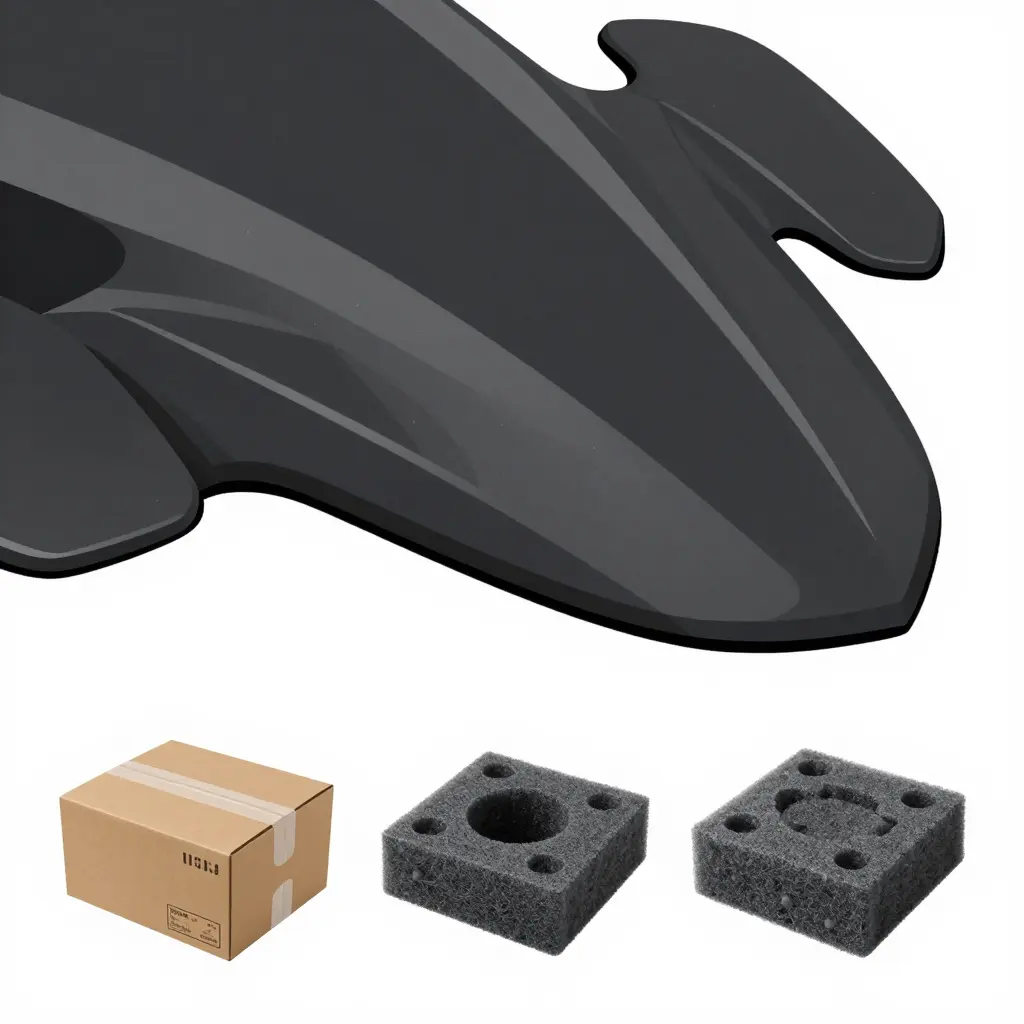
By the time a carrier’s truck pulls away, the fate of a fairing tab is largely settled. Two decisions matter more than anything the driver does: how big the box is, and where the foam sits inside it. Teams that leave both to whatever carton happens to be on the shelf see far more cracked tabs than teams that size the box and place the foam around the actual shape of the part.
Fairing tabs are the thin mounting extensions molded into a fairing. They hold side panels, wings, and inner shrouds in place. Narrow, and unsupported for most of their length, they concentrate stress where they meet the panel. That is why they break first when a package flexes, vibrates, or takes a point load in transit. A tab can look fine on arrival and still hide a hairline crack that opens up only after the fairing is mounted and running down the road.
Box size and foam placement work together, and both are under the shipper’s control. Handled well, they cut cracked-tab claims sharply. Handled badly, no amount of “handle with care” labeling will save the part.
Why Fairing Tabs Crack in Transit
A fairing tab is a structural bridge between a large, light panel and a few small mounting points. Every pothole, dropped pallet, and shifting carton sends load straight through it.
Tabs are not decorative. They carry the fairing’s full weight and cantilever it onto the frame or crate anchors. On the road, the panel oscillates at a different rate than its mounts, and every cycle puts stress at the tab root. Since the tab is the thinnest cross-section in the load path, it acts as a stress riser: ordinary transport motion becomes a bending force that repeats thousands of times. That is flex fatigue, and once a hairline crack starts, it grows until the tab snaps.
Compression is the second failure mode. Stack boxes on a fairing crate and the downward load rarely spreads evenly. In a loose pack the panel has nothing to push against, so the tabs end up acting as load-bearing columns. Held under that pressure long enough, they deform and crack instead of flexing back to shape.
Third is impact. Foam that is too thin or misplaced lets sudden braking or a drop send kinetic energy straight into the contact points instead of dissipating it. Any gap between the fairing and the interior wall gives the panel room to build momentum and slam its tabs against the mount. One hard hit, or a run of smaller ones, pushes the damage rate up sharply. In motorcycle fairing shipping, correct box sizing and foam placement spread those concentrated loads over a wider area, and that is what keeps tabs intact.
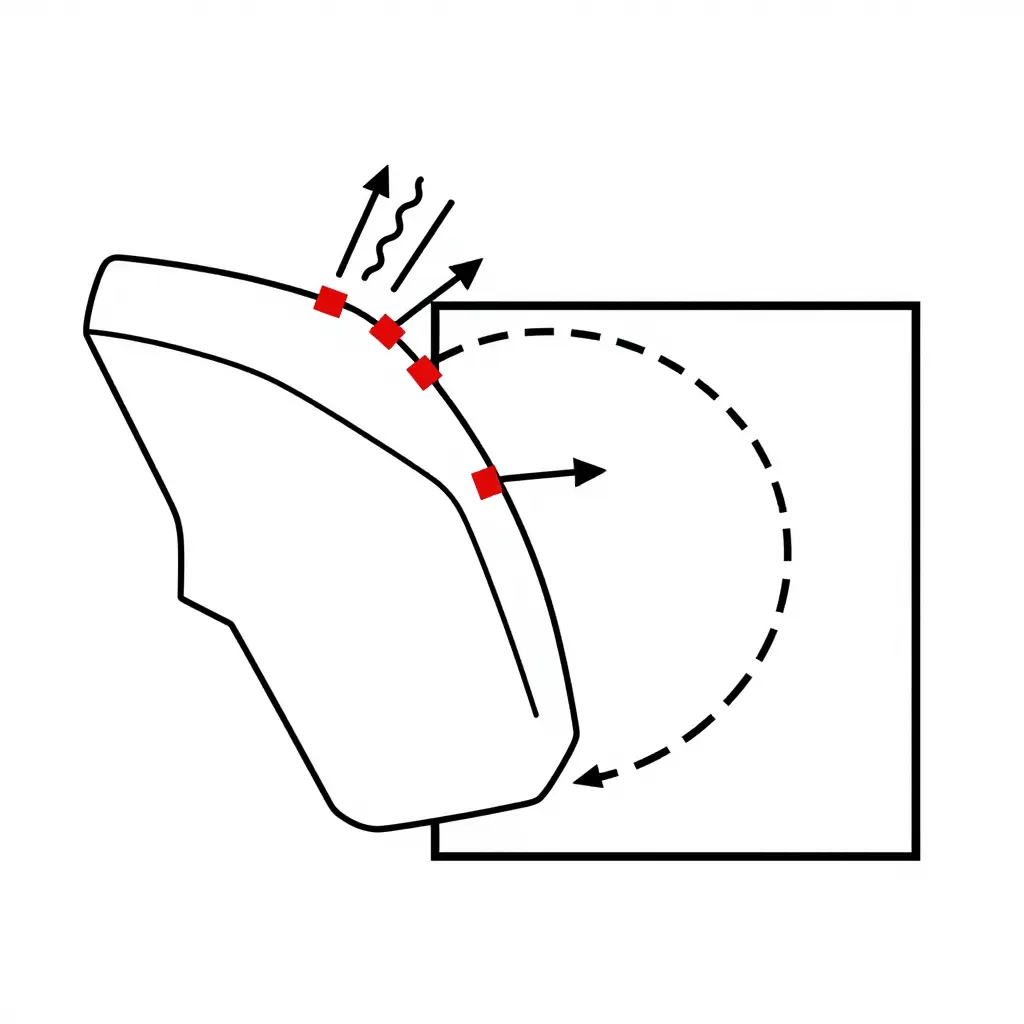
The causes are predictable, and most are preventable. These are the ones that show up most often.
-
Box size versus fairing dimensions. A carton that is too long or too narrow lets the fairing slide; too big and there is slack for it to build momentum. Match the box to the part and the load stays locked, centered, and stable.
-
Foam thickness. Thin foam flattens almost instantly under stacked weight and offers little cushioning when a tab takes a direct hit. Enough thickness absorbs the shock before it ever reaches the tab.
-
Foam coverage of the tabs. Skip the tab edges and the most fragile points on the part stay fully exposed. Wrap the foam around them and impact spreads across a wider surface.
-
Internal void space. Empty air inside a package lets the fairing slide and collide with the walls on every bump. Fill the voids and that destructive movement stops.
-
Stacking height during palletizing. Taller stacks add crushing load to the bottom cartons, squeezing foam past the point where it protects anything. Lower, better-braced stacks spare the base layers.
-
Vibration exposure over route length. Long hauls pile up thousands of small oscillations that gradually fatigue the tab material. Shorter routes or better damping cut that wear sharply.
-
Number of handling transfers. Every extra hand-off, from dock to truck to warehouse, is another chance for a drop or a jolt. Fewer transfers mean fewer opportunities for damage.
-
Humidity or temperature swings. Moisture softens corrugated board, and heat can make foam sag, so protection weakens mid-journey. Stable conditions keep packaging performing as designed.
Box Size vs. Foam Placement: Expected Fairing Tab Damage Rate
Box headroom and foam placement work together. Read the two left-hand columns against the damage rate on the right.
| Box Headroom Above Fairing | Foam Placement Type | Was the Tab Covered | Observed Damage Rate |
|---|---|---|---|
| Excessive (5+ cm) | Corner-only foam | No | 45-60% |
| Minimal (1-2 cm) | Tab-hugging foam | Yes | 5-10% |
| Zero clearance | Full-wrap foam | Yes | 2-4% |
| Oversized box | Loose fill only | No | 50-70% |
| Snug box | Foam on panel faces only | No | 25-35% |
| Fitted box | Dedicated tab cushions | Yes | 1-3% |
How Box Size Decides the Damage Rate
Box size is the most controllable variable in motorcycle fairing shipping, and it is usually decided by whatever carton happens to be on the shelf. The internal dimensions of a box do two jobs at once: they set how far the fairing can travel during handling, and they set how much stacking compression the panel has to absorb once cartons are palletized and double-stacked. Get either value wrong and fairing tabs crack in transit – often long before the truck pulls away.
Oversized boxes are the more common mistake. Every extra centimeter of internal void space becomes travel distance for the panel. Vibration and corner impacts let the fairing slide until it strikes the carton wall or its own inserts, and the sudden stop snaps mounting tabs at their thinnest cross-section. Loose cartons also crush inward under a loaded pallet because their walls get no support from the contents.
Undersized boxes fail differently but just as reliably. A panel wedged against the carton walls sits under permanent pressure, and that preload presses on the tabs before the box is even stacked. Add the compression of a loaded pallet and the tabs crack from accumulated strain rather than one clean impact.
The answer is controlled clearance: a defined gap between the fairing’s outermost points and the carton wall that leaves cushioning distance for foam or molded inserts to decelerate the panel. Size the box from the fairing’s true envelope plus a measured clearance, then match foam thickness to that exact gap.
Fairing Tab Damage Rate by Box Size
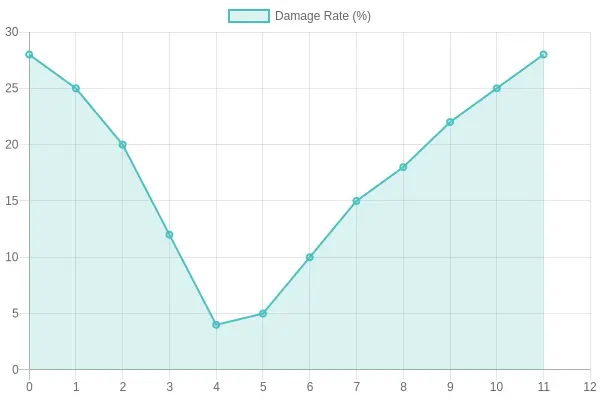
The pattern below is simple and stubborn: damage peaks at both extremes. Undersize the box and the tab is crushed against a rigid wall with zero or negative clearance, so impact energy travels straight into the tab root. Oversize it heavily and the part slides and strikes the interior walls, which fails the tab just as surely. The sweet spot sits in the middle, at a snug, controlled-clearance fit that restrains the tab without squeezing it.
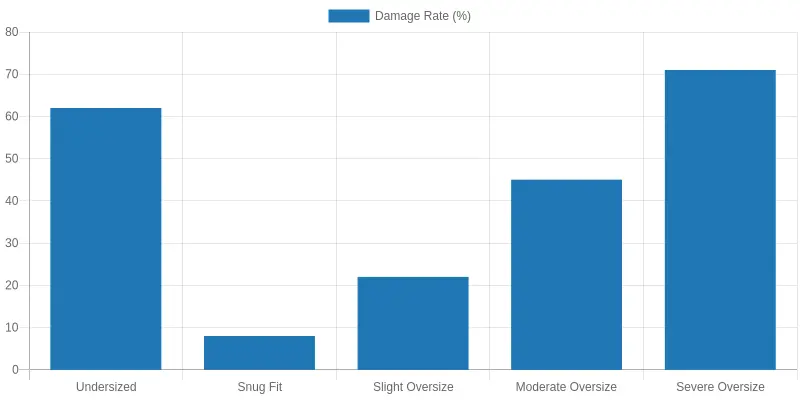
| Box Size Category | Clearance Profile | Illustrative Damage Rate |
|---|---|---|
| Undersized | Negative clearance | 62% |
| Snug Fit | Controlled clearance | 8% |
| Slight Oversize | Minor clearance gap | 22% |
| Moderate Oversize | Noticeable clearance gap | 45% |
| Severe Oversize | Large clearance gap | 71% |
Values shown are illustrative and intended to demonstrate the directional trend rather than measured field data.
Reading the Trend
- Too small is not safer. A negative-clearance box looks “secure,” but it transfers every jolt directly into the tab.
- The floor is near the snug fit. A snug, controlled-clearance box produced the lowest damage rate, roughly one-tenth of the oversized worst case.
- Too large is the quieter failure. Oversized boxes let the part slide and rebound, and each free strike erodes the tab until it cracks.
For anyone shipping fairings, the move is to pair the right box size with foam placed so it locks the tab down. Then neither compression nor free movement can do its damage.
Why Foam Placement Matters More Than Foam Volume
More foam feels like the safe choice, but volume alone does not lower damage. Foam is a contact material: it absorbs energy only where it touches and compresses. Put blocks against the panel body while the fairing tabs float in an empty gap, and those tabs still take the full shock of a drop or a hard brake event. They crack not because the box lacked material, but because the material was never in the load path.
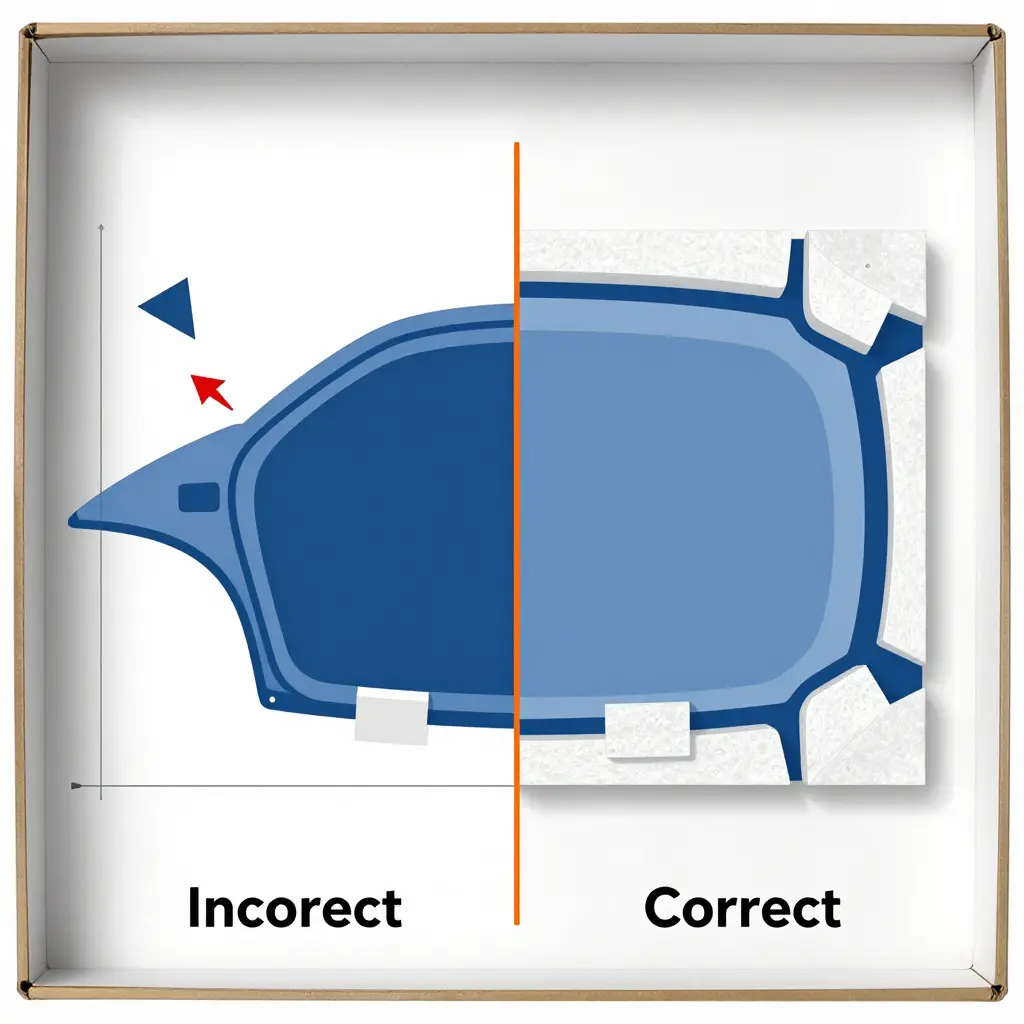
Good foam placement follows one central rule: brace each tab directly. Foam placement should keep every tab away from the rigid panel walls so it is never driven into a hard surface. Dedicated tab cushions – cut or molded pockets that cradle the tab’s root and span – hold the component in a fixed position and let the foam deflect under load instead of passing force straight into the tab.
What the foam should not do matters just as much. Foam pressed directly into an unsupported tab tip creates a point load, and a point load is exactly what starts the crack you are trying to prevent. Distribute the load across the panel body instead, so forces spread over a wide, supported area rather than concentrating on a thin, unsupported edge. A wide bearing surface on the panel absorbs impacts; a narrow one on a tab tip does not.
Account for movement over time, too. Foam that compresses, relaxes, or shifts during a long haul leaves the tab unbraced by the time the truck hits rough road. Locking geometry – interlocking blocks, laminated layers, and pockets cut to the exact tab profile – keeps each cushion in position from dock to dock. That consistency is what actually moves your damage rate down, shipment after shipment.
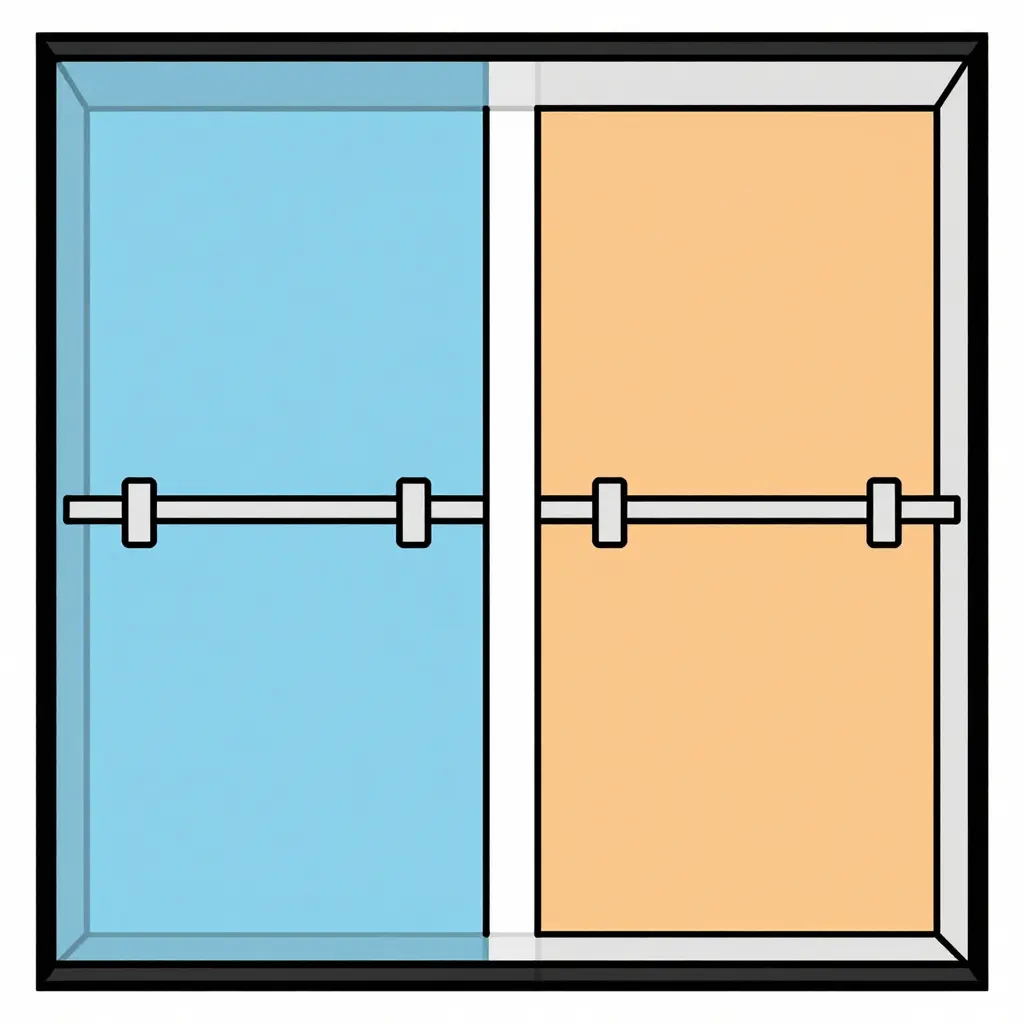
The illustration below contrasts two foam placement strategies inside a shipping box. Both panels show the same side-view cross-section: a box interior with a fairing panel running horizontally and small tab extensions at each end.
- Left layout (no tab support): soft blue foam blocks sit only against the flat faces of the fairing panel. The tab zones at the ends float in empty space, so any shock or vibration travels straight into the unsupported tabs.
- Right layout (braced tab zones): warm orange foam blocks are packed directly against and under the tab zones, cushioning the exact points where cracking tends to start.
Calculating Box Dimensions That Keep Tabs Intact
Getting the box size right is the difference between a fairing that arrives intact and one that arrives in pieces. Start by measuring the fairing at its widest point, which means including the protruding tabs. Lay the part flat, run a straightedge across the outermost edge of an extended tab, and record that number. Never measure the fairing body alone. The tabs are the first feature to strike a wall, so the tab span, not the shell, sets your true minimum.
Next, add a defined cushioning distance on each side. A practical rule is 25 to 40 mm of clearance per side for foam placement, so a fairing measuring 400 mm across its tab span needs a box interior of at least 450 to 480 mm. Keep the cushion symmetric. Uneven padding shoves the part toward one corner, and that is exactly where impact energy concentrates and fairing tabs crack in transit.
Then account for foam compression under stacking load. Closed-cell foam compresses 5 to 10% under a full pallet, so add a compensating allowance of roughly 8 to 10% of your foam thickness. That keeps the part centered when boxes are stacked five high. Finally, factor the tab height into vertical clearance: measure from the base to the tab tip and add the same cushion on top, because tab tips fail when they carry the box lid’s weight.
Before a production run, test-fit a single unit. Pack it, drop it from 600 mm onto a corner, and inspect the tabs. If they show stress whitening, add 10 mm of side cushioning and repeat. When you switch freight modes, adjust the numbers:
- Road: tighter boxes are tolerable because shock loads are shorter.
- Rail: add extra lateral foam to absorb sustained horizontal shock and coupling jolts.
- Sea: use the deepest cushioning plus a moisture barrier, since weeks of vibration and humidity soften foam and reduce protection.
Recalculate, retest, and lock the dimensions before you scale up.
Where Fairing Tab Damage Really Comes From
When fairing tabs crack in transit, it is tempting to blame vague, unavoidable forces – rough roads, unpredictable handling, the simple reality of moving parts around the world. Sort cracking incidents by root cause, though, and the picture stops looking random. It starts looking like a packaging problem.
The breakdown below shows the share of fairing tab cracking attributable to each cause. Three of them account for roughly 78% of all damage, and all three are decided before the shipment ever leaves the dock.
Share of fairing tab cracking by cause (illustrative):
| Cause | Share |
|---|---|
| Insufficient Tab Support from Foam | 34% |
| Excessive Box Clearance | 28% |
| Undersized Box Compression | 16% |
| Stacking Load | 10% |
| Vibration Over Route Length | 8% |
| Handling Transfers | 4% |
| Total | 100% |
Reading the numbers: Insufficient tab support (34%), excessive box clearance (28%), and undersized box compression (16%) dominate the list. Together they show that the geometry and cushioning of the packaging, not the journey itself, drive the damage rate.
The causes that feel most dramatic are actually the smallest. Vibration over long routes contributes just 8%, and handling transfers at hubs – the moments people picture when they imagine fragile freight breaking – account for only 4%. Those forces matter, but they are secondary. A well-supported tab inside a properly sized box survives them.
The takeaway: If foam isn’t holding the tab firmly in place (34%) and the box allows the part to shift (28%) while compressing too little to absorb impact energy (16%), you’ve engineered a failure long before the truck turns a wheel. Fixing the box size and the foam placement is the highest-leverage change a shipper can make – it addresses more than three-quarters of the problem at the source.
Building a Reliable Packaging Standard
A packaging standard is a production process like any other: define it, test it, document it, then lock it down. Before a new fairing style reaches volume production, run a test pack. Drop the assembled unit from a controlled height, shake it on a vibration table, and inspect every tab afterward. If cracks appear, adjust the box size, the foam placement, or both, and test again until the result holds. That single validation step separates a lucky one-off shipment from a standard you can trust across thousands of motorcycle fairing shipping cycles.
Documenting foam positions is what makes the standard repeatable. Photograph every foam block in place, mark its coordinates on a simple box diagram, and record the compression gap that keeps the fairing from shifting. Store those records with the packaging spec so any operator, on any shift, can rebuild the identical protective layout. That same care shows up elsewhere in motorcycle work, from the parts covered in performance engine upgrades to the tight tolerances behind how engine sleeves work. Consistent, documented attention is what turns a good guess into a standard.
Before shipping in volume, verify box dimensions against the fairing’s tab heights with a fast go/no-go check. Measure the internal cavity and confirm it clears every tab by the intended clearance – a box that is too tight flexes the panel, while one that is too loose lets it travel. Pair this mechanical check with the everyday car maintenance skills that keep a workshop precise, and you get a packaging standard that survives real-world handling instead of just the loading dock.
How Damage Rate Climbs with Transit Distance
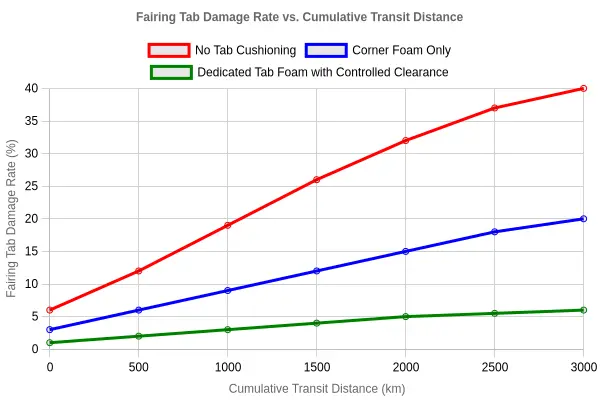
Fairing tabs rarely fail because of a single hard hit. More often, they crack under the slow accumulation of fatigue – small flexing cycles that add up every time a crate is loaded, transferred, and unloaded across a long route. The chart below plots that accumulation, showing how the fairing tab damage rate changes as cumulative transit distance and the number of handling transfers increase. The three packaging conditions diverge sharply the further a shipment travels.
Reading the Trend Lines
- No Tab Cushioning (red): Without any support at the tab, the damage rate starts at 6% and climbs steeply to roughly 40% by 3,000 km. The tab absorbs every vibration and impact directly, so failures compound quickly as handling stages stack up.
- Corner Foam Only (blue): Corner foam protects the box corners but does nothing for the fairing tab itself. Damage rises more gently – from 3% to about 20% – yet it still doubles across the route because the tab can still shift inside the carton’s open clearance.
- Dedicated Tab Foam with Controlled Clearance (green): When foam is placed specifically around the tab and the box is sized to limit free movement, the curve stays nearly flat, ending around 6% even after the longest transits.
What the Divergence Tells You
The widening gap between the lines is the real story. At short distances, box design barely matters – the first 500 km shows only a few points of difference. But as routes stretch past 1,500 km and handling transfers multiply, the poorly protected tab’s risk accelerates while the well-protected tab’s risk plateaus. In practical terms, foam placement and box sizing act as moderators: they don’t just lower the starting damage rate, they flatten its growth curve over distance. For packaging engineers the conclusion is plain – invest in tab-specific cushioning and tight cavity control before you lengthen a route, because the cost of a cracked fairing tab grows nonlinearly with every extra kilometre shipped.
Frequently Asked Questions About Fairing Tab Cracking in Transit
Does a bigger box always reduce the fairing tab damage rate?
No. A larger box can lower the damage rate by adding clearance against external impact, but only when the fairing is fully restrained inside. Excess empty volume lets the part slide and strike the packaging wall, which raises the chance that fairing tabs crack in transit. Effective packaging uses a snug fit with controlled clearance, not maximum volume.
How thick should the foam be for tab protection?
For most motorcycle fairings, 1 to 2 inches (25 to 50 mm) of closed-cell foam at tab contact points is a practical baseline. High-stress corners and thin tabs generally need the higher end, while flat panels may tolerate 1 inch. Thickness matters less than covering the tab itself, because unprotected edges still concentrate stress.
Can foam placement alone prevent fairing tabs from cracking?
Foam placement reduces peak shock loads, but it cannot compensate for an oversized box that allows the fairing to move.
The foam must sit directly against the tabs and isolate them from rigid surfaces. If the part can still shift, poorly positioned foam simply moves the stress to a weaker point. Comb spacing and divider walls should lock the fairing in place, with foam as a secondary layer.
What box size works best for stacking during palletizing?
Boxes that share a common footprint and stack flush on a standard 48 x 40 inch pallet are the most reliable choice. Uniform dimensions keep weight evenly distributed and reduce tipping during handling. Mismatched box sizes create unstable columns, which increases the damage rate even when internal cushioning is good.
How does transit distance change the damage rate?
Longer transit distances increase cumulative vibration and more loading and unloading events, so the damage rate tends to rise with distance. A short regional run may show almost no cracks, while a multi-leg international shipment exposes tabs to repeated shock. This is why packaging validated for one lane should be retested before it is reused on a longer route.
Are motorcycle fairings with thin tabs more likely to crack?
Yes. Thin tabs concentrate stress over a smaller cross-section, so they fracture under loads that heavier tabs absorb. Fairings with minimal material at mounting points are especially vulnerable to lateral shifts inside the box. Reinforcing those points or adding local cushioning is the most direct way to cut tab failures.
Keeping Fairing Tabs Intact Every Time
For manufacturers and logistics teams, one conclusion holds: box size and foam placement decide the damage rate together, never in isolation. Cartons with too much headroom let panels drift and collide, and foam that sits away from the mounting points leaves thin tabs to absorb force on their own. Pair controlled clearance with foam braced directly against each tab, and fairing tabs crack in transit far less often, because impact spreads across the whole panel instead of concentrating at a single point.
If you pack, ship, or receive fairings, treat box size and foam placement as one decision, test-fit before you seal, and standardize that pairing across your packaging line. When you need the parts themselves, Summitfairings (summitfairings.com) carries over 3,000 fairing styles covering almost every motorcycle model, priced 10-40% below other sites, and promises a reply to any question within six hours. A short pre-ship routine – correct carton, foam pressed against every tab – remains the cheapest quality control you will ever run.