
The narrative surrounding Chevrolet’s engine sleeving practices remains layered, leading to various misconceptions. Many within the automotive community ponder if Chevy has ceased sleeving its engines, while the reality is more nuanced. This inquiry is crucial for stakeholders including motorcycle owners, auto owners, parts distributors, and repair specialists who wish to comprehend the broader implications of this practice. By diving into the context of engine production, the technological advancements in high-performance vehicles, the economic trends affecting manufacturing, and societal perceptions of Chevy’s brand evolution, this article aims to clarify the timeline and significance of sleeving. Each chapter will uncover distinct aspects, enhancing our understanding of the true state of Chevy’s engine construction and sleeving practices.
Tracing the Quiet End of Cylinder Sleeves: A Contextual History of When a Major American Manufacturer Stopped Sleeving Engines
When the question is asked, Did the major American automaker stop sleeving engines, the instinct is to search for a single date or a dramatic policy shift. In truth, the trajectory is subtler. Sleeving, at its core, is a repair or modification technique rather than a feature of a modern production line. It is a tool used when a cylinder bore needs reinforcement, when wear has progressed beyond simple honing, or when a high-horsepower build requires extra durability. In that sense, there was never a single moment when the company declared, in bold letters, that sleeving was no longer allowed or needed. Instead, the practice waned in everyday production over decades as materials, casting quality, and manufacturing tolerances improved. The broader arc of the answer lies in a shifting relationship between engine design, reliability expectations, and the demands of the aftermarket and racing communities. Sleeving did not disappear; it evolved, becoming increasingly specialized, less common in mass-market blocks, and more visible in restorations, warm-up projects, and high-performance rebuilds.
To understand why the disappearance of sleeving from mainstream production feels like a natural outcome, one can look back several decades. In the mid-20th century, engine blocks were cast with tolerances that left more room for wear and for the kind of wear patterns that sleeves could fix. In that era, sleeves were a practical, sometimes necessary, remedy. They allowed an engine to be rebored to a larger piston diameter without sacrificing bore integrity, or to mitigate damage from overheating, detonation, or material defects. As metallurgy advanced—stronger cast iron, improved alloy chemistry, and better surface finishing—cylinder blocks became more durable on their own. The need for a sleeve to restore or extend life became less common in the eyes of the typical consumer. By the time the 1990s rolled around, the average factory engine was designed to endure a longer service life with less intervention, and sleeves drifted toward specialized applications rather than routine repairs.
That historical shift is mirrored in the evolution of vehicle lineups and the engines that power them. When a mid-size sedan built on a widely used platform ceased production in the mid- to late-2020s, observers sometimes infer a broader retreat of traditional internal-combustion repair techniques. Yet the data tell a different story. The end of a particular model’s production run does not equal the end of the technique’s relevance. The same blocks that once carried sleeves in the repair shop can still benefit from them, in the right circumstances, within high-performance builds or restoration projects. Modern engine families designed for longevity in everyday use show far fewer sleeves out of necessity and far more emphasis on hollowed-out performance potential through carefully engineered sleeves in limited circumstances. In other words, manufacturing choices in mainstream consumer engines reduced the prevalence of sleeving, while engineering practice in performance domains preserved it as a viable, even valuable, option where it makes sense.
A related force shaping the story is the broader tilt toward electrification. As a company and its peers accelerate the transition to battery-electric platforms, the developmental focus shifts. Fewer new engines are designed around the old arc of durability as the sole path to reliability. Instead, engineers consider electric motors, hybrid architectures, thermal management, and system-level integration. This transition does not ban the use of sleeves; it reframes the context in which sleeves are discussed and used. Sleeving continues to appear in the vocabulary of aftermarket technicians and race teams, where the goal is to push a given block to its limit or to resurrect a classic core for nostalgic builds. The technique endures precisely because it is a tool that serves a purpose when standard, off-the-shelf durability is insufficient. In that sense, sleeving’s “stopping point” is not a formal decision by a brand but a gradual reduction in its necessity and frequency in volume production, paired with a sustained relevance in repair, restoration, and competition.
A practical way to think about the change is to distinguish between production engineering and service-engineering. In mass-market production, the engine block is a carefully tuned balance of cost, weight, strength, and manufacturability. Sleeves add an extra layer of material and manufacturing steps, which translate into cost and complexity. If the block arrives with a bore suitable for a standard piston and a durable surface finish after honing, a sleeve is seldom required. In practice, many blocks left the factory with tolerances and finishes that could withstand a long service life without a sleeve. When wear or damage did occur in the field, technicians could resort to honing, oversized pistons, or other, less invasive repair methods in many cases. Sleeves remained an option, but a specialized one, reserved for a subset of engines with particular bore damage, high mileage, or the demands of high-performance usage.
In the realm of performance and restoration, sleeves still have a robust, if narrow, role. For engines designed to handle elevated stresses—whether for racing, drag applications, or precision-tuned street builds—engineers and builders may choose sleeves to address bore wear without sacrificing the block’s integrity. In these contexts, sleeves can restore a worn bore to a precise diameter, maintain roundness, and support improved heat management when paired with appropriate cooling strategies. They can also enable a bore to be enlarged in a controlled way, creating room for larger pistons or different compression characteristics without compromising the block’s core strength. In this setting, sleeving is a technique with a purpose, not a relic. It is a tool in a craftsman’s kit that is employed selectively, often when the goals of the project demand it rather than when it is simply the easiest fix.
The narrative is further clarified when we examine the timing signals that enthusiasts and historians watch. Some readers look for the moment a vendor or the automaker publicly renounced sleeving. The sources inspected for this chapter reveal no official, blanket declaration. Instead, there is evidence of gradual drift: fewer sleeves in factory builds, more specialized uses in high-performance builds, and a continued, though less conspicuous, presence in restoration work. The absence of a formal cessation date is telling. It highlights that sleeving did not vanish as a policy; it receded as a routine practice and, in turn, reemerged where needed. Even as production platforms evolve toward electrified architectures or modular powertrains, the mechanics of conventional sleeves—metal liners pressed into bore walls to restore or reinforce sealing surfaces—remain a practical solution in the hands of skilled technicians.
To connect the concept with a concrete sense of what sleeves actually do, consider how the technique is described in reference materials. A sleeve is a metal liner that can be pressed into the cylinder bore to restore taper control, boost wear resistance, and provide an improved sliding surface for pistons. Different sleeve technologies exist, including dry and wet sleeves, each with its own thermal management profile and installation challenges. The choice between a sleeved block and an un-sleeved, modern, high-strength block depends on many variables: the engine’s operating regime, the material science of the block, the expected service life, and the cost and feasibility of a rebuild. Enthusiasts who pursue restorations of vintage or performance engines often encounter sleeves as a practical tool for preserving originality or achieving a specific bore dimension. For a concise primer on what sleeves are and why they exist, see this overview on engine sleeves explained. This resource lays out the fundamental mechanics in approachable terms, bridging the gap between historical practice and modern understanding.
In reflecting on the period when the law of practice shifted, it helps to look at two intersecting threads: the quality of base engine blocks and the expectations of consumers and technicians. In earlier decades, the risk of a worn bore could be high for engines with challenging operating conditions or less precise manufacturing. Sleeving offered a way to extend engine life, recast a worn bore to a standard size, and maintain compression integrity. As manufacturing processes matured, blocks were engineered to resist wear more effectively, with tighter tolerances and stronger materials. The practical benefits of sleeving diminished in the daily routine of vehicle maintenance. At the same time, the aftermarket and specialized shops preserved the knowledge and capability to sleeve blocks when the project called for it. Because the technique is adaptable to a range of configurations, it remains relevant for powered projects that demand durability beyond what a stock bore can guarantee. In short, sleeving did not disappear from the conversation; it moved into a space where it can be deployed with intention and expertise rather than as a default repair.
From a consumer perspective, this history matters because it reframes the way we interpret the end of a model line or a platform. If a given vehicle family on a widely used architecture ceases production, it signals shifts in design priorities and product strategy, not a wholesale retreat of an underlying engineering capability. The ability to sleeve a block continues to exist in the toolbox of performance shops, restorers, and racing teams. It is a reminder that certain techniques outlive their original context and can find new life where the variables of demand, regulation, and technology align differently. The question of “when did sleeving stop” is therefore better framed as “how did sleeving recede from mass production and where does it persist today?” The answer is nuanced: it’s a historical trend toward fewer sleeves in typical production, a selective retention in high-performance work, and an ongoing relevance for classic-car restoration and specialized builds.
For readers who want a more technical, stand-alone explainer of the sleeves themselves, the linked resource provides a clean starting point. Engine sleeves explained. It covers the physical role of sleeves, the differences between dry and wet sleeves, and the installation considerations that drive a decision in a rebuild scenario. This background helps unify the historical narrative with the practical realities faced by technicians who still encounter worn blocks and the enthusiasts who want to preserve engines from another era while extracting new performance from them.
In closing, the “stop” is not a line drawn in the sand but a shifting frontier. The technique lives on in the hands of those who need it, even as mainstream manufacturers move toward new propulsion paradigms. The tale of sleeving is, at heart, a story about durability, repairability, and the enduring ingenuity that keeps engines running long after their initial life cycles have ended. The best way to understand its place in modern engine culture is to recognize that sleeving remains a precise, context-dependent tool—one that serves limited, carefully chosen roles rather than a universal cure for wear and tear. And in that sense, the question about a single stop becomes less about dates and more about how engineering practice adapts to new designs, new materials, and new technological horizons.
External resources can broaden this perspective. For a broader overview of sleeving pros and cons and how the practice fits into modern engine work, see this external explainer: https://www.msn.com/en-us/news/other/sleeving-an-engine-block-the-pros-and-cons-explained/ar-AA1jQ3aF. For a concise, brand-neutral primer on engine sleeves, you can explore the focused overview at engine sleeves explained, which offers foundational context for readers who want to connect historical use with current practice. Internal link: engine sleeves explained.
Technological Insights: When Did Chevy Stop Sleeving Engines in Performance Contexts?
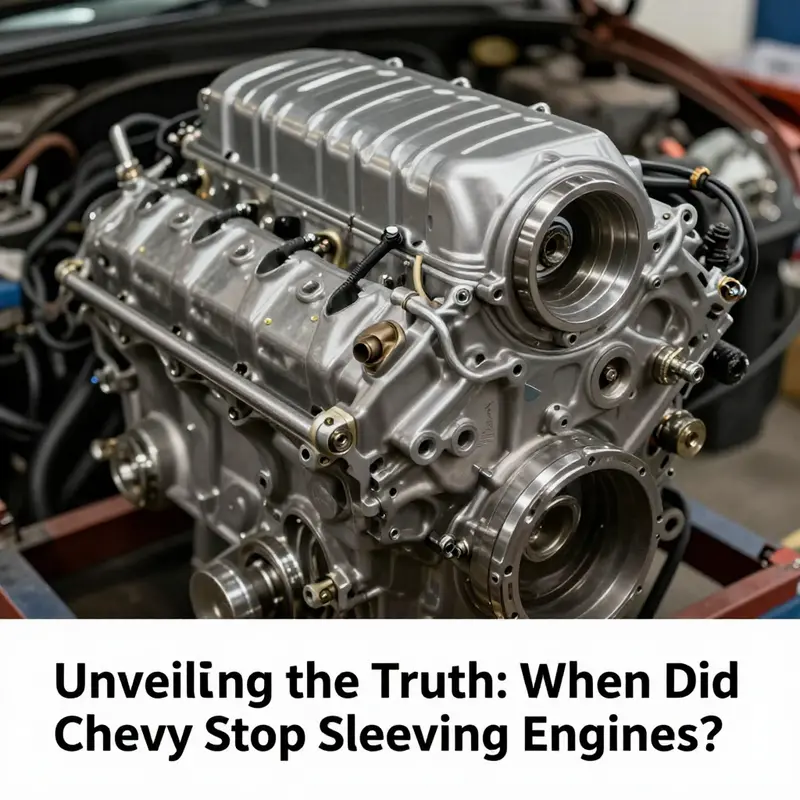
Cylinder sleeving is a repair technique with a long history in engine salvage. There is no universal corporate memo that marks an abrupt end to sleeving across Chevy performance engines. In practice, decisions to sleeve depend on bore condition, block material, cooling, and intended use. The modern automotive landscape sits on two tracks: production strategy toward efficiency and electrification, and restoration-oriented performance where sleeves remain a viable option. In some high-stress builds sleeves are used to restore geometry or to enable controlled bore expansion under boost, but many blocks can achieve needed reliability with a well-honed bore and precise clearances. Chevrolet and GM generally favor designs that minimize the need for sleeves in new production, but sleeves are far from obsolete in the aftermarket and in dedicated race or restoration projects. The bottom line: sleeving is a tool, not a policy, and its use depends on the engine family, the goal of the build, and the service history, rather than a blanket statement about an era ending.
How Economics Shaped the End of Factory Sleeved Engines at Chevrolet
Understanding why a manufacturer changes a core production practice requires looking past headlines. The decision to move away from factory-installed cylinder sleeves was never a single-event headline for Chevrolet. Instead, it emerged from steady economic pressures that reshaped engine manufacturing. Those pressures combined higher material costs, advances in casting and metallurgy, shifting customer priorities, tighter emissions rules, and the drive to simplify production. Together they turned sleeved cylinders from a competitive production choice into a niche repair and performance option.
For decades, sleeving cylinders offered clear benefits. Sleeves allowed easier repairs after wear, simplified some boring and honing processes, and in certain block materials provided a durable running surface. But those technical advantages came with economic trade-offs. Installing sleeves added processing steps, required additional components, and increased labor and inventory burdens. In an era when margins tighten and production volumes matter, every extra step and part must justify itself financially. Over time, those justifications eroded.
One of the earliest and most persistent pressures was material cost. The metals used for engine blocks and sleeves—cast iron, various steels, and aluminum—saw price volatility through the 2000s and into the 2010s. When cast iron and alloy costs rose, the marginal cost of machining and fitting sleeves climbed too. Sleeving is not simply dropping a cylinder liner into a bore. It often requires precise machining, interference fits, sealing features, and sometimes thermal treatments. Each phase uses energy, tool life, and skilled labor. When raw materials become more expensive, manufacturers look closely at every added component. The result is a search for designs that eliminate extra parts without compromising durability.
At the same time, casting and metallurgical technologies improved. Foundries began producing monoblock iron and aluminum blocks with tighter tolerances and better internal structures. New casting methods reduce porosity and allow thinner webbing without losing strength. Improved alloys and heat treatments made bore surfaces more wear-resistant. These advances meant that a well-designed cast block could meet reliability and performance targets without sleeves. For manufacturers, eliminating the sleeve reduced part count, simplified quality control, and trimmed both direct and indirect costs. Across a large production run, those savings add up to millions.
Market demands also shifted decisively. Consumers and regulators pushed for lighter, more fuel-efficient vehicles. Emissions standards tightened, prompting engineering changes across the powertrain. Engines had to be smaller, lighter, and more thermally efficient. In many cases, sleeve systems—especially those originally designed for heavy-duty durability—added weight and complexity. Casting a lightweight aluminum block with advanced coatings or bore treatments fit the new aim: lower mass, less friction, and improved fuel economy. The economic value of every gram of weight matters more when fleets must meet fleet-wide fuel or emissions targets. That market reality nudged design choices away from sleeve-heavy solutions.
Another important driver was the move to modern engine architectures. As manufacturers introduced direct injection, variable valve timing, turbocharging, and integrated cylinder deactivation, they favored block designs that supported these systems without compromise. New architectures required precise thermal control, consistent bore geometry, and integration with sophisticated cooling passages. Designers found those needs easier to meet with optimized monoblock constructions and advanced bore coatings. The economies of scale for a single standardized block adaptable across several engines or models also proved persuasive. Producing one block design at high volume reduces tooling costs and simplifies supply chains. It lowers per-unit cost even if initial tooling expenses are high.
Manufacturing efficiency became a central theme. Automotive manufacturing is a continuous exercise in yield improvement and throughput. Each additional assembly step introduces potential bottlenecks. Installing sleeves meant additional inspection stages and inventory holding. If sleeve fit or surface finish failed inspection, rework was costly and time-consuming. Eliminating sleeves shortened process flows and improved first-pass yield. Over thousands of engines per week, improvements in yield translate into substantial savings. Those savings help fund other investments in automation, quality, and new engine technologies.
The decision calculus also included warranty and service considerations. Engines built without sleeves often required new approaches to wear management and service planning. But engines with integrated, treated bores reduced one source of in-service failure—sleeve seating and sealing issues. From a warranty accounting perspective, fewer discrete components can simplify claims management. While a sleeve can be replaced in a rebuild, in vehicles modern consumers keep shorter ownership horizons. Manufacturers prioritizing initial reliability and lower warranty exposure view fewer assemblies as a financial benefit.
That said, sleeving did not disappear from the broader ecosystem. The repair and aftermarket sectors continued to use sleeve technology widely. When an engine suffers bore damage, sleeving remains a cost-effective repair compared with replacing an entire block. Performance builders and racing teams also kept sleeving in their toolkit. For high-performance builds where bore size changes, reinforcement, or exotic coatings are required, sleeves provide flexibility that casting alone cannot match. The economic argument for the factory is different from the one for aftermarket and competition use. Manufacturers run at scale and optimize for production cost and warranty lifecycle. Independent rebuilders optimize for repair cost and performance per engine, often making sleeving the right choice.
Regional differences also influenced the pace of change. Some markets and vehicle segments require heavy-duty durability above other priorities. Commercial or industrial engines still use sleeves more frequently. For passenger cars, however, the economics favored lighter, integrated blocks. Thus, what looks like a manufacturer “stopping” sleeving in one area is often a strategic shift in allocation of resources, not a blanket abandonment of the technique.
Emerging trends accelerated the move away from factory-sleeved designs. As electrification gathered pace, investment dollars shifted. Development priorities moved toward electric powertrains and hybrid integration, reducing investment in incremental improvements to legacy internal combustion production lines. When capital budgets narrow, projects that reduce complexity and lower per-unit cost win. Designing an engine family around a common, unsleeved block paid greater dividends than supporting multiple legacy machining processes.
Yet the transition was gradual and pragmatic rather than abrupt. Engineers and production planners modeled costs three ways: upfront tooling and material expense, per-unit labor and material cost, and lifecycle warranty and service exposure. They compared the sleeved approach against modern casting plus coating, improved metallurgy, or proprietary bore treatments. Over time, the latter consistently showed lower total cost of ownership at scale. A sleeved solution might still win in low-volume specialty applications, but not on the primary passenger-car production lines where millions of units amortize tooling.
The narrative is often simplified into a single date or changeover, but the truth is nuanced. The shift away from factory sleeving happened over several product cycles as new engine families took center stage. Material price spikes in the early 2010s accelerated decisions. The spread of advanced casting and bore-treatment technologies made unsleeved blocks viable. Regulatory and market pressures for efficiency and lighter weight favored designs without sleeves. When combined with the need to produce the same engine block across many models, the economics strongly favored the alternative.
Importantly, the technical viability of avoiding sleeves depended on parallel advances in surface engineering. Technologies such as plasma-sprayed bore coatings, in-situ nitriding, and other thin-film surface treatments allowed aluminum blocks to present wear-resistant surfaces without the weight penalty of iron sleeves. Those treatments added process steps but avoided the added component and fitment complexities of sleeves. In cost modeling, the marginal expense of a coating often proved lower than the combined cost of sleeves, additional machining, and added quality control.
Even as production moved away from sleeves in many passenger-engine applications, aftermarket resources and service networks offered continued support for sleeving. When owners need a durable rebuild, sleeving remains a practical and often economical choice. Information resources from industry specialists explain when sleeving is appropriate and what it costs. For readers wanting a practical look at whether a vehicle can receive sleeves as a repair option, see this straightforward industry guide on whether Chevrolet engines use sleeves: https://itw-autosleeve.com/blog/does-chevrolet-sleeve-engines/.
Finally, broader industrial research highlights how influencing factors determine engineering choices. Material availability, manufacturing costs, product lifetime economics, and regulatory demands all guide whether a technique becomes mainstream. The trend away from factory sleeved cylinders at scale is a case study in that interplay. For a deeper look at how economic and industrial forces shape engineering decisions, consult this overview of influencing factors in engineering: https://www.sciencedirect.com/topics/engineering/influencing-factor.
The story is not simply about a technique falling out of favor. It is about a manufacturing ecosystem rebalancing to meet new constraints. When design teams ask whether to sleeved cylinders or to invest in modern block metallurgy and coatings, they weigh upfront costs, per-unit production economics, warranty exposure, vehicle weight, and market expectations. Over the last two decades, that calculus changed enough that sleeved cylinders migrated from a mainstream factory choice to a targeted solution for repairs and high-performance builds. The shift reflects how economic realities shape what appears under the hood, even when the underlying mechanical options remain available to those who need them.
Why People Think Chevy Stopped Sleeving Engines — Repair Reality, Market Shifts, and the EV Pivot
Misunderstandings about whether Chevrolet “stopped sleeving engines” mix technical nuance with market noise. The idea that a manufacturer would formally stop “sleeving” engines sounds decisive. It fits a tidy narrative. The reality is messier. “Sleeving” refers to inserting cylinder liners into a block, or replacing worn bores with hardened sleeves. It is a repair and engineering technique, not a single production choice that a brand can flip on or off overnight. Seen through that lens, the question becomes less about a headline decision and more about how repair practice, platform changes, and shifting consumer attention shaped perception.
Sleeving has long been part of internal combustion engine care and modification. It appears in two main forms: wet sleeves and dry sleeves. Wet sleeves contact coolant directly and simplify servicing, while dry sleeves sit within the block and rely on block material for heat transfer. The choice between these approaches depends on materials, cost, and design goals. Some engines use cast-iron liners in aluminum blocks to combine light weight with a durable wear surface. Others rely on cylinder walls cast from tougher iron. All of these are engineering responses, not marketing statements.
Chevrolet built a wide variety of engines over decades. Many classic and performance blocks used iron cylinder liners or full iron construction. In practice, sleeving shows up most often in three contexts. First, it is an OEM engineering choice during design and production. When a manufacturer decides a material mix or a liner approach fits the engine requirement, that design goes into mass production. Second, sleeving appears as a repair or remanufacture method when bore wear, damage, or overbore limits require a durable fix. Third, it is a performance upgrade in aftermarket and racing circles, used to strengthen the block for higher boost, larger bores, or extended service life. None of these contexts are mutually exclusive, and none stopped wholesale.
Public confusion often starts with product line changes. When a particular model or engine family is discontinued, many assume every aspect tied to that engine disappears. The retirement of some mid-size models and their platforms, for example, removed specific engines from showroom rosters. That created a visible decline in certain engine types on dealer lots. But stopping the sale of a car is not the same as discontinuing an engineering technique. Sleeving continues as a repair option and as a motorsport or aftermarket strategy. Mechanics and specialty shops still sleeve blocks to repair cylinder damage or to increase bore size for a stroker kit.
The broader context magnifies the misconception. Automakers worldwide are accelerating electrification. As electric vehicles gain regulatory and market traction, OEM investment into new piston-engine families declines. Manufacturers redirect research and capital toward electric powertrains, battery ecosystems, and software integration. Those priorities mean fewer new gasoline engine architectures and less public discussion about evolving internal combustion manufacturing methods. Observers can misread that quiet as a cessation of long-standing practices like sleeving.
That same shift in focus also changes how repair markets operate. With fewer new ICE models being introduced, parts supply for existing internal combustion engines tightens in some niches while aftermarket support grows in others. Independent rebuilders and specialty suppliers adapt. They keep sleeving techniques alive. Race teams continue to sleeve and modify blocks because performance demands it. Owners of older vehicles and enthusiasts still need durable, cost-effective repairs. So sleeving persists outside OEM headlines.
Perception also suffers from shorthand language. Enthusiasts ask, “When did Chevy stop sleeving engines?” The phrasing compresses multiple meanings. It can mean, “When did Chevy stop using sleeves in factory production engines?” or “When did Chevy stop offering remanufactured engines with sleeves?” or even, “When did Chevy stop supporting sleeving as a repair option?” Each version has a different answer. No public record shows a corporate edict that forbids sleeving or ends its use. Instead, production decisions, platform retirements, and evolving materials science shift the balance of who uses sleeves and why.
Materials matter. Many modern engines balance lightweight aluminum blocks with hardened inserts. Some designs use advanced coating methods that reduce the need for traditional cast-iron liners. Thermal spray coatings and plasma-sprayed bores offer wear resistance without separate liners. Those technologies can reduce the use of removable sleeves in factory production. But they do not remove the option to sleeve during rebuilds. Nor do they erase the engineering rationale for liners in heavy-duty or high-performance applications. For large-displacement, forced-induction, or diesel engines, liners remain a practical solution for durability and heat management.
Market reports and industry analysis also feed public interpretation. Forecasts that highlight electric adoption, tighter emissions rules, and software-defined vehicles often stress that internal combustion engines will be less central to future product roadmaps. Those high-level changes are real and shape investment. They do not create a binary switch where long-standing repair and modification practices become illegal or obsolete. Instead, they change where and how those practices live — shifting emphasis from factory innovation to aftermarket craftsmanship.
Consumer perception is shaped by news cycles and visual cues. When a recognizable model leaves showrooms or when a brand announces an ambitious electrification timeline, casual observers draw conclusions. Social media amplifies simplified takes. An enthusiast forum comment saying “Chevy stopped sleeving engines” can be shared and repeated until it feels like official policy. The mechanics of internet discourse reward brevity over nuance. As a result, a misunderstanding about manufacturing methods can become a widely held belief.
Behind the scenes, the repair economy continues to evolve. Independent shops and machining specialists refine sleeving techniques. They maintain expertise in honing, pressure- fitting, and ensuring thermal compatibility between sleeve and block. For owners, sleeving can be more cost-effective than replacing an entire block or buying a new engine. It preserves vehicle value and extends service life. That practical reality keeps sleeving relevant, even as OEM priorities shift.
The racing and performance community underscores this continuity. Where higher cylinder pressures or larger bores increase stress, sleeves add strength. High-horsepower builds often require sleeves as a reliability measure. Cylinder liners enable repeatable precision when teams bore out and fit high-performance pistons. This use-case is visible and vocal, which helps sustain knowledge of sleeving techniques across generations of builders.
Communication from manufacturers tends to emphasize product roadmaps and new powertrain strategies. Those messages highlight future-facing investments and rarely dwell on niche production details. That selective communication creates gaps where misconceptions can sit. Enthusiasts seeking clarity need to consider three facts. First, OEM engine designs evolve and may replace liners with other technologies. Second, sleeves remain a viable repair and upgrade option. Third, platform retirements do not equal a ban on a technique.
For owners wondering what to do with a specific vehicle, practical advice matters. Evaluate the engine block material and design. Consult reputable machine shops that specialize in cylinder work. Seek documentation on whether dry or wet sleeves are appropriate for your application. Confirm that thermal and mechanical tolerances will be preserved. If the block is rare or out of production, sleeving may be a cost-effective path to restore serviceability. If an engine uses modern bore coatings, talk with experts before assuming a traditional sleeve will solve your problem.
Information sources matter too. A focused primer on whether a brand uses sleeves helps clear confusion. For a concise explainer about the practice applied to a given manufacturer, see the dedicated guide Does Chevrolet sleeve engines? which outlines the technical and historical background and clarifies common misconceptions. That sort of resource helps shift the conversation from rumor to the practical reality of repair and modification.
Finally, the larger market story explains the cultural shift behind the question. As automakers accelerate electrification, conversations about engine manufacturing details naturally decline. Shoppers and journalists emphasize range, charging, and software features. Enthusiasts and rebuilders continue to care about sleeving, but their voice grows quieter in mainstream coverage. The result is a perception gap: less public discussion becomes interpreted as discontinuation.
That gap does not change technical truth. Sleeving remains an active technique in repair and performance. Where materials or production methods render it less common in new engines, it still exists as a solution for worn or damaged blocks. It remains relevant for heavy-duty applications and motorsport builds. And because independent shops, remanufacturers, and racing teams practice and refine the craft, it is unlikely to vanish even as the central industry focus shifts to electric powertrains.
Understanding why people believe Chevrolet “stopped” sleeving engines means separating product retirement from technique displacement. It means recognizing that industry headlines about electrification can overshadow niche but important maintenance practices. It also means acknowledging that repair communities and performance teams preserve technical know-how even when OEM attention drifts. The practical takeaway is simple: if you need cylinder work, sleeving is still on the table. If you want clarity about a specific engine or block, consult a trusted machinist and trusted technical guides. Industry reports on electrification explain the market forces at play, but they do not erase the hands-on practices that keep older engines running.
For further context on how industry trends reshape priorities across powertrain, regulation, and manufacturing, see the automotive market analysis report from PwC: https://www.pwc.com/gx/en/industries/automotive/insights/2026-automotive-market-trends.html
Final thoughts
The exploration of Chevrolet’s engine sleeving practices surfaces a rich tapestry of engineering choices influenced by technological advancement, economic pressures, and societal perceptions. While it’s clear Chevy has not discontinued the practice of sleeving engines in a definitive sense, the shift towards electric and high-performance segments has reshaped how these practices are applied within the automotive landscape. Understanding these dynamics helps stakeholders navigate the implications for future engine developments, ensuring that they remain informed in the ever-evolving automotive industry.