
The performance of radio-controlled (RC) engines hinges significantly on the quality of their components, particularly the piston sleeve. Selecting the right material for this critical part is essential for ensuring durability, efficiency, and overall engine performance. Hyper-eutectic aluminum alloy has emerged as the preferred choice among enthusiasts and manufacturers alike, thanks to its low thermal expansion and high strength. This article will delve into the performance characteristics of different materials, the economic implications of using high-silicon aluminum, manufacturing considerations inherent to producing pistons from this alloy, and the comparative advantages of hyper-eutectic aluminum over traditional materials. Each chapter will provide insights to equip motorcycle owners, auto owners, distributors, and repair shops with the knowledge required to make informed material choices.
Material Mastery for RC Engine Piston Sleeves: Performance, Trade-offs, and Longevity
Behind every tight gasket and crisp power band in an RC engine lies a quiet decision about the sleeve material. The piston sleeve is not just a passive wall; it is the heat sink, the wear surface, and the dimensional anchor for every combustion event. In the tiny world of model powerplants, where temperatures can spike and rpm climb into the five-figure range, the sleeve material must perform across several competing demands: minimal thermal expansion, resistance to abrasion, and enough strength to resist deformation under load, all while shaving weight to boost response. The choice reverberates into compression, sealing, and ultimately the engine’s response to throttle input. This chapter looks at how different materials meet those pressures, how they interact with pistons and fuels, and why certain blends have become the de facto standard in performance-minded RC setups.
The consensus around the RC community gravitates toward hyper-eutectic aluminum alloys, commonly called high-silicon aluminum, for sleeves paired with hyper-eutectic aluminum pistons. The logic is straightforward and historically reinforced by field observations: silicon raises hardness and wear resistance, while aluminum keeps the assembly light and responsive. The extremely low coefficient of thermal expansion (COTE) in hyper-eutectic alloys means that as heat pours into the cylinder during a hard pull, the sleeve swells only modestly. In an engine where just a few thousandths of an inch can determine permanent seizure or a dropped compression seal, that stability is less a luxury and more a necessity. The result is a sleeve that maintains tight clearance with the piston over a wide temperature swing, preserving sealing force without inviting galling or scuffing. When the piston and sleeve behave as a matched pair, the engine can sustain higher compression without losing reliability, and the risk of overheating-induced loss of power diminishes with every degree the sleeve resists expansion.
Wear resistance follows closely behind in the value proposition. Silicon in the alloy forms hard, wear-resistant phases that resist abrasion from the piston skirt and the rotating ring of contact within the cylinder wall. This matters not only for longevity but for maintaining the precise clearance the engine relies on for efficient combustion. A sleeve that deforms or wears unevenly can change the piston-to-wall gap, altering compression, exhaust scavenging, and even the timing of the ignition event in extreme cases. The lighter weight of aluminum, compared with steel or cast iron, contributes to a more responsive throttle and a lighter rotating assembly, which translates into quicker acceleration and a more lively running characteristic—desirable features in competition and scale performance alike. A note from industry discussions emphasizes that, while this is a general trend across several RC engine families, the core benefit remains the same: a stable, low-expansion, wear-resistant bearing surface that tolerates the heat and friction of high-RPM operation.
Yet material science rarely rests with a single solution. Some builders explore reinforced glass composites for sleeves when the aim is exceptional thermal resilience and dimensional stability under dramatic heat input. The glass component, embedded in a polymer matrix, provides a high heat tolerance and a favorable strength-to-weight ratio. The result can be a sleeve that resists warping and maintains more consistent tolerances across rapid temperature cycling. The trade-off is that glass composites introduce a different wear mechanism and can require different lubrication strategies to minimize friction at the interface with the piston. In practice, these sleeves shine in demanding thermal profiles, where their dimensional stability and resistance to thermal creep help keep the engine sealing tight even as temperatures spike. The material’s stiffness also helps resist deformation under repeated high-RPM cycles, a factor that translates into stable compression and predictable performance over a long run in a race or endurance event.
Another path you’ll encounter in advanced builds is the use of hardened steel inserts or nickel-plated surfaces within the sleeve construction. These approaches push surface hardness up beyond what aluminum alone can offer. Hardened steel inserts reduce galling and wear in the contact regions and can dramatically extend sleeve life in racing conditions where the engine runs at peak power for extended periods. Nickel plating serves a similar purpose, delivering a tougher, more abrasion-resistant surface while also providing a degree of corrosion protection. The trade-offs here are material density and cost, as well as the potential for altered clearance behavior as the base material and the coating respond differently to heat. In high-performance contexts, some builders blend these treatments with an otherwise aluminum base to sculpt a sleeve that can handle the abuse of sustained high RPM without compromising the delicate balance of tolerances that define top-end power.
What emerges from this spectrum of choices is a practical framework: sleeves are not a single-property part but a tuned interface. The optimal sleeve depends on the engine’s piston material and its intended use. The most common pairing remains hyper-eutectic aluminum sleeves with hyper-eutectic aluminum pistons. That combination leverages low COTE and matched thermal behavior, creating a stable seal and predictable clearance during rapid temperature swings. The very foundation of successful operation rests on minimizing the chance of seizure and keeping the piston skirt within a toleranced corridor where friction remains manageable. The lower expansion of the sleeve relative to hotter components helps maintain that corridor when the engine heats up, reducing the risk that thermal growth would push the piston into the wrong side of the bore or reduce the oil film below the level required to prevent metal-to-metal contact.
In considering these materials, it is essential to keep the broader context of RC powerplants in view. The sleeve material interacts with more than just the piston and the air-fuel mixture; it also interacts with cooling, lubrication, and the manufacturing realities of small-scale production. Lightweight sleeves that maintain sharp tolerances reduce the energy required to accelerate the rotating mass. Efficient lubrication reduces frictional heating, which in turn helps preserve the intended clearance. Effective cooling keeps the sleeve from surpassing critical temperatures that could amplify expansion and undermine sealing. These are not abstract concerns; they translate into longer engine life, more consistent power delivery, and the kind of reliability that racers and enthusiasts rely on when a session hinges on repeatable performance rather than a single explosive pull.
For builders who want to expand beyond conventional wisdom, the choice of sleeve material offers a path to tailor performance to a specific application. A reinforced glass composite sleeve, for example, can be advantageous in a scenario where a compact, thermally robust system is required, and the duty cycle includes repeated, rapid throttle changes rather than prolonged high-RPM bursts. In such configurations, understanding the lubrication regime becomes even more important, because the interface between piston and sleeve governs friction and wear in ways that differ from metal-on-metal contact. The alloy content of the piston is equally important; a hyper-eutectic aluminum piston will harmonize with the sleeve’s expansion characteristics, sustaining tight sealing without inviting scuffing under hot operating conditions. The synergy between sleeve and piston—through matched thermal expansion and complementary hardness—is what often separates a well-tuned engine from one that merely runs.
From a practical standpoint, the decision often comes down to operating discipline and maintenance philosophy. Racing teams may favor a sleeve design that prioritizes maximum wear resistance and stable tolerances under aggressive duty cycles, even if that means a slightly heavier or more expensive component. Hobbyist setups, driven by cost and ease of maintenance, may lean toward the standard hyper-eutectic aluminum pairing because it provides a reliable, well-understood baseline with widely available parts and established servicing practices. In all cases, the goal is consistent, repeatable performance with a margin that protects the engine from the most common failure modes: seizure due to thermal overrun, galling from lubricant breakdown, and unpredictable clearance changes driven by uneven wear.
For readers who want a deeper dive into the broader landscape of engine sleeves and their function, a quick reference on what sleeves are and how they work can be found in dedicated overviews of engine sleeve design and application. engine sleeves provides a concise primer that complements the practical considerations discussed here, especially for readers exploring the mechanics behind cylinder walls, bore coatings, and how different sleeve materials interact with piston alloys.
In the end, the material choice for RC engine piston sleeves is a balancing act. It requires weighing thermal stability, wear resistance, weight, and cost against the engine’s intended use, the operating environment, and the lubrication and cooling strategy. Hyper-eutectic aluminum remains the dependable workhorse for most performance-oriented builds, due to its favorable combination of low expansion, adequate hardness, and lightness. Yet the door remains open to alternative materials when a project pushes into specialized duty cycles or when a builder seeks incremental gains through innovation. Each option carries its own trade-offs, and the most successful engines are those that align sleeve behavior with piston dynamics, fuel chemistry, and the exact cadence of throttle, load, and cooling that define a given session.
External resource: https://www.rcequipment.com/technical-guide/rc-jet-engine-parts-materials/
Balancing Cost and Performance: The Economics of High‑Silicon Aluminum Piston Sleeves for RC Engines
Economic trade-offs and lifecycle value of high-silicon aluminum piston sleeves
Choosing the right material for an RC engine piston sleeve is more than a technical decision. It is a cost decision that affects purchase price, manufacturing complexity, operating efficiency, maintenance cadence, and long-term value. High-silicon aluminum alloys, often called hyper-eutectic alloys, sit at a particular spot on that economic map. They carry a slightly higher upfront material and processing cost than ordinary aluminum. At the same time, they deliver thermal stability, low expansion, and useful wear resistance that reduce lifecycle expenses. This chapter examines those trade-offs in a single narrative so hobbyists, builders, and small manufacturers can make informed choices.
At purchase, raw high-silicon aluminum costs more than standard aluminum billets. The premium reflects alloying and controlled casting practices. It also reflects demand from automotive and aerospace suppliers who value the alloy’s thermal and wear properties. For small-batch RC engine production, that price difference is noticeable. But the alloy’s real economic story is revealed after the first runtime hour. Hyper-eutectic aluminum expands less when heated. That low coefficient of thermal expansion preserves cylinder clearances as combustion generates heat. Tight tolerances mean less piston slap, fewer seizing incidents, and reduced early wear. For a user, that translates to fewer rebuilds and a longer service interval. For a small manufacturer, it reduces warranty claims and customer service costs.
Weight is another subtle but tangible economic factor. Aluminum is inherently light. High-silicon variants retain that advantage over steel or cast iron sleeves. Every gram saved in rotating parts improves throttle response and reduces inertial losses. In competitive racing or endurance runs, better responsiveness can shave fuel consumption. Those savings are incremental but can add up across multiple runs or events. For a hobbyist who buys fuel frequently, the gains are meaningful. For a competitive racer, the small reduction in weight can mean better lap times and fewer engine interventions during an event. Improved performance can also support higher resale value for modified models and kits.
Manufacturing cost is where the alloy’s economics become nuanced. Hyper-eutectic aluminum requires precise heat treatment and careful machining. The silicon content hardens the aluminum matrix. Proper machining tools and feeds are essential to prevent galling and achieve the required surface finish. Heat treatment must be controlled to avoid brittle phases or microcracking. These processes raise production costs compared to a basic aluminum sleeve. However, the up-front investment in tooling and process control often pays for itself. Better dimensional stability reduces scrap rates and rework. For a builder who produces dozens or hundreds of sleeves, process discipline yields lower per-part costs over time.
Durability trade-offs influence long-term economics. In moderate operating conditions, high-silicon aluminum performs exceptionally. It resists scuffing and maintains roundness after repeated thermal cycles. Under extreme loads or prolonged high-temperature operation, however, the alloy can be more vulnerable than steel. Steel sleeves offer superior toughness under shock loads and higher sustained temperatures. For heavily modified engines that raise combustion pressures, steel can reduce catastrophic failures. Thus, where extreme durability is a priority, the additional cost of steel may be justified by lower failure rates. For typical RC use and many competitive classes, the high-silicon aluminum balance between cost and longevity usually wins.
Maintenance patterns change with the material choice. Engines with hyper-eutectic sleeves require less frequent honing and can tolerate slightly looser piston ring tolerances without loss of performance. The reason is the combination of hardness and low thermal movement. Fewer interventions mean lower service labor and parts costs. That is an operational saving. Conversely, if cooling or lubrication is neglected, the alloy’s relative brittleness under thermal shock can produce scoring or cracks. Preventive maintenance, therefore, remains essential. The alloy reduces scheduled maintenance frequency but does not eliminate the need for good engine management practices.
Supply chain considerations matter for the economics of choice. High-silicon aluminum alloys are widely used in multiple industries. That broader market supports steady supply and some economies of scale. For small manufacturers sourcing sleeves, this means more options and competitive pricing. It also means greater availability of pre-cast blanks or aftermarket sleeves, which reduces lead time. Sourcing from established suppliers lowers risk and can reduce the need for in-house metallurgy expertise. That frees resources for design and assembly. Still, small-batch custom alloys or unusual compositions will increase lead time and cost, so matching alloy grade to need is important.
Another economic dimension is the cost of failure. Cylinder sleeve failures can cause collateral damage to pistons, rings, and crank components. When a sleeve made from ordinary material expands unpredictably, piston seizure can result. Hyper-eutectic aluminum’s dimensional stability reduces that failure risk. Fewer unplanned rebuilds mean lower total cost of ownership. For event-driven users, the value of a reliable engine is not only lower repair cost. It is also the avoidance of lost competition time or ruined runs.
Consider the resale and market positioning angle. Engines built with higher-quality alloys can command a premium in the secondary market. Buyers look for documented use of materials that promise longevity and stable performance. A well-documented specification that highlights the use of a high-silicon sleeve can increase buyer confidence. For manufacturers, that can justify a modest markup. The economic effect compounds when brand reputation reduces return rates and increases referral sales.
From a regulatory and environmental standpoint, material choice carries indirect costs. Aluminum production is energy intensive, but its recyclability is high. Using aluminum alloys designed for durability can extend component life, indirectly reducing material throughput. For a conscientious builder, the ability to recycle worn sleeves and reuse aluminum content offsets some upstream environmental costs. In addition, lighter engines contribute to lower fuel consumption. Those operational savings have both economic and environmental value.
When to choose an alternate like steel is a question of operating envelope. If an engine will regularly run at the edge of its design or be highly modified, the higher upfront cost of steel can be offset by longer intervals between catastrophic failures. Steel sleeves also simplify repair in some contexts. Their toughness tolerates more aggressive tuning. For most RC applications, however, the high-silicon aluminum alloy remains the economically rational choice. It delivers performance benefits that offset its incremental manufacturing complexity.
Practical purchasing advice follows naturally. For hobbyists, prioritize sleeves that specify a high-silicon composition. Ask the supplier about heat treatment and machining tolerances. For small manufacturers, invest in the correct tooling and process controls. That reduces scrap and improves repeatability. Track operational metrics like rebuild intervals and fuel usage. Those measurements will show whether the alloy delivers the expected lifecycle savings. If you modify engines heavily, test both materials under the intended conditions to gather real-world failure data. Data-driven decisions keep costs predictable.
Ultimately, the economics of high-silicon aluminum piston sleeves balance measurable and intangible factors. There is an upfront premium in material and process. That premium often pays back through reduced maintenance, improved fuel efficiency, lower failure risk, and higher resale. The alloy performs best when engines are operated within their design limits and maintained properly. For heavy-duty or highly tuned use, steel remains a viable alternative despite higher weight. For the broad majority of RC engines, however, the economic case for hyper-eutectic aluminum is strong. It aligns lower lifecycle costs with the performance demands of hobbyists and competitors alike.
For readers who want a technical market perspective on high-silicon aluminum alloys, see the industry analysis here: https://www.marketsandmarkets.com/Market-Reports/high-silicon-aluminum-alloys-market-1689.html. For practical background on sleeve functions and types, consult this primer on what are engine sleeves for an accessible explanation: https://itw-autosleeve.com/blog/what-are-engine-sleeves/.
Silicon, Heat, and Fit: Mastering Hyper-Eutectic Aluminum Piston Sleeves for High-Performance RC Engines
Silicon dominates the story of hyper-eutectic aluminum piston sleeves, but it is only one part of a complex equation that governs how an RC engine breathes, survives, and responds to the throttle. In small, high RPM machines, the piston sleeve must resist wear and galling, tolerate repeated thermal cycles, and still maintain precise play with the piston and the cylinder wall. The material that makes this possible is a thoughtfully engineered aluminum alloy with a high silicon content. Typically in the range of 12 to 18 percent silicon, this composition drives a low coefficient of thermal expansion, excellent wear resistance, and surprisingly good thermal conductivity for a lightweight metal. The result is a sleeve that stays dimensionally stable as temperatures swing wildly from cold starts to peak power bursts and, importantly, it does so without adding excessive mass to the rotating assembly. The rationale for choosing hyper-eutectic aluminum in RC piston sleeves is not simply about hardness; it is about a balanced response to heat, friction, and the need for reliable, repeatable performance under demanding operating conditions.
But material selection is only the first act. The true engineering challenge lies in translating these properties into a form that can withstand the mechanical and thermal duress of a tiny, high-speed engine. The silicon particles that harden the alloy are also a source of brittleness. They create a microstructure that resists wear at the surface while introducing micro-crack risks if the material is mishandled during manufacturing. This brittleness does not forbid machining, but it does demand care. The sleeve must be shaped with precision, and the process must minimize the creation of surface flaws that could propagate under load. In practice, this means a careful sequence of controlled steps from billet to finished part, each chosen to preserve integrity while delivering the tight tolerances that RC engines demand.
A primer on what engine sleeves are, and how they function within the cylinder assembly, can be found here: What are engine sleeves?. This reference helps anchor the discussion in the broader context of sleeve design, illustrating how the same metallic principles play out across different engine architectures. The sleeve must not only resist wear but also accommodate the piston’s radial movement and provide a stable, lubricated interface with the bore. The low thermal expansion helps keep the piston-to-bore clearance within specification as heat cycles proceed, but it also means that any residual surface damage or machining imperfections can become amplified when temperatures rise. That subtle interplay—low CTE with potential surface sensitivity—drives the entire manufacturing philosophy behind hyper-eutectic sleeves.
From a microstructural standpoint, hyper-eutectic aluminum owes much of its performance to the silicon phase that is finely dispersed within the aluminum matrix. Silicon hardening, in this context, translates to improved wear resistance and the ability to resist galling in the high contact stresses of a running RC engine. Yet the same microstructure can become a liability if the finishing operations are too aggressive or the tooling is not properly chosen. The result can be surface cracking, micro-scale pits, or chronic waviness in the bore that undermines compression and fuel-air delivery. To counter this, machining engineers lean on tools with exceptional wear resistance, such as carbide or diamond-coated tools, and adopt conservative cutting parameters that prioritize surface integrity over maximum material removal rate.
Casting or forging forms a billet that embodies the alloy’s final microstructure, but it is only the starting point. Precision casting or forging sets the stage for tight tolerances, but it is CNC machining that translates raw material into a sleeve that matches the cylinder wall with the exactness needed at high RPM. During CNC work, it is not unusual to see deliberate, incremental passes that avoid heat buildup. The silicon particles, while beneficial to wear, can act like hard abrasives during cutting if the tool or coolant strategy is inadequate. Therefore, the machining program is as much about thermal management as it is about material removal. Coolants are chosen to stabilize temperature, control built-up edge on tools, and prevent micro-cracking in the finished surface. The goal is a uniform, near-mirror finish that keeps the sleeve’s bore cylindrical at every operating point.
Surface treatments form a second, equally critical layer of defense. Anodizing is common because it increases surface hardness and provides a base that can hold lubricants more effectively. In RC practice, MoS2 coatings are also applied to the interface region or integrated into the lubrication strategy to reduce friction during startup and at cold temperatures when oil films are less robust. The lubricity of the sleeve surface becomes a driver of reliability at high RPM, where even small changes in friction can alter power delivery and fuel economy. These coatings and treatments are not mere polish; they are functional enhancements designed to endure the cyclical heat and shear of a running engine.
Thermal management presents a nuanced paradox. Hyper-eutectic aluminum’s low CTE helps keep the sleeve from distorting as it heats, but the material’s relatively good, not exceptional, thermal conductivity means heat must be disposed of deliberately. Uneven temperature gradients in a tiny engine can warp the bore and alter clearance. Accordingly, many sleeves are designed with features that promote even cooling, such as optimized fin geometry on the surrounding components and strategic port configurations that encourage more uniform heat flow. In some designs, cooling channels or dispersed fin patterns address the reality that no single piece can be a perfect thermal equalizer. The manufacturing team must anticipate these thermal paths during the design phase and ensure the sleeve can tolerate slightly different temperature zones without compromising performance.
Clearance control is perhaps the most consequential assembly consideration. The clearance between the sleeve and the cylinder wall must be neither too tight nor too loose. The wrong tolerance invites seizure or excessive blow-by, both of which erase performance gains. This is where the unique combination of low CTE and high hardness becomes a balancing act. The final bore must accommodate the piston’s first-stage thermal expansion without clamping, yet it must not allow enough radial play to degrade compression during steady-state operation. Achieving this balance requires strict process control, validated by inspection at multiple stages—from rough casting checks to final bore measurements and surface finish evaluations. In practice, a well-designed hyper-eutectic sleeve is built with an understanding of how tolerances shift with temperature, and the manufacturing plan builds in compensation for those shifts rather than simply hoping they don’t occur.
An essential part of the quality story is how the sleeve is inspected. Metrology methods examine bore straightness, roundness, and surface finish. Hardness testing confirms that the silicon phase remains effectively distributed and that no deleterious phase separation has occurred during heat treatment. Microstructural checks verify that the silicon particles are uniformly dispersed and that the matrix remains free of microcracks after finishing. These checks are not mere bureaucratic steps; they are the difference between a sleeve that delivers repeatable power and one that fails prematurely under load.
The sleeve’s relationship to the rest of the engine is also about materials compatibility. The aluminum alloy must play well with the piston and the cylinder wall, especially in terms of thermal expansion and lubrication. In RC engines, oil films can be thinner and the lubricant chemistry less forgiving than in full-scale powerplants, so the surface chemistry of the sleeve surface matters. An anodized layer that binds lubricants more effectively, combined with a MoS2 coating in the rubbing zone, can improve film formation and reduce scuffing. The result is more consistent piston travel, steadier compression, and longer component life over a run-to-run cycle of increasingly demanding operation.
Manufacturing hyper-eutectic aluminum piston sleeves is thus a study in controlled extremities. You push the material to its wear-resistant edge while constraining it within precision tolerances that must hold across a range of operating temperatures and RPMs. You protect the surface with coatings that tune friction and wear, yet you do not overreact with processing steps that could introduce brittleness or residual stress. You design cooling features not to create new hot spots but to guide heat along predictable paths. And you align assembly tolerances with the engine’s dynamic behavior so that the sleeve remains one piece of a tightly coupled system rather than a loose component that becomes a bottleneck.
There is a broader incentive here as well. By mastering hyper-eutectic aluminum sleeves, model engine builders and hobbyists can push the boundaries of lightness, responsiveness, and reliability without resorting to exotic materials. The science behind these sleeves is widely applicable, even as the specifics stay tuned to the demands of small-scale, high-revolution machines. The manufacturing discipline—casting or forging followed by precise CNC machining, tempered with purposeful surface treatments and thermally aware design—creates a pathway from alloy composition to a component that actively contributes to power, efficiency, and durability in RC racing or sport applications. This is not a single material choice but a carefully engineered lifecycle, from billet to bore finish, from tool path to coating, and from rough heat cycles to fine-tuned performance.
For readers who want a practical, introductory map of the sleeve’s place in engine architecture, remember that the sleeve is more than a boring wall; it is a critical interface that sustains contact, transfers heat, and survives the rigors of quick accelerations and rapid decelerations. Each manufacturing decision, each finish parameter, and each protective coating is a step toward ensuring that the sleeve remains trustworthy when the throttle snaps open and the RPM needle climbs toward its peak. In the end, the goal is a sleeve that resonates with the engine’s dynamics—quiet, robust, and capable of delivering consistent, repeatable power across many sessions of push and pull.
External reference for deeper technical discussion on piston material choices and sleeve behavior can be found here: https://www.rcgroups.com/forums/showthread.php?745693-ABC-Engine-Piston-Material
Why Hyper‑Eutectic Aluminum Is the Best Choice for RC Engine Piston Sleeves
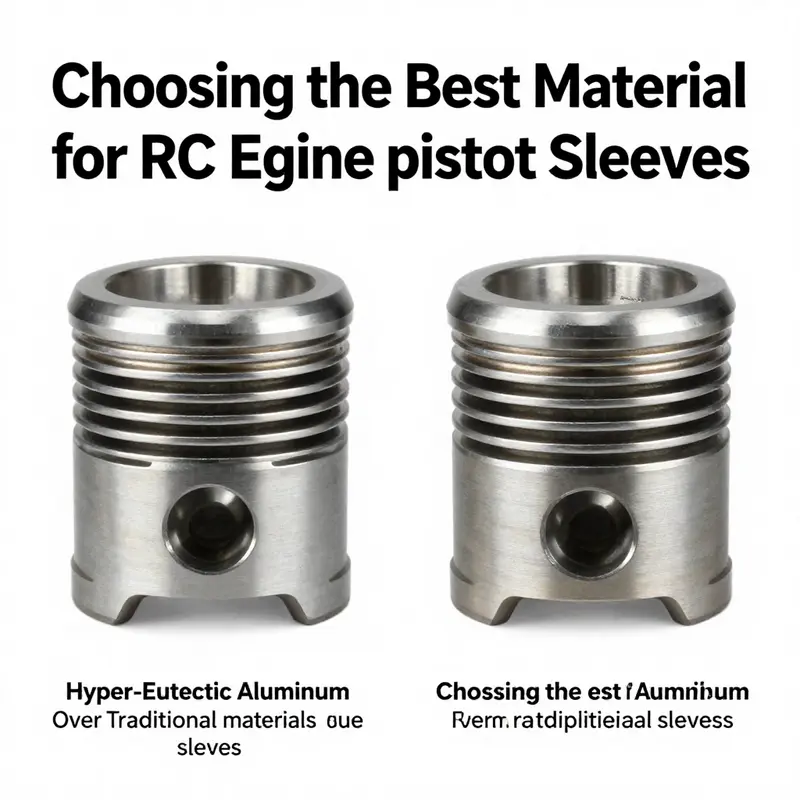
Why hyper‑eutectic aluminum outperforms older sleeve materials
Choosing the right piston sleeve material for an RC engine is not just a matter of tradition. Material selection defines how the engine breathes, heats, tolerates stress, and ultimately how long it lasts. Hyper‑eutectic aluminum has become the de facto standard in high‑performance RC builds for good reason. Its microstructure and bulk properties deliver a combination of low thermal growth, high wear resistance, and light weight that older sleeve materials struggle to match. This chapter explains, in practical terms, why hyper‑eutectic aluminum outperforms traditional options and what that means for engine behavior, maintenance, and design.
At the heart of the advantage is the material’s microstructure. Hyper‑eutectic aluminum contains a high fraction of primary silicon particles formed during solidification. Those hard silicon inclusions act like microscopic wear bars. When a piston slides, the silicon resists abrasion and reduces surface damage. The result is a cylinder surface that tolerates sustained friction with less material loss. In contrast, standard aluminum alloys lack that hard particle reinforcement, and steel or cast iron sleeves, while harder overall, bring heavier mass and different thermal behavior that can be detrimental in small, fast‑spooling engines.
Thermal stability is critical in RC engines because they operate at high temperatures and tight clearances. Hyper‑eutectic alloys have a lower coefficient of thermal expansion than conventional aluminum. That means the sleeve expands less as the engine heats. Smaller dimensional change preserves the engineered clearance between piston and sleeve. Consistent clearances reduce the risk of piston seizure under load and maintain predictable compression and sealing across temperature ranges. Heavier materials such as steel have different expansion profiles. They often require different design compromises and add rotating or reciprocating mass, which reduces responsiveness and alters tuning for small displacement engines.
Wear resistance and friction reduction are not only about material hardness. The silicon particles in hyper‑eutectic aluminum create a surface that works well with lubricants commonly used in RC engines. The hard particles support load, preventing rapid abrasive wear, while the aluminum matrix allows a controlled degree of conformability and texture. This combination helps oil films form and remain stable under transient conditions. The net effect is fewer wear‑related failures and longer interval maintenance cycles. Where standard aluminum would show rapid scuffing, the hyper‑eutectic sleeve retains geometry and surface integrity far longer.
Weight matters more in RC engines than in many full‑size applications. RC powerplants are designed to accelerate quickly and spin up to high RPMs with minimal inertia. Hyper‑eutectic aluminum keeps sleeve mass low without sacrificing fatigue strength. This superior strength‑to‑weight ratio enables lighter pistons and rings to be paired with the sleeve, reducing reciprocating mass and improving throttle response. In contrast, steel or cast iron sleeves increase mass and may necessitate compromises elsewhere in the engine to maintain balance and harmonic behavior. Designers and hobbyists who prioritize nimble performance consistently favor lighter materials that do not give up durability.
Thermal conductivity is another practical advantage. Aluminum conducts heat well, and while the silicon reduces conduction relative to pure aluminum, hyper‑eutectic alloys still remove heat from the combustion zone more efficiently than steel. Faster heat transfer helps keep peak temperatures lower and spreads thermal loads more evenly across the sleeve and surrounding structure. That moderates hot spots that can accelerate wear or cause local seizure. More even cooling also makes engine tuning more predictable; fuel and ignition settings that work in one run will likely be safer in the next, because the sleeve does not trap heat in the same way as denser materials.
Manufacturing and machining considerations also favor hyper‑eutectic aluminum for RC sleeve production. Casting processes for these alloys can be controlled to encourage the right size and distribution of primary silicon. Once cast and properly heat‑treated, the sleeves can be honed and finished with conventional tooling. The hard particles do increase tool wear during machining, but modern tooling and process controls handle this reliably. For small batch or hobby builds, the ability to cast or machine sleeves without resorting to exotic manufacturing steps keeps costs reasonable while delivering superior performance to standard alloys.
There are tradeoffs, and good choices always consider them. Hyper‑eutectic aluminum is more brittle than softer aluminum alloys. The silicon content makes the material less forgiving under certain impact or shock conditions. That is seldom a primary concern in controlled RC usage, but it does advise caution in designs where the sleeve would see strong mechanical shocks or improper assembly. Also, machining requires attention to avoid cracking or excessive tool wear. In practice, the durability and predictable thermal behavior outweigh these tradeoffs for most RC engine builders.
Another often overlooked advantage is consistency of tolerance over repeated thermal cycles. Because hyper‑eutectic aluminum expands less and retains hardness, clearance changes between piston and sleeve are minimal from the first warm‑up to subsequent runs. This stability reduces the need for constant re‑tuning and makes break‑in procedures more straightforward. A sleeve that maintains geometry keeps ring seating consistent and helps preserve compression. In competitive or tuned setups, that reliability translates directly into lap times and reduced risk of catastrophic failure during aggressive use.
Comparisons with traditional sleeve choices help put these benefits in perspective. Standard aluminum alloys tend to be lighter and easier to machine, but they lack the wear resistance and thermal stability of hyper‑eutectic variants. Steel and cast iron can deliver very high wear resistance, but they increase reciprocating mass and change heat transfer behavior. They often require additional engineering to manage expansion differences with the rest of the block. Hyper‑eutectic aluminum occupies a middle ground where reduced thermal growth, enhanced wear resistance, and low density produce a net performance advantage for RC engines.
In real‑world applications, such as turbocharged, supercharged, or high RPM engines, those advantages compound. Forced induction raises cylinder pressures and temperatures, amplifying the stresses on the sleeve. A material with strong wear properties and stable thermal behavior will resist dimensional drift and surface degradation under these harsher conditions. For high RPM designs, the low mass helps reduce inertial stresses and keeps balance issues manageable. The combined effect is longer life, more reliable performance, and less frequent rebuilds.
From a maintenance perspective, hyper‑eutectic sleeves extend service intervals. Reduced abrasive wear lowers the frequency of reboring or sleeve replacement. When service is required, machining processes are well established. The sleeve can be honed to restore surface finish without losing the inherent benefits of the silicon‑reinforced structure. Hobbyists and small shops gain an advantage because they can maintain performance without investing in heavy duty equipment or exotic treatments.
Finally, material choice should always align with the intended use. For casual, low‑stress models, nearly any reasonable sleeve material can work. For serious performance builds, however, hyper‑eutectic aluminum provides a clear technical edge. It brings a blend of low thermal expansion, durable hardness, excellent heat conduction, and favorable mass. Those traits support stable clearances, reduced wear, and responsive engine behavior. The result is a piston sleeve that protects the investment in tuning and delivers consistent performance across extended service life.
For readers who want a deeper dive into the material science and comparative studies on hypereutectic aluminum pistons and sleeves, the technical literature explores microstructure and performance in detail. See a focused review on hypereutectic aluminum piston materials for more scientific context: https://iopscience.iop.org/article/10.1088/1757-899X/1463/1/012044. For a practical primer on how sleeves function within engines, this page explains basic concepts of cylinder sleeves and their role: what are engine sleeves.
Choosing hyper‑eutectic aluminum for an RC piston sleeve is a decision rooted in measurable mechanical benefit. It reduces thermal risk, improves wear life, and helps keep engines light and responsive. For builders focused on longevity and performance, it is the smart material choice.
Final thoughts
Understanding the importance of material selection for RC engine piston sleeves is crucial for achieving optimal performance and longevity in your engine. Hyper-eutectic aluminum emerges as the superior choice due to its unique balance of low thermal expansion, high strength, and durability. By opting for this material, motorcycle and auto owners, along with parts distributors and garages, can ensure a quality performance in their RC engines. As discussed, the economic, manufacturing, and comparative benefits underscore the decisions that can lead to enhanced reliability and efficiency in engines, solidifying hyper-eutectic aluminum as a benchmark standard in the industry.