
327 cubic inch small-block Chevys are enduring icons for enthusiasts and pro shops alike. When a sleeving scenario targets a 3.736-inch bore, the question becomes not just a math problem but a matter of sleeve design, material integrity, and cost against reliability. Although 3.736-inch is smaller than the factory bore, sleeving discussions often focus on enabling safe overboring or repairing worn walls—yet this bore size challenges conventional expectations. This article links engineering fundamentals to shop-floor realities for motorcycle owners, auto owners, distributors, and repair shops. Chapter 1 tackles the technical feasibility and sleeve-design considerations for a 327 block at a 3.736-inch bore. Chapter 2 dives into material choices and wall-thickness limits that determine whether sleeving is appropriate or necessary. Chapter 3 weighs practical constraints, cost implications, and viable alternatives that fit business models while preserving safety and long-term reliability. Each chapter ties back to the central question, equipping decision-makers with a clear framework for evaluating sleeving projects in a real-world setting.
Undersizing for Precision: The Feasibility and Design Nuances of Sleeving a 327 Chevy to a 3.736-Inch Bore
The notion of treating a classic SBC 327 as a canvas for precision bore work can seem counterintuitive at first. A 3.736-inch bore is smaller than the factory size, yet the idea persists in certain high-precision builds: a bore that is intentionally reduced to align with a specific piston, ring package, or cooling strategy. This chapter explores what that entails, why someone might pursue a bore that sits beneath the stock dimension, and what it means for reliability, heat management, and long-term durability. Importantly, the conversation rests on one core point: sleeving to a smaller bore is not a standard “sleeve-up” modification. Instead, it is a bore-reduction scenario that uses carefully engineered sleeves to establish a precise, smaller cylinder diameter while preserving strength where it counts. To grasp the underlying logic, consider how sleeves are used when the goal is not to add material to increase bore size but to provide a stable, well-supported wall for a tighter bore than the original walls can safely support. This subtle distinction frames the feasibility discussion and guides the design choices that follow.
If one scans the landscape of engine work, the stock bore for a 327 Chevy is 3.875 inches. A bore of 3.736 inches, therefore, sits inside the original cylinder walls rather than outside them. The practical implication is clear: you are not looking to overbore beyond factory limits; you are targeting a tighter diameter. In most hot-rod or high-performance contexts, an undersized bore is pursued for reasons that do not center on raising displacement through bore growth but on achieving exact compression ratios, optimizing piston geometry for a given combustion chamber design, or accommodating a piston and ring package with compatibility constraints. When seen through this lens, sleeving to a smaller diameter becomes a highly targeted engineering decision rather than a routine machine shop operation. It benefits from the same rigorous planning and precision that characterize any bespoke engine build, yet it demands an explicit justification tied to the build goals.
One way to deepen understanding of the sleeving concept is to explore what sleeving means in general terms. A clear explanation helps differentiate between the conventional use of sleeves to tolerate oversize bores and the more specialized process of bore reduction. This distinction matters because the approaches, materials, and finishing steps shift as soon as the bore moves inward rather than outward. For a concise, technically oriented overview that clarifies the role of sleeves in engine blocks, see resources that discuss the fundamentals of sleeving and its implications for wall thickness, heat transfer, and seating integrity. What Sleeving an Engine Means provides foundational context about how sleeves are chosen, installed, and finished, which informs how a bore like 3.736 inches can be realized in practice.
Feasibility begins with the block itself. The key consideration is whether the cylinder walls and the deck surfaces can tolerate the precision machining required to establish a 3.736-inch bore without compromising structural integrity. Even though the final bore is smaller, the surrounding material must remain robust enough to resist the stresses of operation, including hoop stresses from pressure during combustion, thermal cycles, and the mechanical loads of higher-performance components. In a typical 327 block, solid wall thickness around each bore provides a reasonable margin for various overbore scenarios. When the bore is reduced, that margin is not inherently jeopardized; rather, the concern shifts toward achieving a perfectly concentric bore and ensuring the sleeve, if used, seats flush with the deck and aligns with the main bore axis. Precision is non-negotiable here because even minute misalignment translates into ring seal issues, improper piston travel, or accelerated wear.
From a materials perspective, the sleeve choice remains central to success. For bore-reduction applications, sleeves are selected not only for compatibility with a smaller diameter but also for their ability to transfer heat efficiently and resist deformation under load. Ductile iron sleeves have historically been a reliable choice in many small-block contexts; hypereutectic alloys are another option, offering dimensional stability and good wear characteristics. The sleeve’s external geometry must mate with the block’s bore surface, and the interior bore must be honed to the exact final diameter. The process requires careful balancing of interference fit, seating depth, and the required surface finish. In a well-executed design, the sleeve becomes part of a unified assembly that supports a precise, stable bore while maintaining the integrity of the water jacket and cooling passages. The aim is not merely to create a smaller hole but to sustain mechanical reliability under all operating conditions.
The installation method is equally critical. Sleeves can be pressed into the block or bonded, depending on the sleeve design and the engineering goals. A press-fit approach provides a straightforward mechanical hold, but it demands exact tolerances and clean, square seating surfaces. Epoxy bonding, where approved, offers additional locking characteristics, but it also introduces considerations about curing, heat cycling, and long-term bond stability. The choice of method shapes subsequent steps, including how the sleeve is aligned with the crank’s axis and how the deck surface is prepared for a true, round bore once the sleeve is seated.
Alignment and finish emerge as the next essential frontier. After seating, the assembly must be checked for concentricity between the sleeve bore and the crank’s main bore axis. Any deviation can compromise piston ring sealing and lead to uneven wear. Once alignment passes, the final bore is honed to the requested 3.736 inches with a surface finish appropriate for ring seal and compression. The finishing step is more than cosmetic; it defines how the rings will seal against the bore, how oil clearance will behave under load, and how consistent friction will be across a wide range of engine speeds. For precision work of this kind, the finish must be controlled, repeatable, and compatible with the chosen piston rings and their end gaps. The final dimension is not just a geometric target; it is a functional interface that determines compression characteristics and engine breathing in a narrow window of operation.
Compatibility with downstream components also bears emphasis. In a bore-reduction scenario, pistons, rings, and wrist pins must be coordinated with the final bore size. Off-the-shelf piston sets designed for standard small-block configurations may not align with a bespoke 3.736-inch bore unless they are specifically designed for that diameter. This means a build plan must include detailed piston-ring package selection and precise piston weight and skirt clearance considerations to maintain quiet operation, proper piston stability, and reliable ring seal. The consequence of neglecting this compatibility check can be misalignment at top dead center, unpredictable combustion chamber behavior, or accelerated wear. The path to a successful result weaves together the bore’s precision, the sleeve’s integrity, and the complementary performance attributes of the piston and ring set.
Design and process workflow unfold as a coordinated sequence rather than a single magic step. First, a block viability assessment is performed: wall thickness, deck condition, and cooling channel integrity are measured with high-precision instruments. If the block passes this viability screen, the next step is sleeve selection, where material type, interference fit, and seating method are chosen in light of intended operating conditions—street, race, or high-load street performance. Preparation and machining then follow: the block is cleaned, surfaces are scribed, and any material that could contaminate the bond is removed. Sleeve installation proceeds with strict control of tolerances to ensure the sleeve sits evenly and the bore remains perfectly true. After seating, a verification phase checks alignment and the sleeve’s seating depth, while the deck surface engages in a final surface/face finish to accept the final bore. The bore is then honed to the exact 3.736 inches, with a finish grade that supports optimal ring seal yet minimizes friction. Validation testing—ring end gaps, bore roundness, and skirt clearance under simulated load—closes the loop, ensuring the assembly will behave predictably under dynamic operation.
For builders who pursue this path, the practical implications are clear. The work is intricate, time-consuming, and expensive relative to conventional overbore procedures. The added complexity stems from the need to achieve not only a precise final bore but also robust sleeve seating, impeccable alignment, and tight tolerances that tolerate the engine’s thermal and mechanical cycles. A reputable machine shop with documented experience in small-block sleeves becomes a critical partner. The costs reflect both the specialized tooling and the extended engineering time required to confirm compatibility with pistons and rings, to verify the sleeve’s long-term stability, and to guarantee that heat transfer remains adequate across the block’s cooling circuit. The result, if achieved with discipline, is a bore that reliably meets a specific performance target while preserving the long-range durability of the block—and that, in turn, supports a broader design strategy that may emphasize precise compression ratios, tailored combustion chamber dynamics, and compatibility with a specific breathing system.
From a thermomechanical standpoint, sleeve selection and bore precision also influence cooling and heat transfer. A sleeve that conducts heat poorly can create hot spots around the cylinder’s outer edge, inviting distortion and fatigue after repeated heavy use. Conversely, an appropriately chosen sleeve material paired with a well-designed cooling path supports stable temperatures and consistent lubrication performance. Temperature uniformity across the bore is not a mere technical nicety; it anchors the engine’s reliability envelope. In a smaller bore like 3.736 inches, where the ring travel and piston mass are tightly coupled to the bore, maintaining thermal consistency becomes even more pivotal. This is where the interface between sleeve design, coolant routing, and deck surface finish matters. Even small deviations in material properties or fitting depth can ripple through the engine’s breathing characteristics, influencing ring gaps and the engine’s propensity to detonate under compression. In practice, the build must harmonize all these variables, recognizing that the bore is a fundamental datum around which the rest of the engine’s performance is choreographed.
In practical terms, pursuing a 3.736-inch bore in a 327 hinges on clear objectives. If the aim is to address cylinder-wall wear or to align with a very specific piston-and-ring package, bore reduction with a sleeve can be a legitimate solution. If the goal is purely displacement increase, this approach is unlikely to be advantageous; increasing displacement typically involves overboring beyond the stock diameter, not reducing it. Conversely, if the engine’s cooling capacity or deck surface preparation has shown vulnerability in the past, a sleeve strategy can contribute to a more robust, controlled cylinder environment. Each decision—whether to sleeve, which materials to use, how deeply to seat the sleeve, and how to finish the bore—should be anchored in a detailed build plan that accounts for torque loading, combustion chamber geometry, and the target operating regime. In this sense, the bore’s final diameter becomes one element of a larger design symphony rather than the sole focal point.
Finally, it is essential to connect these technical strands to the broader practice of engine building. Sleeving a 327 to a 3.736-inch bore sits at the intersection of precision machining, material science, and performance engineering. It demands a disciplined approach, a clear justification grounded in the build’s goals, and a partnership with a machine shop that can translate the concept into a reliable physical reality. While not a common route for everyday performance upgrades, it remains a viable path when the specific constraints of a build require a tighter bore and a controlled mechanical environment. For readers seeking a concise gateway to the conceptual framework behind engine sleeving, it is helpful to reflect on the general principles of sleeve design, the balance of wall strength and heat transfer, and the meticulous nature of alignment and finishing. In other words, the feasibility of a 3.736-inch bore for a classic SBC 327 is less about a single machining trick and more about a disciplined synthesis of materials, measurements, and methodical execution that keeps the engine reliable under the exacting conditions of its intended use. The result is not just a smaller hole, but a carefully engineered intersection where form meets function, and where precision supports performance in a lasting, meaningful way.
External reference for broader context: Chevrolet Performance – Engine Building Guide
Chapter 2: The Fine Print of Sleeving a 327 Chevy — Material Choices and Wall-Thickness Realities
Discussions about reviving a classic small-block like the 327 often circle around one big lever: the bore. The instinct is to chase more displacement, higher compression, or improved reliability through meticulous restoration. Yet when you poke into the mechanics of sleeving a 327, the conversation becomes a careful balance of material science, geometry, and the realities of a block that wore its original temper well. The 327’s lore invites enthusiasts to chase the most efficient path to power without surrendering the engine’s durability. In that spirit, this chapter approaches sleeving not as a hack but as a disciplined negotiation with wall thickness, sleeve material, and the cooling system’s interface. It also clears up a common point of confusion: a bore of 3.736 inches is, on the face of it, smaller than the factory bore for the 327, which is typically listed around four inches. If the goal is truly to reduce the bore to 3.736 inches, sleeving becomes unnecessary and the project’s motivations may lie elsewhere—such as plugging core shifts, repairing damaged walls, or re-surfacing an old block before a rebuild. If, instead, the aim is to increase the bore beyond the factory size, sleeving becomes a plausible route, but only with a sober eye to wall thickness and sleeve selection. The practical message, therefore, begins with aligning intention and engineering reality.
When a builder encounters a bore target that sits below stock, the immediate takeaway is simple: you don’t typically sleeve a hole to a smaller diameter. Sleeving is invoked when the cylinder walls cannot safely support a larger bore because the remaining wall thickness after overboring would fall below a critical minimum. In the context of a 327, the official bore is commonly cited as 3.875 inches, and many blocks carry a standard wall thickness that varies with casting year and production tolerances. Working from that reference, a bore of 3.736 inches would, in effect, be a reduction. In practice, it would sidestep the mechanics that sleeving is designed to address. The practical implication for a builder is to confirm the actual stock bore, measure the current wall thickness, and verify whether there is any legitimate objective behind shrinking the bore. If the objective is increased displacement, then the next questions begin: how large a bore is feasible without compromising structural integrity, what sleeve material best resists the demands of the intended use, and what walls remain after the bore to water jacket are accounted for.
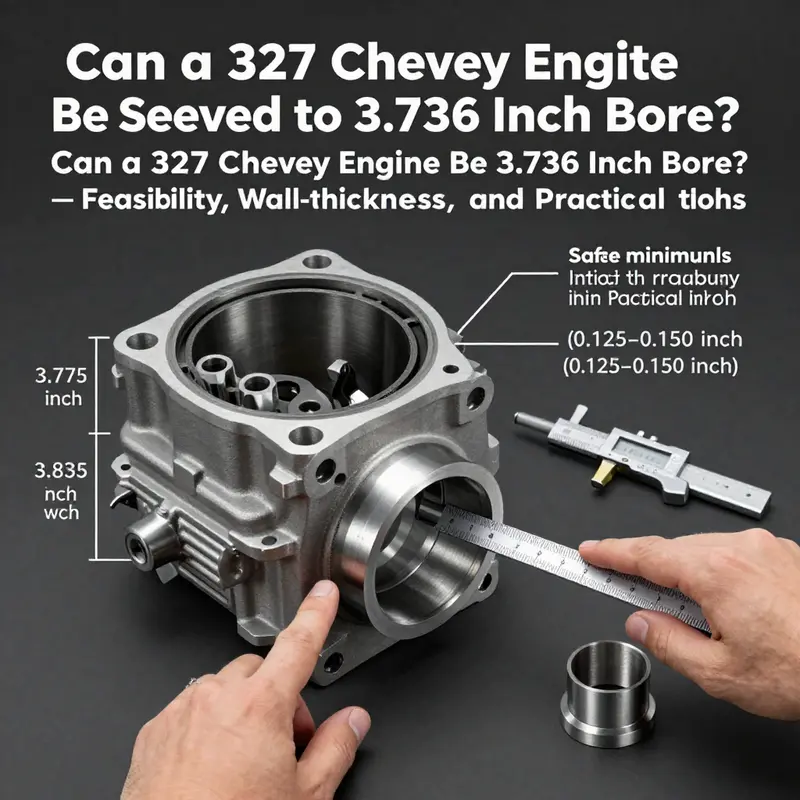
For anyone who intends to increase the bore, even modestly, the logic is straightforward: once you remove more metal from the cylinder to achieve the larger diameter, the remaining thickness of the cylinder wall between bore and the exterior water jacket becomes the critical parameter. This is where sleeving often enters the conversation. The basic physics are simple: a thicker, more robust wall can better resist the combined forces of pressure, heat, and vibration. A thinner wall is more prone to distortion, micro-cracking, or even cracking if the block is subjected to high combustion pressures or elevated boost. The rule of thumb many machine shops apply is to preserve a minimum wall thickness in the neighborhood of roughly 0.180 to 0.200 inches for a reliable street or lightly boosted build, with taller margins required for higher boost or race conditions. That guideline is not a hard law; it is a practical boundary that takes into account alloy quality, the block’s casting integrity, cooling efficiency, and the sleeve’s ability to transfer heat away from the bore.
To ground the discussion in geometry, imagine the bore as a cylindrical cavity bounded by the original iron of the block and, if sleeved, by the sleeve that sits inside that cavity. If you plan to bore from 3.875 to 3.900, you would remove roughly 0.025 inches from each side in a typical house-keeping operation. If you push toward 3.940, you might be removing about 0.0325 inches per side. Each fraction sounds small, but across all four cylinders it compounds into a meaningful drop in wall thickness. A careful measurement of the remaining material, especially near the water jacket, is essential. When overboring approaches the lower edge of the safe range, the sleeving option becomes not merely prudent but necessary. In some blocks, even a modest overbore to 3.900 or 3.940 can demand a sleeved solution if the bore is too close to the jacket or if the core shift and taper around the cylinder’s bottom compromise integrity after rough cleaning and honing.
The endgame for wall thickness is not only a function of the bore size. It is also a function of the sleeve’s material properties and its fit. Here, the conversation turns to sleeve materials. The most common choices for performance-minded builders are ductile iron sleeves and steel sleeves, each with distinct benefits and challenges. Ductile iron sleeves offer good wear resistance and compatibility with aluminum and iron blocks alike, with relatively forgiving machinability. Steel sleeves, while potentially stiffer and more wear-resistant in extreme conditions, require precise interference fits and careful control of thermal expansion. The sleeve’s outside diameter and its inside bore must be machined with tight tolerances to ensure a uniform wall thickness around the circumference. The goal is a symmetrical bore with a consistent finish that will hold lubrication, resist heat cycling, and maintain a seal against the head and deck surfaces.
As part of the sleeving decision, a critical distinction must be made between wet sleeves and dry sleeves. Wet sleeves extend into the coolant passages, and their compatibility with the block’s cooling system is a factor in heat transfer and long-term durability. Dry sleeves, on the other hand, sit behind an insulated jacket and rely on an external seal to keep coolant away from the sleeve. Both approaches have a place in the rebuild toolbox, but the choice carries implications for servicing, coolant management, and the sharing of heat between sleeve, coolant, and the block walls. The right choice depends on the block’s original architecture, the anticipated operating environment, and the builder’s comfort with the machining required to install the system smoothly.
To make sense of all these moving parts, one must examine the practical workflow in a responsible machine shop. The process begins with a precise cylinder bore measurement, usually using a bore gauge and micrometer to establish the current diameter and the wall thickness. Then the bore is overlaid with a protective finish that defines the final target size. If the target is larger than the stock bore, the machinist evaluates whether the wall remaining around the bore will be robust enough after overboring. If not, sleeving is proposed. The sleeves are selected based on material, weight, thermal conductivity, and the engine’s eventual operating regime. The sleeves are then pressed or interference-fit into the cylinders, depending on whether wet or dry sleeves are used, followed by machining operations that include locating the sleeve with the correct wall thickness, truing the sleeve-absent surface, and honing the new bore to a precise final diameter. The result must be a uniform, straight, and well-seated cylinder that has reliable concentricity and plating around the entire circumference. Any deviation here can produce out-of-round conditions that stress the piston rings and impact compression sealing. This careful sequence underscores why overboring beyond the original limits is not a casual undertaking; it is a task that demands accurate measurement, vetted materials, and a facility that can deliver consistent tolerance control.
In this light, the specific question of a 327 sleeved to a 3.736-inch bore reads as a test of interpretation. If the bore target truly sits at 3.736 inches, that is smaller than the factory bore and would seldom be pursued as a performance upgrade. Sleeving would not be the tool to achieve it; rather, it would be a matter for the block’s basic repair or a different modification path, such as a cleaning, surface restoration, or a very careful line-bore to address alignment issues. When the intention, however, is to push the bore outward to a larger size—for example toward 3.900, 3.940, or even 4.000 inches—the sleeve becomes a central component of the plan. In that path, the wall thickness and sleeve material dominate the project’s success. A thick-walled, well-bonded sleeve can maintain strength at higher pressure and temperature, whereas a thin-walled sleeve or a sleeve of marginal material risks failure under engine load, especially when operating at high RPMs or with boost, where the pressure spikes and thermal cycling intensify the demands on the bore wall.
The practical takeaway for builders who want to know where to start is simple: measure first, then model the outcome. If the measured wall thickness after potential overboring comfortably sits above the conservative minimum, sleeving may not be required. If the wall is thinner than the safe threshold, or if the desired bore size robustly exceeds the current wall’s capacity, plan for sleeves from the outset. In all cases, insist on high-quality sleeves and a shop with demonstrated competence in sleeved blocks. This is not a gamble with a classic; it is a careful engineering decision that governs reliability, longevity, and the engine’s behavior under load.
For readers who want a grounded, practical explanation of sleeving, a concise way to think about it is this: sleeving is a structural upgrade for the cylinder. It adds material where the original casting provides too little to support an enlarged bore. It also creates a more uniform thermal path and can reduce the risk of crack propagation around the bore. The goal is to maintain concentricity, minimize distortion, and preserve the water jacket’s integrity while delivering a bore that suits the build’s aspirational performance. In plain terms, it is about turning a worn cylinder wall into a controlled, reinforced channel that can sustain higher pressures and heat without surrendering durability.
With that frame in place, it helps to connect the understanding of sleeving with the practical literature that guides engine builders. One accessible way to grasp the concept is to read about what sleeving an engine means and how it is approached in modern machine practice. This resource provides a grounded explanation of material choices, fit, and the interplay between bore size and sleeve geometry, which is essential when planning a 327 build that seeks to exceed stock displacement without compromising reliability. What sleeving an engine means offers a concise primer on the core considerations that underpin successful sleeving projects, from wall thickness to sleeve-to-block interface. This background helps anchor the discussion here and emphasizes the importance of a measured approach rather than a speculative one.
As you weigh the options for a 327, a few practical guardrails help keep the project on track. First, verify stock bore dimensions and actual wall thickness with a trusted machinist. Second, if the objective is to increase bore size, assume a modest target first—perhaps 0.020–0.040 inches over stock—and assess the wall you have left. Third, if the wall thickness after overboring would dip below a robust safety margin, proceed toward sleeving and select a sleeve material appropriate to the block’s alloy and intended use. Fourth, decide early whether you will run a wet-sleeve or dry-sleeve configuration and plan coolant and sealing strategies accordingly. Fifth, remember that the block’s core integrity, timing cover, deck, and cylinder alignment all contribute to the final engine’s behavior; these aspects must be checked and corrected as needed to achieve true reliability in service.
The overarching aim is not to chase numbers in isolation but to ensure the final bore, wall thickness, and sleeve configuration cohere with the engine’s operating context. A 327 that wears its walls thin or suffers from core shifts can respond poorly to high RPM, heavy load, or forced induction. By rooting the decision in measured wall thickness and appropriate sleeve selection, you set the stage for a durable rebuild that preserves the block’s character while delivering the reliability builders expect when increasing displacement. While the bore target of 3.736 inches may not necessitate sleeving, the broader logic—measure, model, and match material to application—applies to any overbore, and it remains the central discipline of meaningful engine enhancement.
In sum, sleeve decisions hinge on the actual wall thickness that remains after any intended overboring, the sleeve material’s properties, and the intended application’s demands. If you are curious about the fundamental concept of sleeving and how it relates to the 327’s architecture, consider the concise explanation linked above. It distills the core mechanics of sleeving into a readable primer, helping you translate specification sheets into a practical plan for an authentic yet fortified rebuild. For a deeper dive into the technical side of sleeve selection and installation practices, consult a trusted technical resource that outlines the material, wall-thickness requirements, and installation considerations for iron-block sleeves. This guidance helps bridge the gap between theory and a robust, reliable engine build that honors the 327’s legacy while embracing modern engineering standards. External resource: https://www.summitracing.com/technical/articles/engines/sleeve-selection-for-iron-blocks
Rethinking the 3.736 Bore: Practical Limits, Costs, and Realistic Paths for a 327 Chevy
The question of whether a 327 Chevrolet engine can be sleeved to a 3.736-inch bore invites a broader conversation about what sleeving actually accomplishes, what the block structure can support, and where the real value lies for a classic small-block. On the surface, the inquiry seems precise enough: can you sleeve a 327 to a 3.736 bore? Yet the practical implications ripple through every stage of the build. The short answer, grounded in engineering realities and field experience, is nuanced. A 3.736-inch bore is smaller than the stock bore of a 327, which is 3.875 inches. In that sense, this specific bore target does not require sleeving to increase bore size; it would instead be a reduction in bore. But the real engineering and project decisions revolve around either preserving the original bore size, increasing it safely via overboring with or without sleeves, or choosing an alternative path that yields more meaningful gains with fewer risks. As with many classic iron-block projects, the path chosen depends on the intended use, the block’s current condition, and the budget available for a project that must endure the punishment of spirited driving or competition without sacrificing reliability.
In a modern engine-building mindset, the core issue is wall thickness and the potential loss of strength as you alter the cylinder bore. The 327’s cast-iron block was designed around the stock bore—3.875 inches—with a specific clearance between the bore, the water jackets, and the exterior walls. If the plan is to push the bore outward, even by a small amount, the wall thickness between the bore and the exterior surface becomes a critical factor. Sleeving, in many builds, is a technique used when the block must be overbored beyond safe local wall thickness or when a worn cylinder wall cannot support the intended diameter. Yet sleeving is not a universal remedy. It carries its own set of risks, precision requirements, and costs, all of which must be weighed against the expected performance gains.
While the lore around sleeving often centers on the possibility of increasing displacement, the practical gains from moving from a 327 to a larger bore are modest unless paired with a proportional strategic upgrade elsewhere in the engine. For a 327, a typical route to meaningful power is not simply widening the bore; it is choosing a broader strategy: better pistons, optimized compression, improved intake and exhaust flow, and a robust, well-cooled block. The math of bore increase must always consider wall thickness. A common rule of thumb is to maintain at least 0.125 to 0.150 inches of wall material between the bore and the exterior or water jacket when overboring. In a relatively slender section of a vintage small-block, shaving even a few thousandths from the cylinder wall can erode strength around combustion pressures. Ceiling and inter-cylinder reliability can hinge on that small margin. The result is a balancing act: you want more displacement and power, but you cannot ignore the structural envelope of the block.
The 3.736-inch bore target, as a concept, sits in an unusual space. It is smaller than stock, which already makes it an atypical choice for performance tuning. If the goal is to reclaim a worn bore or to reduce bore size for a different compression or sealing strategy, that may be a legitimate workflow in a very specific restoration or budget-constrained project. However, for those seeking noticeable, durable power gains, this bore is not a lever that reliably delivers better performance. The more common and effective path tends to be either staying at or near factory bore sizes or stepping up to a larger bore where the block can safely support it, often with sleeving as a controlled, engineered solution when the geometry demands it.
To appreciate what sleeving actually involves, it helps to visualize the core constraints. The cylinder wall is not an isolated ring; it is one wall of a multi-layered system that includes the coolant jacket, the deck, and the integral lattice that carries the combustion pressures out of the head and into the block. When you overbore or sleeve, you are reconfiguring this delicate system. A sleeve must seal against the bore with precision interference fit and be properly anchored to the parent block so that differential thermal expansion does not create leaks or stress concentrations. The sleeves themselves can be made of steel, iron, or specialized alloys, each with its own machinist’s tolerances and heat-treatment considerations. The process requires meticulous block preparation, precise boring to exact dimensions, careful alignment, and a testing protocol to confirm that the deck surface remains true under pressure and heat.
The structural concerns around sleeves grow when you consider adjacent cylinders. A frequently discussed caution is that sleeves in neighboring bores can transfer or concentrate stresses in the deck area between cylinders. If the roof of the block or the deck becomes compromised in any way, head gasket sealing can suffer, coolant flow patterns may be disrupted, and overall rigidity can be undermined. In a block with tight packing of cylinders, even small misalignments or mismatches in sleeve diameter can propagate into headaches with head-gasket sealing and leak paths. This is not a universal verdict on sleeving, but it is a reminder that any such modification should be undertaken with a thorough plan and a reputable, experienced machinist who understands the idiosyncrasies of small-block Chevys.
From the machining and installation standpoint, sleeving a 327—or any vintage block—demands a high level of precision and a willingness to invest in the necessary equipment and workflow. The preparation work includes verifying deck flatness, ensuring the bore centers are true, and confirming that the sleeves will sit at the correct height relative to the deck and head surface. The installation process involves achieving a clean, burr-free bore, an appropriate interference fit for the sleeve, and a reliable seal against the block’s coolant passages. The final assembly must pass a pressure test and a leak test before it is ever started under power. These steps are not merely formalities; they are the difference between a durable, reliable engine build and a project that yields a few miles of fun before requiring costly reseal work.
Cost considerations follow a similar arc. The expense of sleeving can vary widely, driven by the sleeve material, the extent of block preparation, and the shop’s labor rates. In some cases, the total can be several hundred dollars, while in more involved builds it might exceed a thousand. The incremental displacement gained from a sleeved bore is often modest, particularly when the bore target remains near stock. For a 327, moving the bore out to roughly 3.940 inches can yield a few cubic inches more per cylinder, translating into a few extra horsepower at the crank. But that gain is not linear with the investment. When you factor in the risk of heat management challenges, potential leakage, and the need for additional strengthening or redesigns of ancillary systems (valvetrain, cooling, lubrication), the bottom line becomes clear: the financial and logistical costs can dwarf the incremental power benefit.
Practical alternatives frequently emerge as more attractive. If the objective is higher displacement, many builders gravitate toward a modern, stronger block in the same family—bumping to a 350 or 383 cubic inch variant, or swapping to a crate-style engine that benefits from modern casting techniques, stronger cast iron, and better overall block rigidity. These options deliver clearer, more predictable performance gains with a lower risk profile. They also preserve the reliability and cooling characteristics that classic small-block fans often want, while avoiding the more fragile deck and wall dynamics of a re-sleeved 327. In other words, there is a reason the industry trend has leaned toward upgrading to larger displacement blocks rather than pursuing aggressive sleeving of a smaller, older design.
From a performance perspective, the marginal gains of sleeving a 327 to 3.736 inches are not compelling when weighed against the effort. The bore itself is not a lever that delivers reliable performance improvements when the bore is reduced. If the aim is more torque and horsepower, the sensible route is to improve breathing and reliability through a combination of higher-flow heads, optimized intake, exhaust routing, and a robust bottom end that can handle higher power with efficient cooling. If a larger displacement is essential, a modern approach is to move to a bigger-block or a larger-stroke, high-compression short-block that is designed to tolerate the higher pressures and temperatures of a performance setup. This is where the practical, real-world strategy often diverges from the theoretical possibility of sleeving.
For those who want to anchor their build with a better understanding of what sleeving entails, a concise explainer can set expectations about the process and limitations. What are engine sleeves? is a crucial reference point in this discussion, and exploring it helps to demystify the engineering behind sleeving. This resource can provide a high-level view of why sleeves are used, how they are installed, and the kinds of materials and tolerances involved. It is not a substitute for a skilled machine shop’s assessment, but it helps frame the decision-making process for enthusiasts who must balance budget, risk, and ambition. What are engine sleeves? Meanwhile, the practical conclusions from the body of experience suggest a tempered approach: sleeving a 327 to a 3.736 bore is not a typical or recommended target for performance, and if an overbore or sleeving strategy is being considered, the driver’s goal should be to maximize reliability and power within a well-supported plan that respects the block’s structural limits.
The overall conclusion, then, is clear but nuanced: sleeving a 327 to a 3.736-inch bore is technically possible only under exceptional circumstances and with a high level of expert craftsmanship. It is not the recommended path for most builders seeking meaningful, durable performance. For most enthusiasts, the wiser approach is to consider a more robust block or to step up to a larger displacement engine with proven reliability under the stresses of spirited driving or competition. This route aligns better with the realities of block geometry, sleeve integrity, and cooling performance, and it tends to deliver power with a clearer maintenance and service path. In the end, the question morphs from a simple measurement into a broader decision about how to balance risk, cost, and capability in a classic engine project.
For readers seeking additional perspectives beyond this chapter, historical discussions and practical threads provide context on the durability concerns that arise with sleeved blocks. A cautionary note from a long-running discussion highlights the structural limitations when sleeves are applied across adjacent cylinders and how that can affect deck rigidity and sealing. This serves as a reminder that engineering judgments in vintage builds must be anchored in validated dimensions, careful measurement, and a willingness to adjust plans when mirror-checks reveal risk. If you’re curious about these in-context discussions, you can explore the historical dialogue in public forums where builders share their firsthand experiences and the lessons learned from sleeving attempts. As a reminder, always consult with a trusted machine shop that specializes in small-block Chevys and has a track record with sleeved builds, and reference authoritative guidance on engine building from trusted sources.
In summary, the specific target of a 3.736-inch bore for a sleeved 327 is not a practical or common improvement path. It sits outside the typical overbore range where sleeving proves most valuable, and it does not align with the performance priorities that typically drive a rebuild—from reliability and cooling to horsepower and efficiency. If the aim is to gain displacement or power with a robust, reliable foundation, the field-tested route is either to preserve the factory bore and extract more from the top end and breathing, or to move to a larger-displacement block that was designed to handle higher output. The decision should be grounded in a careful assessment of wall thickness, deck integrity, sleeve fit, and the total maintenance envelope. In the end, the engine that is easier to live with, and that delivers the desired performance consistently, is often the engine that was chosen to be built in the first place—with a plan that respects the geometry and material realities of the block rather than bending them to fit a preferred bore size.
External reference: For a broader engineering perspective on sleeving and related block integrity considerations, see a historical discussion thread that illustrates the kind of caution exercised in real-world projects. https://www.stangnet.com/forums/showthread.php?t=94237
Final thoughts
The 3.736-inch bore target for a 327 Chevy engine sits outside typical overboring norms, and sleeving to this dimension requires careful assessment of wall thickness, sleeve material, and the intended use. For motorcycle and auto owners, repair shops, and parts distributors, the key takeaways are to verify actual wall thickness after preliminary boring calculations, select proven sleeve materials and interference fits, and weigh the total cost of machining, inspection, and reliability. When in doubt, consider safer near-stock bore options or a thoughtfully planned stroked displacement path that aligns with performance goals and long-term durability. By applying the technical framework laid out in the chapters, shops can make informed decisions that balance risk, performance, and profitability.