
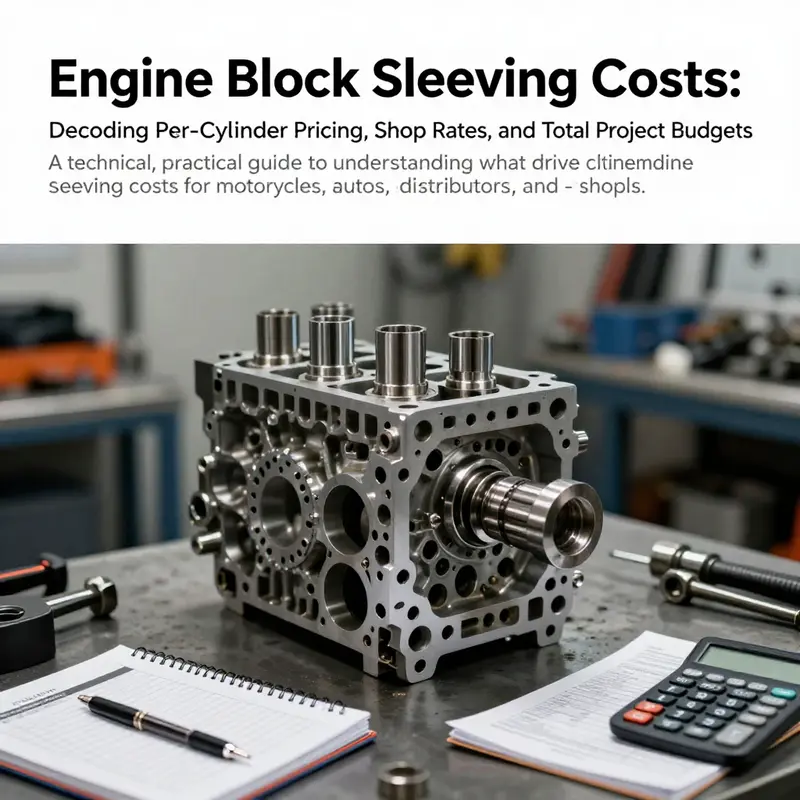
Engine block sleeving is a precision repair option used when cylinders are damaged beyond simple honing. For both motorcycles and automotive engines, sleeving can restore bore integrity, extend engine life, and support higher-performance builds, but it comes with a price tag that varies widely. Key drivers include sleeve material (cast iron vs steel), bore size, block condition (cracks, porosity, cavitation), the number of cylinders needing sleeves, and the shop’s labor rate. Typical ranges show a per-cylinder cost around $200–$400 for the sleeve and installation, with total block projects commonly $200–$500 or more per block when you factor in sleeves, deck resurfacing, boring, honing, and related machining. Vendors may offer kit-based pricing or bundled services, which can reduce the bill when buying sleeves and hardware together. The five chapters that follow break down the price structure, the factors that influence the final quote, and practical steps to obtain accurate estimates from reputable machine shops. By the end, you’ll understand what drives sleeving costs and how to plan a project that matches your engine goals and budget.
Cost Consequences: Understanding the Price Range and Drivers for Sleeving an Engine Block
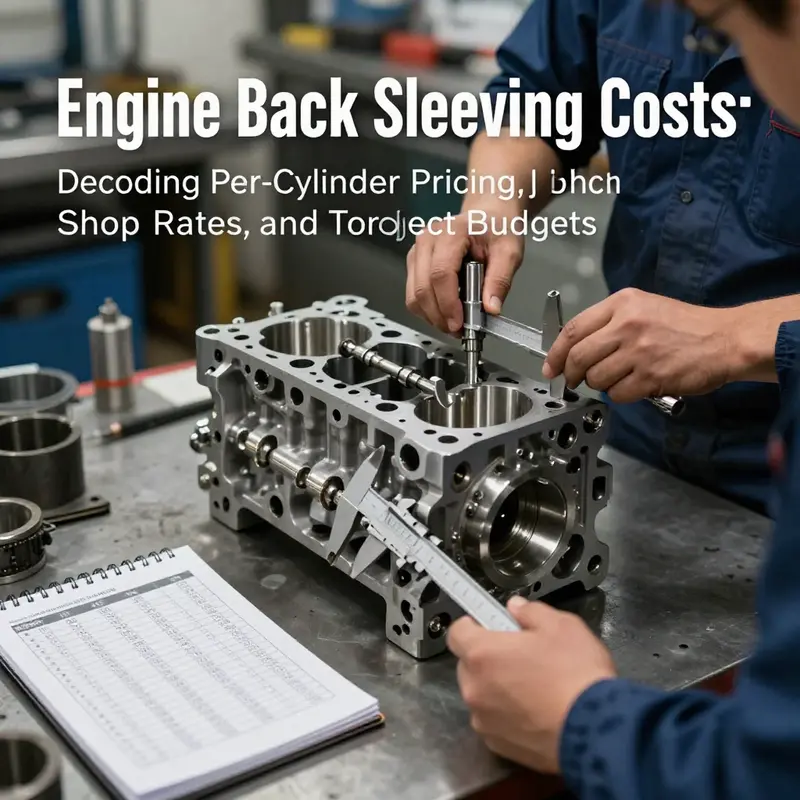
Sleeving an engine block is a repair method aimed at restoring cylinders that have worn beyond simple honing or suffered damage that can no longer be safely corrected with standard boring. The process centers on replacing or lining the affected cylinders with sleeves, then preparing the bore to the piston specifications. It is a precise, labor-intensive operation that hinges on the engine’s design, the material chosen for the sleeves, and the shop’s access to specialized tooling. Across the market, prices can swing widely. Some jobs that involve only basic sleeving on a straightforward cast iron block can be comparatively modest, while others—especially when aluminum blocks, high-performance builds, or complex alignments are involved—can push the total well into multiple thousands. The variability is not a sign of inconsistency so much as a reflection of the many moving parts that define a sleeving project. The cost is not a single line item; it unfolds as a combination of material, machining, and meticulous fitting that must be tailored to a specific engine family and its operating goals.
A useful way to frame the conversation begins with general price ranges, which help set expectations before a shop assesses a block in person. On the lower end, a basic sleeving job on a standard cast iron block—which typically means removing minor wear, installing sleeves, and performing the essential machining to ensure a proper fit—can fall into a broad range that includes engine models with modest bore work. Early industry snapshots and current shop practices place these projects roughly around eight hundred to one thousand five hundred dollars per block. The lower end assumes a relatively straightforward bore, dry or conventional sleeves, and no unusual block defects. It also presumes the block is in decent condition aside from cylinder wear rather than structural issues. The price climbs quickly if the block is cracked, has porosity, or cavitation erosion that needs cleanup before sleeves can be installed. In those cases, the preparation steps require more time, and the bill grows accordingly.
For aluminum blocks, sleeving is distinctly more intricate. Aluminum’s properties demand careful handling to preserve tolerances and heat transfer characteristics. The cost range for sleeving aluminum blocks is typically higher, reflecting the added precision and sometimes specialized materials or liner techniques. Real-world estimates place aluminum sleeving in a roughly two-tier band: around fifteen hundred to three thousand dollars for many standard applications, with higher numbers for complex or high-performance builds. The higher price often correlates with the need for precise liner fits, additional surface treatments, and extended machining to maintain correct deck heights and bore alignments. These jobs are not purely about inserting a sleeve; they require a coordinated sequence of boring, honing, and sometimes deck resurfacing to ensure the final bore is truly square and concentric with the crank centerline.
Beyond these base ranges, the most demanding projects can push well past four thousand dollars. High-performance or custom sleeving often involves bespoke sleeve configurations, multiple alignments, and CNC-assisted machining. In such cases, the goals are not only restoring bore integrity but also optimizing the engine for peak efficiency, durability under high power, or specialized tolerance stacks that accommodate oversized pistons, tight turbo clearances, or unique piston rings. When a build aims for consistent performance under stress, shops may employ thicker or steel-lined sleeves, more rigorous inspection cycles, and additional testing phases. Each of these steps adds time and material costs, and the final price reflects the cumulative impact of every added operation.
The big picture hinges on a handful of cost drivers that recur across many sleeving projects. The first is the block condition. A block with cracks, porosity, or cavitation erosion often requires substantial upfront repair work, welding, core drilling, or structural reinforcement before sleeves can even be installed. This prep work adds not only direct labor but also the risk that the project will uncover further defects once work begins. The second driver is material choice. Cast iron sleeves are the most common, but some engines benefit from steel-lined sleeves or, in rare cases, specialty liners designed for extreme service. Aluminum blocks demand liners or carefully engineered sleeves due to heat management and the need to preserve weight and tolerances. The third driver is labor rate and regional cost variance. Shops in major metropolitan areas or regions with higher living costs typically bill more per hour, and the time required for precision sleeving is a fixed quantity of meticulous labor. The fourth driver is engine type and complexity. A high-performance V8, a turbocharged mill, or a compact diesel often requires tighter tolerances, more exacting bore finishes, and additional inspections, which all translate into higher labor and material costs.
To understand how these factors translate at the shop bench, consider the process itself in practical terms. Sleeving begins with removing the damaged sections of the bore and cleaning up the block’s interior to receive the sleeve. The sleeve is then press-fitted or otherwise secured into the bore, depending on the chosen sleeve design. After the sleeve is seated, a boring operation ensures the sleeve bore aligns perfectly with the piston’s diameter and the crank’s axis. The honing step follows, bringing the bore to the precise finish and size required by the pistons and rings. In a full sleeving job, this sequence is repeated for each cylinder needing repair, with some projects applying sleeves to every cylinder in the block. Additionally, deck resurfacing may be required to guarantee a true top surface for proper head gasket sealing and to maintain correct piston deck heights. Each cylinder count matters: per-cylinder costs commonly become the practical unit of measurement when shops quote for partial versus full-block sleeving. In many shops, professional sleeving is priced per cylinder, with typical per-cylinder ranges reflecting the cumulative cost of the sleeve itself, the boring and honing, and the labor of install. When multiple cylinders are involved, some shops offer volume pricing, but the reality remains that each sleeve requires careful setup, alignment, and verification, so the price continues to accrue with each additional bore.
The material choice for sleeves—whether cast iron, steel-lined, or a specialized alloy—also shapes the price and the performance outcome. A steel-lined configuration may provide superior wear resistance and durability, especially in high-load or high-heat scenarios, but it comes with a higher material cost and potentially longer setup times. In contrast, a standard cast iron sleeve may be perfectly adequate for many street or moderate-performance builds, offering a lower upfront cost but potentially different long-term wear characteristics. The presence of an aluminum block further complicates decisions. Aluminum’s lower modulus and different thermal expansion behavior demand precise tolerances and sometimes a liner approach, which can elevate both the technical difficulty and the project price. Such decisions tie directly to the block’s intended use, maintenance plan, and the acceptable balance between upfront cost and long-term reliability.
The shop’s labor rates are the single most influential real-world lever. Even a modest hourly rate can yield surprisingly high numbers when the project spans multiple cylinders and requires extensive fixture work and precision measurement. While some reports cite historical labor estimates for single-cylinder sleeve work at around one hundred fifty to two hundred dollars per cylinder for a basic liner installation, today’s reality often shows a higher baseline because precision equipment, heat-treated sleeves, and the need for careful finalizing operations (deck resurfacing, final honing, and inspection) drive the total. Inflation, wage growth, and the specialized nature of engine machining all contribute to the upward drift in costs. Regional differences, too, mean that an identically specified job can cost notably more in one part of the country than in another, underscoring the importance of getting a precise, location-specific quote.
Another practical factor is the availability of replacement blocks. In markets where new blocks are scarce or expensive, sleeving becomes a more common repair route. The scarcity can drive up demand for repair services and compress the number of competitive options, which in turn can influence pricing. In such environments, buyers should expect to encounter longer lead times and a broader spread in quoted costs as machine shops balance workload against the need to deliver a reliable, correctly aligned bore. These dynamics are not just about price; they reflect a broader ecosystem where sleeving becomes a preferred path to engine life extension when new blocks are hard to source.
From a buyer’s perspective, the path to a fair, accurate estimate starts with a candid shop discussion. Prospective owners should bring the engine model, a clear description of the block’s condition, and the number of cylinders needing sleeves. It helps to specify sleeve material preference (cast iron versus steel-lined versus specialty liners), and to indicate whether the job includes bore and hone to final piston specifications, deck resurfacing, or any required piston and ring replacements. A robust quote will itemize the sleeve price per cylinder, the machining and press-fit charges, and any additional services needed to complete the job. It should also spell out potential contingencies, such as the need to address porosity or surface defects discovered during teardown. Obtaining quotes from several reputable shops and comparing the detailed line items is the best guard against sticker shock and surprise charges later in the project. For a focused breakdown of sleeve costs and how the math typically works, you can consult a dedicated guide such as the Engine Sleeve Cost resource, which breaks down the economics in a more condensed format. Engine Sleeve Cost
As you weigh the numbers, keep in mind that the end goal of sleeving is not merely to restore a bore but to restore a predictable, measurable level of durability and performance. The best outcomes come when the sleeve choice, machining tolerances, and finishing processes are aligned with the engine’s intended duty cycle. A properly sleeved engine block can deliver years of service with controlled oil leakage, reliable compression, and repeatable cylinder wear characteristics. That long-term value—durability, reliability, and the ability to avoid a full block replacement in a market where replacement blocks are scarce—often justifies the higher upfront cost in situations where the alternative would be a block swap, an engine rebuild, or even a disposal of an otherwise salvageable block.
For readers seeking a broader technical frame and practical guidance beyond the trade-off curves, a trusted external reference provides a more technical, process-focused view of sleeving. It covers core machining steps, tooling, and quality checks that underpin durable sleeves. External resource: https://www.summitracing.com/technical-resources/engine-block-sleeving-guide
In sum, the price you pay to sleeve an engine block reflects a mosaic of decisions: the block’s material and condition, the sleeve type, the required machining precision, and the shop’s regional cost structure. While the numbers may jump based on the engine family and performance goals, the logic remains consistent. Start with a clear scope, gather multiple detailed quotes, and use the quotes to compare not just price but the scope of work and the confidence a shop offers in delivering a reliable, well-finished bore. When those elements align, sleeving becomes a sound way to extend an engine’s life, preserve performance, and avoid a larger, more disruptive replacement. For readers who want a concise entry point into the cost mechanics, the Engine Sleeve Cost page offers a focused breakdown that complements the deeper discussion here.
Beyond the Bore: Decoding the Per-Cylinder Cost of Engine Block Sleeving
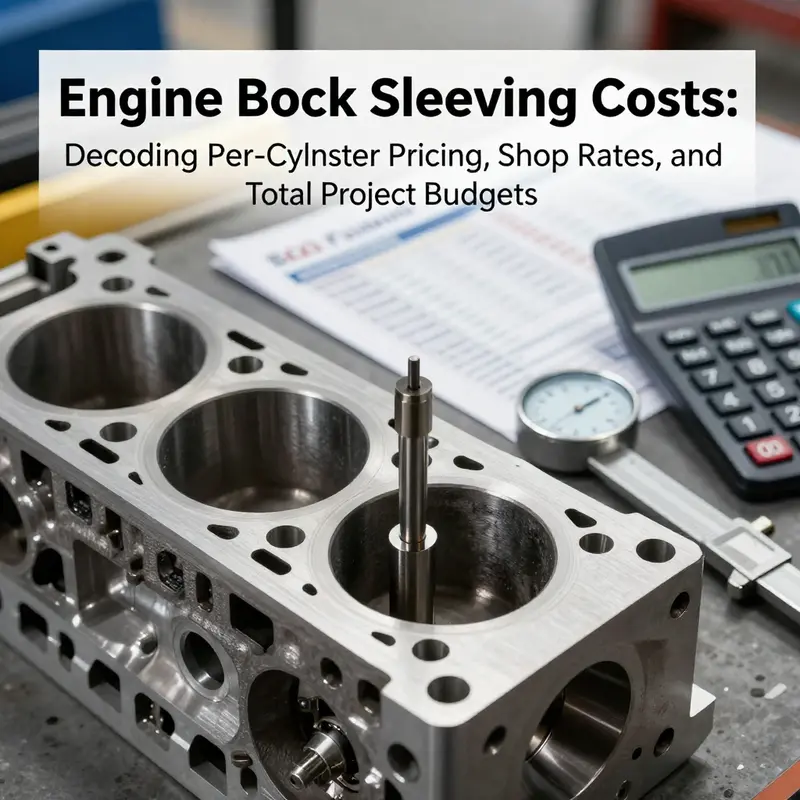
Sleeving an engine block is a precise, multi-step restoration that sits at the intersection of engineering and economics. It isn’t just a lump-sum repair—it’s a process that touches the sleeve material, the way a block is prepared, and the exact tolerances required to bring an otherwise damaged engine back to life. Understanding what drives the price helps you separate cosmetic fixes from lasting reliability and helps you decide when sleeving is the right move versus alternatives like replacement or overhauling the casting. At its core, sleeving replaces compromised cylinder sections with sleeves that restore uniform bore size and strength. The job typically starts with removing the damaged portions, selecting and installing sleeves of a material that matches the engine’s demands, and finishing the bore so the pistons can run true again. This is why the cost is rarely a single number. It is a reflection of material choice, the amount of block preparation, and the labor required to execute a precise fit that won’t leak, warp, or wear prematurely.
The numbers you’ll encounter cluster around two angles: per-cylinder costs and the total block-wide cost. A common way shops price the work is to quote a per-cylinder figure for the sleeving operation, then add the sleeves themselves and the machining necessary to prepare the block. In practical terms, you’ll see per-cylinder ranges roughly from one hundred fifty dollars up to four hundred dollars or more. That broad spread exists for a reason. A straightforward case with cast iron sleeves and moderate block preparation can stay toward the lower end. If you’re dealing with a high-performance build, a high-mileage or damaged block, or sleeves made from premium alloys, the per-cylinder price climbs quickly. When you multiply across several cylinders, the total can easily move into the five-figure territory for a single engine, especially if the engine is large, complex, or in poor condition to begin with. For many shops, the target is a balanced job where the sleeve cost, the required tooling, and the essential machining stay within a sensible envelope that preserves the engine’s reliability and the owner’s budget.
The material choice for the sleeves is one of the most visible cost drivers. Cast iron sleeves are typically the most affordable option and have a long track record in standard rebuilds. They offer reliable wear resistance for most daily-driving applications and are easier to machine in many shops. Steel sleeves, by contrast, are selected for high-stress or high-heat environments. They bring superior wear resistance and better thermal stability, which can matter in performance builds or engines operated under demanding conditions. The premium category often includes specialized alloys or coatings that can address niche needs, such as very high compression, elevated exhaust temperatures, or specific oiling regimes. Each material tier shifts both the initial sleeve price and the long-term durability, which in turn influences how many sleeves you’ll replace or rework during a rebuild. The sleeve’s interface with the block also matters. Wet sleeves, which sit in a bore and interact with the coolant, demand a different machining approach than dry sleeves, which are dry-lined and rely more on the press-fit integrity and precise honing. These installation methods carry distinct equipment needs and risk profiles, and that translates into cost.
Labor rates are another major determinant. The hourly rate charged by a machine shop varies widely by region, by shop reputation, and by the skill level of the technicians involved. In many markets, a highly experienced machinist will command a premium, particularly when the work requires meticulous alignment, delicate surface finishing, or the ability to recondition the deck surface to the exact plane. The labor math isn’t just about the act of pressing or boring a sleeve; it includes the preparatory work that ensures there are no hidden defects after sleeving. If the block needs resurfacing or warping corrections, or if porosity and micro-cracking demand additional sealing work, the hours required rise quickly. Add in the need to bore to piston specifications, hone to the correct finish, and possibly true the deck flatness, and the labor contribution becomes the largest variable in many budgets.
Block condition and preparation form a second axis of cost risk. A healthy, factory-true block with clean oil passages and no core shifts will move through sleeving with a predictable duration. A block that has cracks, porosity, or cavitation erosion requires a more extensive repair plan before a sleeve can even be installed. In such cases, the shop may re-bore, plug questionable areas, or perform dimensional corrections that add both time and material. Even when a block looks clean, the process demands precision: the sleeves must be pressed or shrink-fitted to a controlled interference fit, the bore must be exactly true for a snug, oil-tight seal, and the honing must match the final piston dimensions to avoid scuffing and premature wear. All of this contributes to the final cost, which is why two engines that look similar on the outside can end up with very different sleeving bills once the actual bore and conditioning work is counted.
Beyond the basic sleeve price and the raw machining, the number and type of sleeves being installed influence the economics. If you’re sleeving multiple cylinders, some shops offer per-cylinder discounts or bulk pricing, but the total still scales with the work involved. The decision to sleeves other components during the same rebuild—pistons, rings, bearings, or a more extensive gasket and oil-system refresh—also alters the job’s overall economics. In high-performance or heavy-duty builds, the cost delta often reflects the chosen sleeve geometry or finish, plus the additional measurements and finalizing passes necessary to achieve the exact bore and surface finish that the piston rings expect. The ultimate total, then, is not a single figure but a stitched tapestry of sleeve material, installation method, block prep, and ancillary services that are triggered by the engine’s condition and the owner’s performance goals.
For a practical baseline, many engine-machine shops present a composite view: the sleeve itself may be a modest line item, while the bulk of the cost arises from the tasks that ensure the new sleeve will perform reliably for thousands of miles. A typical complete sleeving project can be in the range of two hundred to five hundred dollars per engine block when considering sleeves, installation, and related machine work such as deck resurfacing, boring, and honing. In some cases, dry cylinder sleeves can be easier and cheaper to install than alternatives, offering potential savings that show up in the final quote. Yet even with a seemingly straightforward block, the actual cost will hinge on the specifics—how many cylinders need sleeves, the engine’s overall condition, and how aggressively the builder intends to match the final bore to the pistons.
If you’re preparing for a sleeving project, the best approach is to obtain quotes from several reputable machine shops and to request a detailed, itemized breakdown. A good quote will separate sleeve price, tooling and press-fit work, and the finishing steps from any additional tasks such as pistons, rings, bearings, and oil-restriction kits. It will also note whether the shop expects to bore and hone to final piston specs and whether deck resurfacing is included. Presenting the engine model, the number of cylinders requiring sleeves, the sleeve material preference, and a clear description of any block prep needed helps shop personnel produce a precise quote rather than a rough estimate. This diligence saves you from sticker-shock and ensures that you’ll know where each dollar is going as the project progresses.
For readers seeking a concrete baseline without wading through multiple quotes, a practical reference point exists in a dedicated guide that outlines the economics of sleeve work. You can consult the engine sleeve cost guide for a concise breakdown of sleeve price, tooling, and labor rates, which provides a snapshot of how the per-cylinder cost can evolve with material choices and installation methods. This resource serves when you need to gauge general expectations before visiting a shop or when you’re comparing bids across several facilities. engine sleeve cost offers that snapshot, while your local shop will deliver the exact line-by-line numbers for your engine.
In the end, sleeving remains a highly effective way to salvage a worn or damaged engine block, preserving core components and the engine’s overall geometry. The price you pay reflects more than the sleeves themselves. It is the sum of material choices, the precision required to fit a new bore into an aging block, and the labor needed to ensure the revs and stresses of real-world use won’t rinse out the investment. The more you understand the levers that move the price, the better you can negotiate an honest, durable rebuild that aligns with your goals and your budget. The road to a reliable sleeved engine is paved with careful planning, accurate quotes, and a clear sense of what each cylinder needs to deliver long-term performance. External resources can broaden your understanding, but the practical value comes from a shop that communicates clearly about what must be done, why, and how the final assembly will behave under load.
External resource: https://en.wikipedia.org/wiki/Cylinder_liner
Inside the Price Tag of Engine Block Sleeving: How Shops Quote, Bundle, and Balance Materials
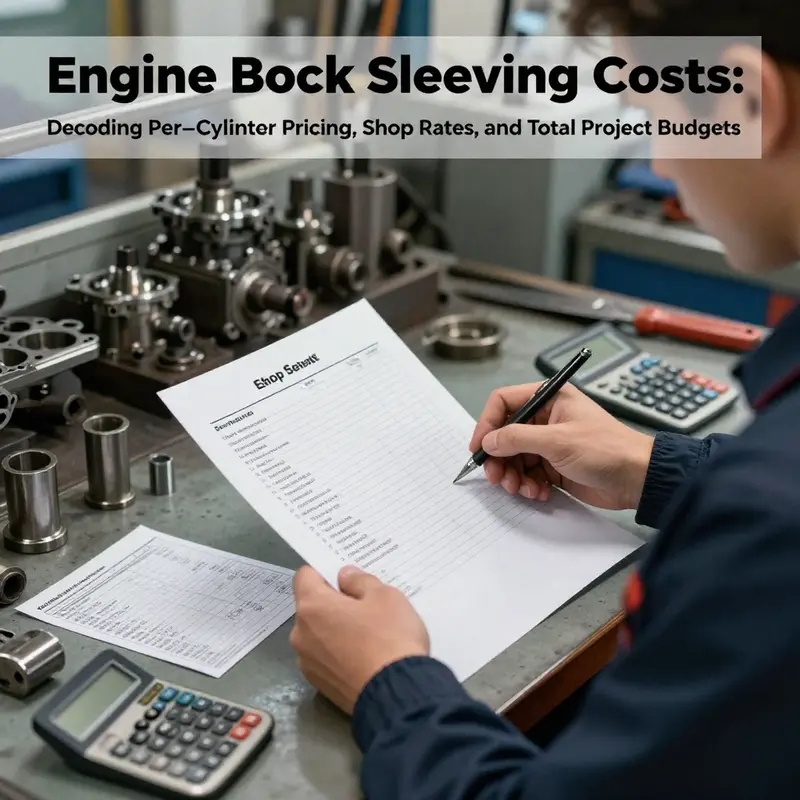
When an engine block begins to show the telltale signs of wear—cracks, porosity, cavitation, or deep pitting—techniques to restore its life must be weighed against the realities of cost and complexity. Sleeving, the process of inserting a new cylinder liner into the bore, offers a practical route to renewed reliability. It is not a one-size-fits-all repair, and its price tag reflects that reality. The chapter you’re about to read traces the anatomy of those costs, from the bare bones of sleeves and labor to the bundled packages that shops increasingly promote as a way to simplify budgeting. It is a window into how machine shops price a project that sits at the intersection of technique, materials science, and regional economics, all while keeping a lid on the variability that can emerge from engine type and block condition.
At its core, sleeving is a judgment about longevity. A damaged or compromised bore can be stabilized by installing a sleeve that either restores the original bore dimensions or, in some cases, provides a more robust platform for a modern piston and ring package. The material choice for sleeves—whether iron, steel, or a specialized alloy—has a material cost that will be reflected in the bill. The number of cylinders that require sleeves is another major driver. A straightforward V8 or inline-6 block with a handful of compromised bores will be priced differently from a multi-cylinder rebuild where several sleeves must be pressed, bored, and honed to exact tolerances. In practical terms, the cost floor is set by the sleeve itself, while the ceiling is driven by the machining that ensures a true, round, and perfectly aligned bore for each cylinder. The sleeves’ fit—whether they are dry liners that rely on a tight press fit or wet liners that interact with the engine’s cooling system—also shapes labor time and complexity, nudging price up or down.
From the shop floor’s perspective, the most straightforward sleeves cost less to install because they require fewer specialized steps. A single-cylinder sleeving job, performed by professionals with the right tooling, often includes boring and honing to match a precise piston size, and the labor charge reflects the time consumed and the precision achieved. However, when multiple cylinders need sleeves, or when the engine block has additional defects such as cracks extending into the deck surface, porosity in the casting, or signs of cavitation erosion, the job becomes a more elaborate rebuild. These conditions may require surface resurfacing, deck checks, or even block straightening, each step adding layers of cost that compound with the overall project.
The cost landscape grows more nuanced when you separate sleeve parts from the machining labor. Sleeve kits themselves can vary widely in price depending on material quality, bore size, and whether they are standard OEM-sized items or aftermarket equivalents. In certain data snapshots, sleeve components per cylinder can range from modest amounts to several tens of dollars per sleeve, but those prices are only part of the story. The bigger component is the machining and installation labor. A typical full sleeving job, which includes removing the damaged section, pressing in new sleeves, boring and honing each sleeve to final piston specs, and performing any necessary finishing work such as deck resurfacing or leak testing, often lands in the broad band of about $1,200 to $3,500 for a standard automotive engine block. That range captures the majority of common engines in North American shops as of early 2026, acknowledging that high-performance or marine diesel applications can push total costs well beyond that, sometimes past the $5,000 mark when precision-fit sleeves and specialized materials or extensive porting and alignment are involved.
To put those figures in another light, some shops present bundled “complete sleeving” packages. These packages are designed to provide a single price point that covers the core services needed for a restored block: cylinder boring and honing, sleeve installation with proper press-fit, surface finishing and leak testing, piston clearance verification, and often deck surfacing or crankshaft inspection as optional add-ons. The bundled approach can offer clearer budgeting, though it can also mask the cost of the underlying components if the scope of work is expanded later. In practice, you might encounter complete sleeving bundles starting around $1,500, with actual final invoices climbing once you add the sleeves themselves, any required piston and ring work, oiling system components, or specialty tools. The regional cost environment matters too; urban centers with higher labor rates and overhead costs tend to push those bundles upward by a noticeable margin, while rural areas can deliver a leaner tag for similar work.
The sleeve itself, the metal that forms the rebuilt cylinder wall, is where material science meets economic reality. Steel or iron sleeves designed for aluminum blocks commonly land in a price spectrum that reflects size, material quality, and the fit required for a given bore. In some catalog-like listings, the sleeve price per cylinder can range from a modest fraction of the total cost to a more significant contribution when larger bore sizes or heavy-duty applications are involved. The choice between dry sleeves and wet sleeves also shifts the math. Dry sleeves, which rely on precise pressure fit within a slightly oversized bore, typically require less ancillary wet tooling and cooling interactions, which can translate into lower installation time and cost. Wet sleeves, with their integrated water jackets and sealing considerations, demand additional machining and coolant management steps, often adding both material and labor costs.
For those budgeting, the path to a precise quote starts with a careful diagnostic. Shops want to know the engine family, block material, the number of cylinders requiring sleeves, the intended final bore size, and whether any ancillary work is anticipated—deck resurfacing, crankshaft inspection, or a valve train upgrade, for example. The condition of the block also matters: a cracked deck, porosity issues that threaten sealing surfaces, or cavitation damage near coolant passages all raise the bar for the project’s complexity and, in turn, its price. When you request quotes, ask for an itemized breakdown. A transparent quote should separate sleeve price per cylinder, the quantity of sleeves, the estimated machining hours, the tooling charges, and any associated parts such as pistons or rings that must be updated to match the final bore.
If you’re approaching sleeving with a careful eye toward value, a few practical insights help. First, obtain multiple quotes from reputable machine shops, and provide the engine’s exact model and block condition. Second, clarify material preferences—cast iron versus steel sleeves—and confirm whether the shop can supply the sleeves themselves or if you will. Third, acknowledge that the bore and hone process is critical; even small deviations from piston specs can ripple into performance and longevity issues. And fourth, consider the potential for bundled pricing, especially if you are planning a broader rebuild that includes deck work or crank inspection. Bundles can deliver cost predictability, but you should watch for exclusions—disassembly, reassembly, or major component upgrades may be outside the bundled scope and priced separately.
For readers seeking a focused set of cost expectations, it helps to consult an accessible reference that lays out sleeve costs in a dedicated context. A useful resource detailing sleeve cost considerations is available here: engine sleeve cost. This page provides a concise view of the factors that drive price and how shops typically structure their quotes, which can serve as a starting point for evaluating bids you receive from local shops.
In sum, the final price to sleeve an engine block emerges from a blend of engine type, block material, the number of cylinders, sleeve material, and the scope of accompanying work. The cost spectrum spans from the mid-range sums for straightforward, limited-sleeve scenarios to premium, fully bundled packages that reflect high-precision machining and specialized materials. A careful budgeting approach will treat sleeves and machining as two intertwined components: the sleeves themselves set the baseline material cost, while the machining and surface preparation determine the final fit and longevity. The most reliable path to an accurate estimate is a detailed, shop-specific quote that itemizes each element of the project and aligns it with the engine’s intended use and reliability goals.
External resource for broader context on current machine shop rates and sleeving services: https://www.machinistweb.com/articles/engine-sleeving-costs-and-services
How Much Does It Cost to Sleeve an Engine Block? Sleeve Kit Pricing, Component Costs, and What Really Drives the Total
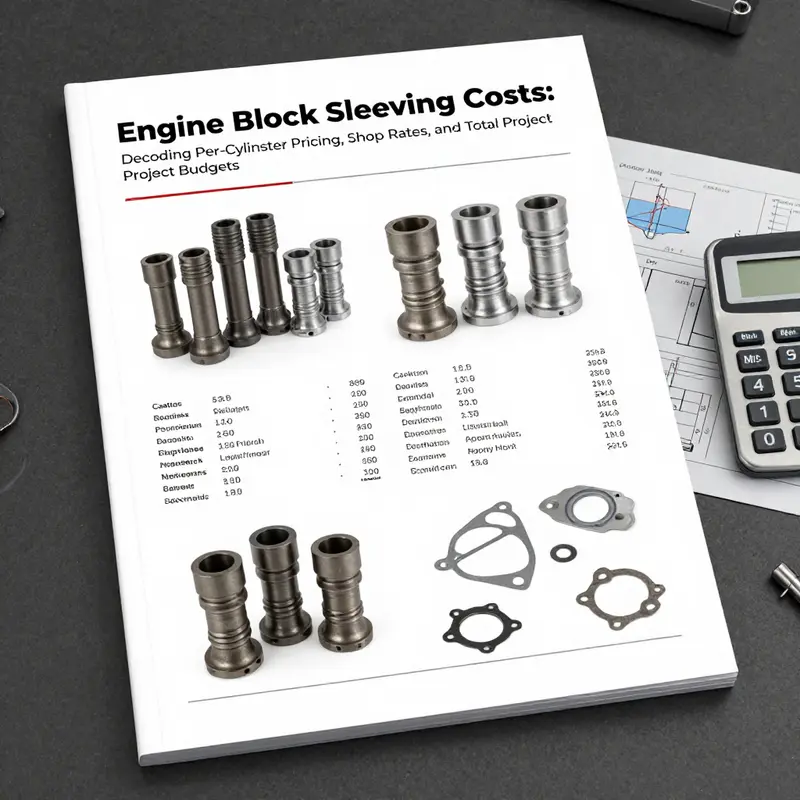
Sleeving an engine block is a precision job whose final cost depends on many variables. The sleeve restores a worn or damaged bore and can support performance upgrades, but the price reflects more than the sleeve itself. Key drivers include engine type, block condition, sleeve material, number of cylinders, and the precision work required by the shop. If you are comparing sleeving with rebuilding, welding, or replacing the block, expect to see itemized quotes that separate sleeve stock, boring and honing, press-fit work, and any deck resurfacing or piston/Ring changes.
Typical pricing ranges: per-block costs commonly run from roughly $200 to $500 or more, while per-cylinder prices often fall in the $200-$400 range. The sleeve material affects cost: cast iron is usually cheaper, while steel and exotic alloys add to the bill due to material and machining requirements. The total project cost is not just parts: it includes tooling, machine time, and skilled labor. A full sleeving job for a standard block frequently lands in the $600-$1000 range, with higher figures for complex blocks, multiple sleeves, or unusual bore sizes.
Shop notes: a thorough inspection of the block is essential, since cracks, porosity, or warping can increase both the complexity and the cost. The final price is driven by the full precision workflow: bore preparation, sleeve installation, final boring and honing, and any necessary deck work. Request a detailed, line-item estimate that shows sleeve price, labor hours, and any ancillary parts. In high-volume shops or when buying sleeves in bulk, per-sleeve pricing may drop, but the total per-block cost often remains in the same general range because each cylinder still requires dedicated machining.
Practical tip: obtain several quotes and verify that the estimate includes all major steps (sleeve stock, boring, honing, rework of decks if needed, and any piston/ring changes). A well-documented quote helps you compare apples to apples and reduces sticker shock. For readers seeking practical benchmarks, many engine-sleeve resources provide sample pricing scenarios and itemized breakdowns to guide expectations.
External reference: some shops provide catalog-style pricing guidance and case studies that illustrate the relationship between sleeve price, tooling, labor, and final bore fit.
How Much Does It Cost to Sleeve an Engine Block? A Practical Look at Labor, Process, and Total Project Costs
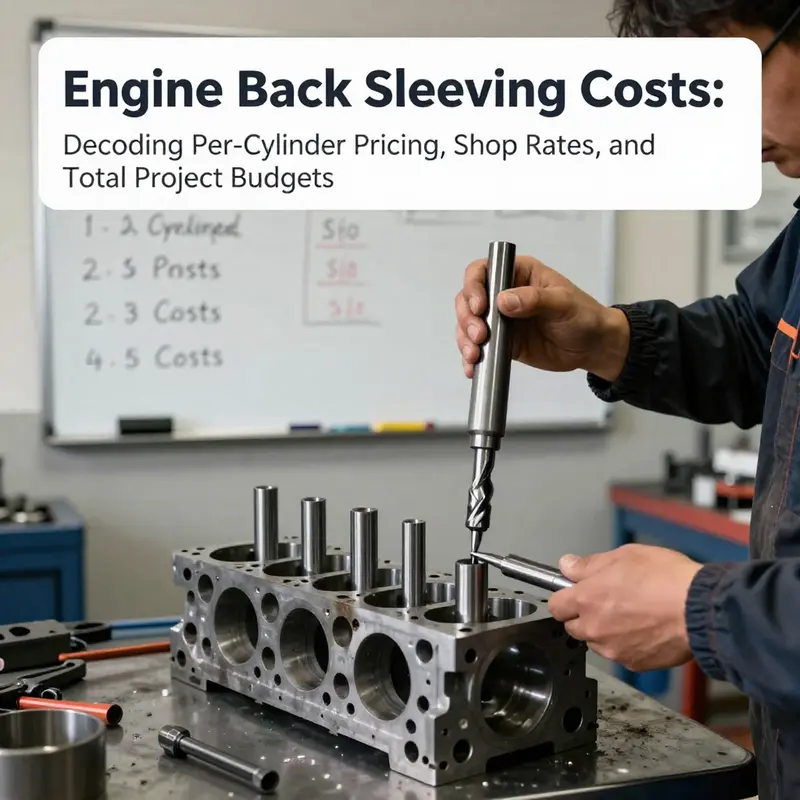
When an engine block shows the telltale signs of a damaged bore—scored walls, porosity, or a compromised seal—the simplest fix is often sleeving. The idea is straightforward: remove the worn cylinder material, insert a new sleeve, and bring the bore back to a precise dimension so the piston and ring pack can seal and rotate smoothly again. But the price tag behind that fix can drift widely. Understanding what drives sleeving costs helps you evaluate quotes, plan a rebuild, and avoid surprises once the engine is on the teardown table. In practical terms, sleeving is a blend of material choice, machining precision, and the condition of the block itself. The material you choose for the sleeve—steel, cast iron, or specialty alloys—will set the stage for the rest of the project, but it is far from the only factor. The process begins with a thorough assessment: cracks, warp, porosity, and the overall integrity of the deck and surrounding cylinders all influence both feasibility and cost. If the block has hidden flaws, the shop may need to perform additional repairs, which adds time and expense. The sleeve itself is a relatively small component, yet its price is a meaningful line item because it determines the bore’s final dimension and the reliability of the seal between sleeve and parent block. The per-cylinder sleeve price can be modest, but when multiplied across several cylinders, it becomes a central driver of total project cost. In general conversation within machine shop pricing, sleeves cost somewhere in the range of tens to a couple of hundreds of dollars per cylinder, depending on material and brand. Cast iron sleeves usually land at the lower end of that spectrum, with steel sleeves often sitting higher due to tensile strength, wear resistance, and the demands of more demanding builds. Wet sleeves, which operate in a coolant environment, and dry sleeves, which do not, can also influence pricing because wet sleeves require additional sealing and sometimes more elaborate installation steps. The shop’s labor charge, however, is the next big hinge point. In modern practice, the labor to complete a sleeving job—removing the damaged bore, boring the block to accept the new sleeve, pressing or heating and fitting the sleeve, and then honing to final piston specs—adds up quickly. A typical full sleeving job involves a substantial amount of precision machining, using vertical boring mills, line honing, and fine honing equipment to achieve the exact bore diameter and finish the piston rings require for a proper seal. The result is not simply a sleeve pressed into a hole; it is a bore that has to be concentric, true to deck height, and compatible with the engine’s intended performance characteristics. It is not unusual for the labor component to run into the mid to upper end of a thousand-dollar figure for a standard block, with variations based on engine complexity, shop rates, and any additional work the block requires to be fit for service. All of this matters because the sleeve’s integrity is only as good as the block’s remaining structure. If the deck needs resurfacing to create a flat, true surface for head gasket sealing, or if line boring is required to true the main and bore relationships, those steps add not just time but also cost. In some cases, a block can be sleeved without significant deck work, and in others, the cost climbs as the shop corrects multiple dimensional faults to hit tight tolerances. The arithmetic becomes layered: the base sleeve price, the per-cylinder machining, the necessary press-fit work, and any pistons or rings that must be swapped to maintain correct bore-to-piston geometry. It is this layering that makes the project price more a function of scope than a single line item. The numbers that show up in shop quotes reflect this reality. For a straightforward, small-block V8 or inline engine where the block is in decent condition aside from worn bores, a typical sleeving project might fall into a few broad bands. Some estimates from recent industry data place the aggregate cost across sleeves, installation, and related machine work in the vicinity of roughly $900 to $1,800 for a basic sleeving job on a single block. When more performance-oriented materials are chosen, or when multiple cylinders require sleeves and the block demands additional alignment and resurfacing operations, total project costs can stretch toward the $2,000 to $4,000 range or higher. These ranges reflect inflation, the modernization of tooling, and the increased complexity of modern engine builds where tolerances tighten and the expectations for reliability grow. While those figures provide a working framework, the practical path to a firm number remains the same: quote carefully, itemize every cost, and verify the scope with the shop before any material or metal is touched. The per-cylinder pricing you may see quoted in smaller machine shops or in catalogs—often $50 to $150 for a cast-iron sleeve and $100 to $200 or more for a steel sleeve—gives a rough sense of the sleeve itself, but it does not stand alone. A single cylinder bore may require boring to a precise oversize, honing to piston-spec tolerances, and careful installation, which all take time and specialized equipment. In a multi-cylinder block, some shops offer bulk pricing, but the economics still hinge on the key variables: the material chosen, the degree of block prep, the number of sleeves, and whether the job includes deck resurfacing or line boring. When you step back and consider the total project, the cost is as much about the process as it is about the sleeves. The process steps—removal and inspection, cylinder bore machining, sleeve installation, final honing, and rigorous quality control—form the backbone of the workflow and anchor the budget. The inspection phase is not merely a courtesy. It determines whether sleeving is even viable, given the block’s metallurgy and any micro-cracking that could undermine the sleeve’s seating area. If the block passes a thorough inspection, the bore is prepared with precision, and the sleeving operation proceeds with controlled press-fit or an appropriate heating method to seat the sleeve. Then comes a critical stage: honing. Honing to match piston specs ensures the rings seat correctly, seal, and wear evenly. Precision here reduces the risk of premature ring land wear or cylinder glazing, both of which can undermine long-term reliability. The quality control phase ties the knot. Leak testing, alignment checks, and a careful reassembly plan for the engine’s subsystems are essential to avoid a return visit to the shop for a redo. The final tally combines sleeve material costs, tooling and consumables, labor, and any additional work tied to the engine’s configuration and its intended use. It’s entirely reasonable for a builder to quote several thousand dollars for a high-performance or heavy-duty build where, for example, high-grade sleeves, specialized coatings, or aggressive bore oversizes are employed, and where the block requires extra care to preserve core strength. For the average street engine, though, many owners find that the sleeving path remains a practical corridor between repair and rebuild, offering a way to extend the life of an otherwise compromised block without adopting a full engine replacement. If you’re evaluating the numbers, it helps to approach the shop with a clear set of questions: How many cylinders need sleeves, and what material? Is deck resurfacing or line boring part of the scope? Will they supply the sleeves or use customer-supplied parts? What tolerances will be targeted on the final bore, and what pistons and rings are compatible with those tolerances? A good shop will provide a line-item estimate that includes sleeves, machining, press-fit work, and any required part replacements. It should also spell out the assumptions behind each cost, such as the intended engine type, the bore size, and whether the block is a high-compression or diesel application, which may push material and processing decisions toward more expensive options. For a numerical frame of reference beyond the shop quotes, it is useful to consider the broader market signals. A modern industry perspective often lists sleeves at roughly $50 to $200 per cylinder, with machining and installation running from several hundred to over a thousand dollars per block. A bulk of the variation is explained by block condition, the number of cylinders, and the specific performance targets. Dry sleeves can sometimes be quicker and cheaper to install than wet sleeves, though the difference in total cost depends on the project’s exact requirements. In practice, the most accurate guidance comes from a local, reputable machine shop that can assess your engine’s model, bore size, and block condition and then deliver a transparent, line-by-line estimate. If you’re planning a rebuild with sleeving as a major milestone, you should also consider the downstream costs: pistons and rings that match the final bore dimension, potential valve work if the head surface was disturbed, and the possible need for upgraded oil restrictions or coolant components to ensure the block now operates in a new, precise envelope. Along the way, you may encounter price differences that reflect regional labor rates or the shop’s specialization. In urban areas with higher overhead and experienced technicians, the total welcome price tag tends to rise. In regions with more competitive labor markets or greater volumes of performance work, you may find more favorable quotes. The goal is not to chase the lowest price but to secure a reliable result that aligns with your engine’s intended lifespan and use. If you want to anchor your understanding with a broader resource on the economics of sleeving, a dedicated breakdown discusses the factors and typical figures in detail, providing context for the ranges described here. For a deeper dive into the math and the options, see the dedicated discussion on engine sleeve cost. engine sleeve cost
External reference: https://www.hotrod.com/articles/engine-block-sleeving-costs/
Final thoughts
Engine block sleeving costs hinge on more than a single price tag. The final bill reflects the choice of sleeve material, bore size, block condition, and how many cylinders require lining, plus the depth of machine work like deck resurfacing, boring, and honing. By understanding per-cylinder pricing, the value of bundled shop services, and the cost makeup of sleeve kits, owners and repair professionals can compare quotes with clarity. The most reliable estimates come from detailed shop quotes that itemize sleeves, tooling, labor, and any necessary component replacements. With that information, you can set a realistic budget, select appropriate materials for your engine goals, and ensure the sleeving project delivers durable, reliable performance.