
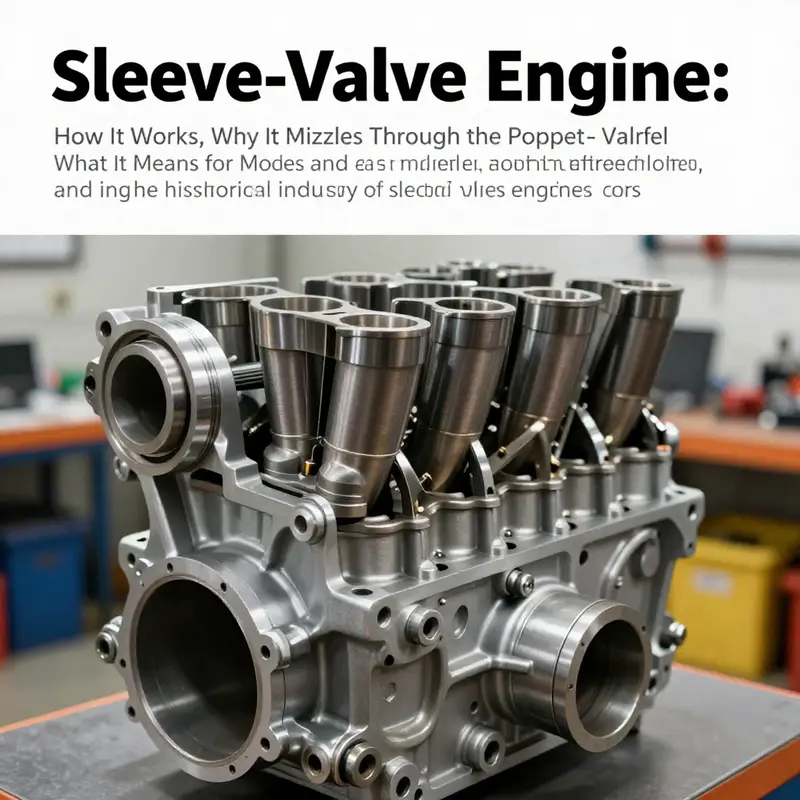
Sleeve-valve engines represent a distinct path in internal combustion history. Instead of a traditional poppet valve setup, a sliding metallic sleeve moves in concert with the piston to open and close intake and exhaust ports. This design promises smoother airflow, improved thermal management, and a different maintenance and parts supply challenge. For motorcycle and auto owners, auto repair shops, and parts distributors, understanding how the sleeve-sleeve cylinder works, how port timing is coordinated with piston motion, and how air moves through the engine helps diagnose performance changes, assess restoration potential, and evaluate parts availability. The following five chapters connect theory to practice: the core mechanical principle and sleeve-ported cylinder design; how piston-sleeve coordination and port timing shape breathing; airflow pathways and how sleeve-based actuation replaces traditional valves; how cooling and thermal management influence efficiency; and a historical view of development, adoption, and current implications for the industry. Together, they offer a cohesive picture of a once-popular concept and its relevance to today’s maintenance, repair, and parts supply environments.
Breathing Through a Sleeve: Reconsidering the Core Mechanical Principle and the Sleeve-Ported Cylinder Design
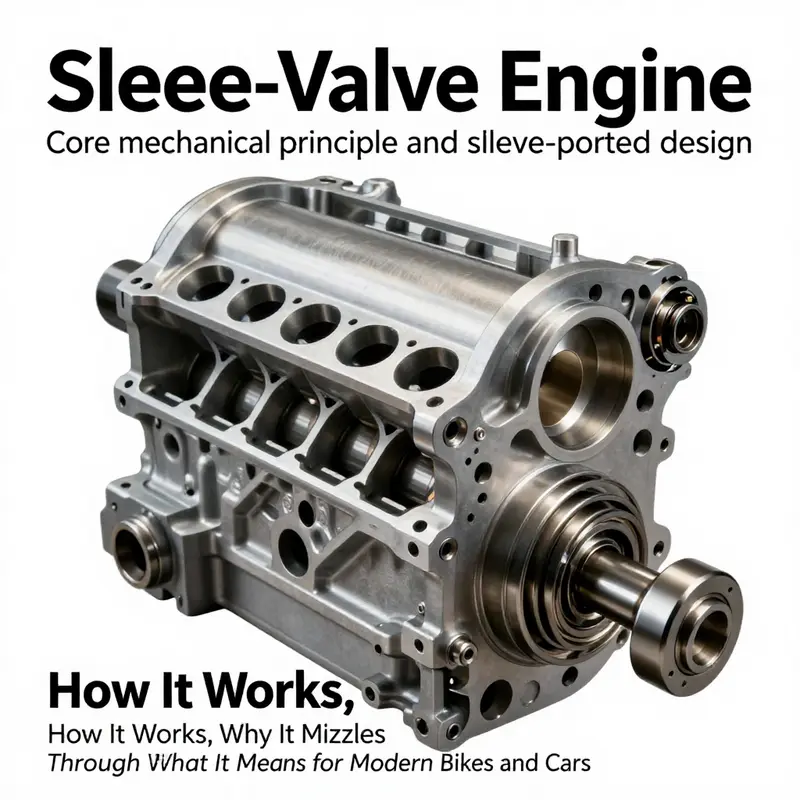
The sleeve-valve engine unfolds as a quiet reinterpretation of the basic internal combustion cycle, where the rhythm of intake and exhaust is choreographed not by fixed poppet valves but by a sliding metal sleeve that lives inside the cylinder itself. In this arrangement, the piston and the sleeve work in tandem, each moving along its own track yet maintaining a linked timing through precise machining and careful assembly. The sleeve is not merely a passive barrier; it is an active gatekeeper, its internal ports aligning with larger, purpose-built openings in the cylinder wall at exact moments of the stroke. When the ports align, fresh air and fuel can rush in, and the spent gases can escape. When the sleeve shifts away, those passages are closed, preserving compression and controlling late-cycle breathing. The result is a system that can deliver smoother flow and potentially higher volumetric efficiency than a traditional poppet-valve arrangement, all while reducing the mechanical complexity that comes with a camshaft, pushrods, and a network of rockers. The principle is elegant in its simplicity: a sleeve moves with the piston, and the cylinder wall becomes an acoustically tuned highway rather than a maze of discrete, independently actuated gates. In practice, this means the engine breathes through larger, burly ports that are opened and closed by the sleeve rather than by small, separate valves. The larger cross-sectional area of these ports helps reduce the throttling losses that often accompany tightly timed valve openings in conventional engines. The trade-off, historically, has been in manufacturing precision and sealing, but when the sleeve and its ports are machined to tight tolerances and kept in exact alignment, the result can be a remarkably smooth air path that resists the turbulence and choked flow that sometimes plague more traditional designs. The mechanical sequence unfolds with a natural choreography: as the piston begins its downward stroke, the sleeve concurrently moves in the opposite direction, so that its internal ports unmask the cylinder wall’s intake passages. Fresh charge spills into the cylinder with a gentler, more continuous sweep than the snap of a valve spring opening. As the piston travels toward bottom dead center, the sleeve’s porting geometry and port timing ensure that the inlet dominates the early portion of the intake cycle, while the exhaust passages are prepared for the next phase by the corresponding movement of the sleeve. When the piston changes direction, the sleeve shifts again to uncover or cover the exhaust channels, expelling burnt gases before the next compression stroke begins. This interplay is not just timing; it is a harmonization of movement, surface contact, and thermal management that distinguishes sleeve-valve engines from their valve-spring counterparts. The cylinder liner in a sleeve-valve arrangement is typically held stationary to prevent any rotation that could misalign the ports. A set of pins or keys anchors the liner, ensuring that the sleeve’s motion never introduces hiccups in the port alignment. This fixation is crucial because a single misalignment over the life of an engine could degrade volumetric efficiency, raise emissions, and disturb compression. The sleeve, therefore, becomes a precisely guided, reciprocating element whose motion is coupled to the piston’s travel through the engine’s bore. The absence of a traditional valve train—no pushrods, no rocker arms, and no camshaft in the usual sense—simplifies the engine’s mechanical architecture. Fewer moving parts in the valve train mean less friction and a lower shearing load on the components that move most rapidly inside the engine. It is easy to fall into the trap of assuming that simplicity equates to fragility, but in the sleeve-valve scheme the reduction in mechanical complexity often translates into smoother operation and improved reliability, particularly in environments where harsh vibrations or abrupt duty cycles would test a more conventional valve setup. Yet the sleeve design does not dispense with challenges. The ports must be machined with extraordinary precision, and their alignment must be preserved across thermal cycles that inflate and contract metal in different directions. The sleeve itself, sliding within the bore, must seal adequately against the port faces to minimize gas leakage during the compression stroke. This sealing, whether achieved through tight fits, gaskets, or specialized coatings, is part of the engineering balance that determines the engine’s durability and efficiency. The geometry of the porting—their width, height, and the timing window during which they’re open—governs how much air enters and how quickly exhaust leaves. A larger intake port can deliver more air at higher rpm, which may push peak power upward. However, the timing window has to be harmonized with the piston’s velocity to maintain the proper air-fuel mixture and avoid pushing unburnt charges into the exhaust or into the opposite cylinder. The sleeve’s travel is thus a dynamic compromise: it must be long enough to provide ample port area yet precise enough in its travel to sequence the cycle correctly. The cylinder wall’s sleeve-ported design also has a thermal narrative. By placing the ports in the cylinder wall and letting the sleeve cover or uncover them in a controlled manner, engineers can modulate how rapidly the hot combustion gases contact the metal surrounding the ports. In some configurations, this arrangement can minimize the early exposure of the high-temperature gas to the cooler parts of the bore, aiding combustion stability and limiting heat transfer that would otherwise sap efficiency. In this way, the sleeve becomes a small but deliberate instrument of thermal management as well as timing. The historical arc of the sleeve-valve concept reveals a persistent tension between ambition and practicality. Early implementations promised high volumetric efficiency and a cleaner power delivery, but they demanded machining tolerances and lubrication regimes that challenged reliability in everyday use. Over time, designers balanced the allure of larger-port breathing with the realities of wear, leakage, and sealing. The result is a nuanced machine—one that appeals to engineers who value the elegance of port geometry and the discipline of precise assembly as much as raw horsepower. The broader literature and technical references describe the sleeve-valve principle as a core mechanical idea: the piston and sleeve coordinate to regulate gas exchange through ported passages in the cylinder wall, without the conventional valve train’s mechanical complexity. The concept emphasizes smoothness of flow, reduced frictions, and improved thermal management in certain operating envelopes. It is not merely a historical curiosity but a platform for understanding how alternative valve technologies can reframe fundamental engine cycles. For readers seeking a concise treatment, a focused overview of what the sleeve does and how the sleeve interacts with the cylinder can be illuminating, and it is there that a larger discussion of sleeve design, port timing, and material choices can be found. A compact, practical explanation of these ideas is laid out in established technical summaries that illustrate the lubricating needs, sealing strategies, and alignment features essential to consistent operation. This chapter draws on those core principles, weaving them into a narrative that underscores how the sleeve’s motion translates into timing, flow, and combustion efficiency. The historical and practical notes converge in a single thread: the sleeve-valve engine embodies a different philosophy of gas exchange. It asks what happens when the gatekeeper is the moving sleeve rather than a fixed valve, and how the engine’s breathing is shaped not by the speed of a cam but by the smoothness of a guided slide. The result is a compelling portrait of an engine that, at its heart, seeks to optimize the timing and the quality of the charge entering the cylinder while simultaneously simplifying the hardware that carries the load of repeated opening and closing. For readers who want to dive deeper into the mechanical principles and the exact design considerations, a detailed technical resource provides a rigorous treatment of sleeve-ported cylinders, port timing, and the assembly practices that ensure reliable operation over the engine’s life. This chapter has traced the central idea—the sliding sleeve as a gatekeeper that synchronizes with the piston to manage intake and exhaust through larger, more efficient ports. It has highlighted how the sleeve’s stationary liner, the precise port cuts in the bore, and the controlled movement of the sleeve come together to create a breathing system that can, under the right conditions, deliver smoother airflow, better thermal management, and a simplified valve-train arrangement. The path from concept to execution is paved with tolerances, materials, and lubrication strategies that keep the sleeve and bore pressed together just enough to seal while allowing the necessary motion. In sum, the sleeve-valve engine invites us to rethink gas exchange as a dance of two coordinated motions—piston and sleeve—working within a shared chamber. It invites engineers to imagine larger ports that breathe more freely, counterbalanced by the discipline required to keep those ports aligned, sealed, and durable. This is the core mechanical principle in its most distilled form: a movable sleeve within a fixed bore that exposes and covers cylinder-wall ports at the right moments, shaping how air enters, how fuel blends, and how exhaust leaves. For curious readers seeking a compact historical and technical synthesis, the sleeve-valve concept is a remarkable case study in how reimagining a fundamental mechanism can alter the feel of an engine’s breathing, its thermal behavior, and its overall mechanical mood. sleeve-valve engine work. External references can illuminate the construction details and the practical realities that accompany this approach. A deeper technical overview is available for study and comparison: Sleeve-valve engine overview.
Breathing Beneath the Piston: Piston-Sleeve Coordination and Port Timing in Sleeve-Valve Engines
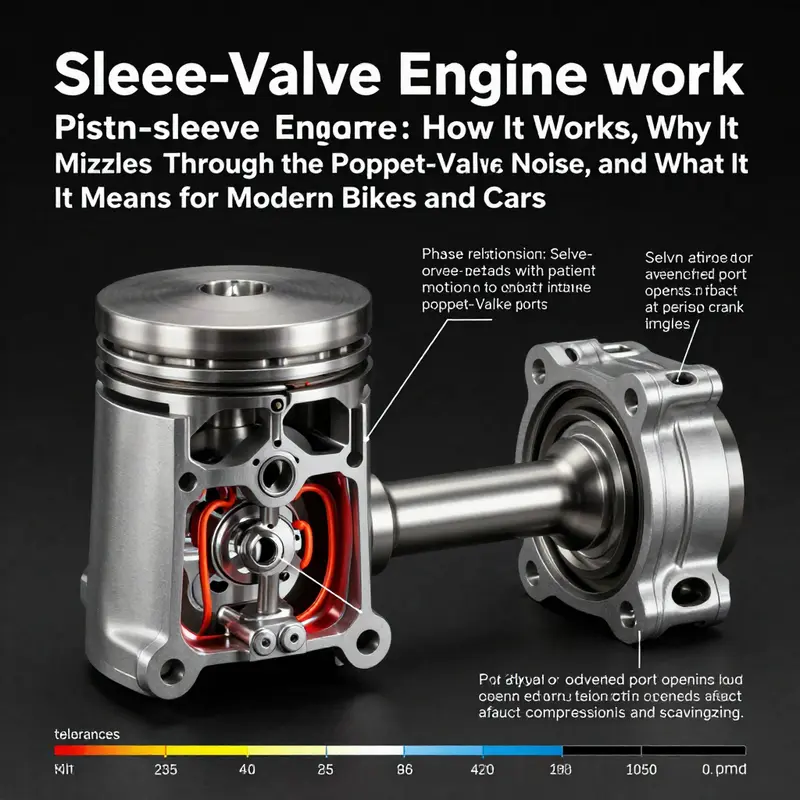
In the sleeve-valve approach to internal combustion, the familiar fixed poppet valves are replaced or augmented by a sliding sleeve that moves inside the cylinder wall. The sleeve carries a pattern of windows or ports that reveal openings in the cylinder wall at precisely arranged moments in the piston’s travel. As the piston shuttles up and down the bore, the sleeve follows a carefully choreographed path, opening and closing the ports so that fresh charge enters at the right time and spent gases exit cleanly. This arrangement replaces the conventional valve train with a sliding interface whose timing is governed by the relative position of the piston and the sleeve, guided by a drive mechanism that links the sleeve’s axial motion to the crank and connecting rod. The result is a breathing system that can be tailored, within limits, to the engine’s speed and load, offering a degree of flexibility that fixed-wall ports cannot ordinarily achieve.
The essence of the sleeve’s operation rests on two intertwined ideas: piston-sleeve coordination and port timing. Coordination means that the sleeve’s axial position and its angular orientation are synchronized with the piston’s position in every instant of the cycle. If the sleeve lags or leads, the windows misalign with the cylinder-wall ports, and the intended gas path is disrupted. If timing drifts too far with engine speed, breathing becomes erratic, peak efficiency slips, and emissions rise. Designers therefore implement drive paths that ensure a stable phasing relationship across the engine’s operating envelope. Some designs use a dedicated sleeve carrier or yoke connected to an eccentric on the crankshaft; others couple sleeve movement to a cam-driven element or a precise link mechanism so the sleeve travel mirrors the piston’s progression through the stroke. In all cases, the goal is faithful phase alignment, so the opening and closing of the ports occur at the intended crank angles, typically near top dead center for intake and near bottom dead center for exhaust, while the compression and power strokes proceed with minimal leakage.
Port timing in sleeve-valve engines is the second pillar of the breathing system. Here, the timing is not fixed by a rigid set of valve seats; instead, it is programmable by the sleeve’s axial travel and its angular orientation. The sleeve’s windows expose the wall ports as it slides, so the exact crank-angle at which a given port pair opens depends on three factors: how far the sleeve has moved along its axis, the current angular alignment of the sleeve relative to the piston, and the geometric relationship between the sleeve windows and the wall ports. Because the port opening is a function of both translation and rotation, engineers can shape the duration of the opening window and the point in the cycle when it occurs. This provides a potential advantage: the intake and exhaust events can be timed to favor either rapid scavenging or thorough charging, depending on operating conditions. In effect, sleeve timing can separate or modulate the moments at which air flows in and exhaust gases flow out, a freedom not readily available in fixed-port designs where both events are more tightly coupled.
In practical terms, this means the intake window can be oriented to admit the fresh charge early in the stroke or later, depending on the desired charge quality and the engine’s speed. Meanwhile, the exhaust window can be timed to start clearing spent gases before the fresh charge arrives, enhancing scavenging. The overlap—when both the intake and exhaust ports are briefly open together—can be controlled with greater nuance, reducing pumping losses at light load and avoiding excessive dilution of the charge at higher speeds. The asymmetric timing made possible by the sleeve thus offers a route to improved volumetric efficiency and combustion stability in certain operating regimes. It also opens pathways to tailored emissions characteristics, because the timing of gas exchange interacts with the combustion chamber geometry, the fuel-air mix, and the thermal conditions inside the cylinder.
The mechanical realization of this coordination and timing is, by design, a study in precision. The sleeve must slide with smooth, low-friction motion inside the cylinder wall, while seals and lubrication protect against gas leakage and wear. The interface between the moving sleeve and the stationary or discretely moving ports must maintain alignment across a wide range of temperatures and speeds. Thermal expansion, ring wear, and surface finish all threaten the delicate timing balance, so material choices, lubrication regimes, and manufacturing tolerances are all pushed to tight specifications. Designers also contend with heat transfer: the sleeve’s exposure to hot combustion products must be managed so that the axial travel and window geometry do not deform or drift under load. The drive mechanism itself—whether it be a cam, gear train, or eccentric linked to the crank—must deliver consistent motion not only at peak torque but also at startup and idle where friction and inertia can alter timing.
To picture the breathing scene more vividly, imagine the sleeve as a second, smaller clockwork that ticks in synchrony with the piston’s primary timing. When the piston climbs toward the end of compression, the sleeve may have shifted to reveal the inlet ports just as the fuel-air mixture is primed for intake, allowing a smooth surge of fresh charge into the cylinder. As the piston moves through the power stroke, the sleeve’s windows close the intake path and open the exhaust path at the right moment, so the burnt gases can be expelled with minimal resistance. The choreography continues through the next cycle, each phase carefully replicated and adjusted for speed. In this sense, the sleeve behaves like a breathing organ, modulating air and exhaust flows in concert with the piston’s heartbeat. For readers seeking a concise, open-access description of the mechanical relationships and timing principles, there is a useful resource labeled sleeve-valve-engine-work that presents a focused view of these interactions.
The design trade-offs surrounding sleeve-valve timing are nuanced. The flexibility in port timing can translate into better scavenging and charge control, yet the gains must be weighed against added mechanical complexity. The sliding sleeve introduces additional wear surfaces and potential seals that must withstand life in a high-heat, high-kinetic environment. Lubrication strategies must be robust enough to prevent galling or sticking, while still permitting the precise, repeatable motion the timing system requires. Manufacturing tolerances become more stringent, because any misalignment between window geometry and port geometry translates directly into performance penalties. In sum, sleeve-valve systems trade the simplicity of fixed, well-understood valve timing for a programmable, coordinated flow control regime. The payoff lies in the ability to tailor breathing to diverse operating conditions and, in some historical implementations, to achieve improved efficiency and smoother operation under specific load and speed regimes.
The historical arc of sleeve-valve engines helps illuminate why modern practice rarely relies on them for mainstream production. Early attempts sought to push breathing control beyond what fixed valves could deliver, especially when attempting to separate intake and exhaust timing. But the extra mechanical complexity, reliability concerns, and manufacturing costs proved formidable challenges. Nevertheless, the underlying principle—controlling gas exchange by coordinating moving parts inside the cylinder with the piston’s position—remains instructive. It offers a lens into how engineers think about timing as a dynamic, controllable parameter rather than a strictly fixed geometric constraint. The sleeve’s “extra degree of freedom” is not a cure-all, but it is a demonstration of how clever motion design can unlock alternatives to traditional valve trains when the goal is precise gas exchange and optimized combustion.
For readers who want to explore primary materials and open-access discussions beyond this overview, a practical entry point is provided by resources that describe sleeve-valve concepts, their synchronization methods, and their breathing characteristics. The sleeves’ coordination and port timing offer a fascinating case study in how mechanical design engineers translate a breathing problem into a motion problem, then back into gas exchange performance. As you move forward in this chapter, keep in mind the core idea: timing is not just when the valve opens and closes, but how the moving sleeve and its windows interact with a network of stationary ports to sculpt the engine’s breathing. This perspective will help you recognize how sleeve-valve principles relate to broader discussions of alternative valve technologies and internal combustion strategies.
For a direct, open-access exploration of the mechanical relationships and a more detailed depiction of the sleeve’s motion relative to the piston, see sleeve-valve-engine-work.
External historical context and visuals can be found in open archival resources that illustrate sleeve-valve practice, such as demonstrations of historical engines and period discussions of breathing control. For a historical perspective and visual reference, consult open archival film and documentation at https://www.britishpathe.com/video/sleeve-valve-engine.
Sleeve-Valve Engines: A Continuous, Coordinated Gas-Exchange System
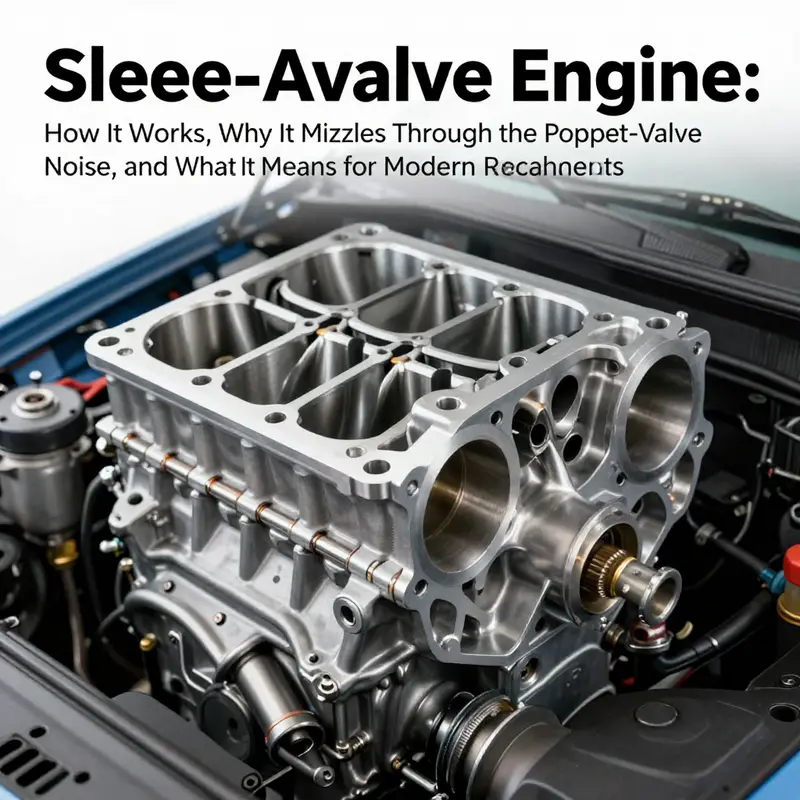
The sleeve-valve engine replaces discrete poppet valves with a sliding sleeve that encircles the piston and carries intake and exhaust openings in the bore wall. As the piston moves, the sleeve shifts to uncover an intake port near the bottom of the bore during the intake stroke and to uncover an exhaust port higher up during the exhaust stroke, while sealing the other openings to trap the charge for compression. The arrangement provides larger, smoother flow paths compared with conventional valve trains and removes the need for spring loaded poppets, but it requires very tight tolerances, robust lubrication, and careful heat management. While it can improve part throttle behavior and reduce pumping losses in theory, real world challenges such as wear, oil film stability, and manufacturing cost limited its widespread adoption. The sleeve-valve concept remains a useful historical and engineering case study in how valve geometry, piston motion, lubrication, and cooling interact, illustrating the trade offs between flow potential and reliability, with further discussion available in technical literature at https://itw-autosleeve.com/blog/sleeve-valve-engine-work/.
null

null
From Sleeve to Stroke: Unraveling the Working Rhythm and Historic Reach of Sleeve-Valve Engines
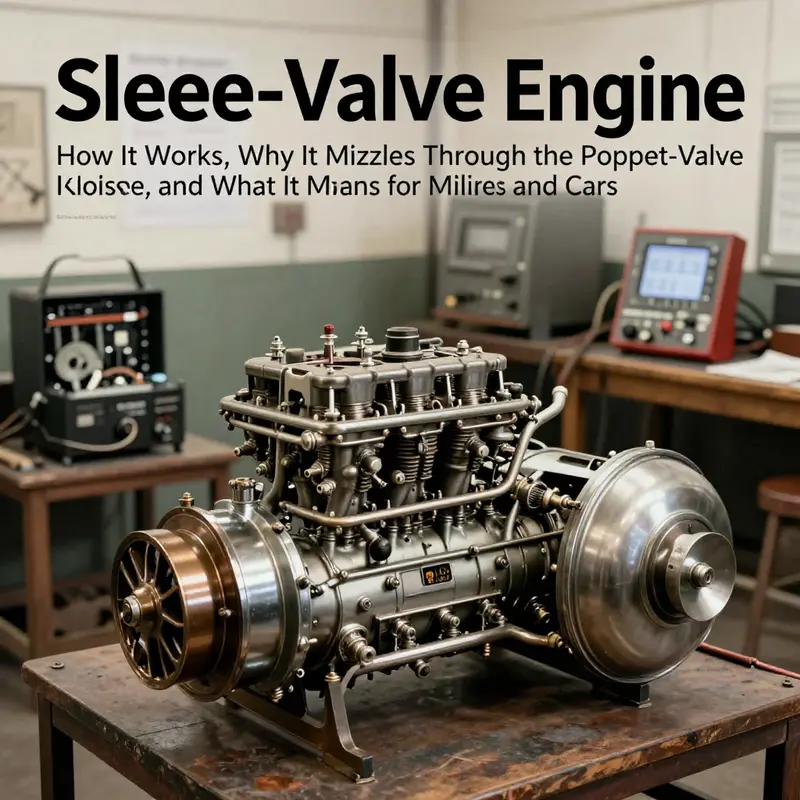
A sleeve-valve engine presents a different kind of listening to the engine’s pulse. Instead of a rigid set of poppet valves opening and closing in time with each crankshaft revolution, a sliding sleeve or sleeves inside the cylinder governs the flow of air and exhaust by shifting its own ports into and out of alignment with the intake and exhaust passages. The result is a more continuous, less jangling interaction between the piston and the cylinder as the piston moves through its power, intake, compression, and exhaust strokes. The principle is elegant in its simplicity: a hollow sleeve carries openings that, at precisely chosen moments in the cycle, reveal or cover the ports in the cylinder head. The piston and sleeve are coordinated so that fresh mixture can rush in when the intake port is open, and burned gases can escape when the exhaust port is open. In many configurations the sleeve is fixed in relation to the piston, so its sliding action becomes an extension of the piston’s motion rather than a separate timing mechanism. The timing is not achieved with a camshaft and poppets but with the synchronized travel of the sleeve itself, a design choice that reshapes not just valve timing but the entire breathing profile of the engine.
To grasp why this approach appealed to early 20th-century engineers, one can imagine how the airflow behaves when throttle bodies and intake runners are smaller, when the flow is interrupted by small, round poppet valves. The sleeve-port arrangement offers a relatively larger, flatter portal for gas to pass through compared with the small valve openings and the surrounding seat. This can reduce the abruptness of flow changes, smooth out the rise and fall of pressure inside the cylinder, and thereby soften the rise of noise and vibration during operation. The smoother breath of the engine translates into a perceived improvement in refinement, especially at moderate to high speeds where abrupt valve action can introduce turbulent losses. In practice, the sleeve’s continuous motion also creates different cooling dynamics: portions of the engine experience heat differently because the hot gas is carried away more steadily, and the sleeve can be shaped and positioned to manage heat in a way that keeps the combustion chamber within a range that supports stable ignition and efficient burn. For engineers curious about the exact mechanics, a detailed treatment of the sleeve’s operation and its timing can be explored in dedicated analyses such as the piece on Sleeve Valve Engine Work, which traces the real-world mechanics and timing relationships of the sleeve and piston in a comprehensive, accessible way. Sleeve Valve Engine Work
The historical arc of the sleeve-valve concept begins with a distinctly modern ambition: to quiet the engine while extracting more power per unit displacement. Charles Yale Knight, credited in the early literature with the development of a single-sleeve concept around the turn of the century, aimed to replace the noisy, high-friction poppet valve train with a more forgiving breathing system. The patenting of the core idea in 1902 set the stage for a generation of experimentation. By the 1920s and 1930s, sleeve-valve engines found a place in both automotive and aviation contexts within a handful of British manufacturers. These firms pursued the technology not only for the novelty of smoother operation but also for the prospect of higher reliability at elevated speeds and improved thermal behavior, especially under demanding aerodynamic or high-altitude conditions. In aviation, the sleeve valve promised a robust, compact path for air and exhaust that could be managed even under the rapid, high-load cycles of a high-performance airframe. In cars, the same logic promised a refinement in drivability and an ability to sustain smoother acceleration across wider rpm bands. The narrative of their adoption is thus not a single tale of triumph but a layered story of engineering ambition meeting production realities, since the sleeve’s own geometry demanded rigorous manufacturing control, precise lubrication, and careful tolerances that were challenging to sustain in mass production.
The practical advantages of the sleeve design are many in theory. The porting area available to the gas flow is often larger and less constrained than a small, circular poppet valve’s seat. This can reduce flow resistance, minimize the throttle-induced turbulence during intake, and lower exhaust-back pressure, contributing to better volumetric efficiency at speed. The sleeve’s movement, being intimately linked with the piston, also creates potential for more efficient thermal management in the combustion chamber. With careful shaping, the sleeve can keep the hottest regions away from the most vulnerable parts of the bore, delaying heat soak that can degrade efficiency and induce knock or pre-ignition. The net effect, at least in controlled environments, can be a cleaner, steadier burn and a slightly crisper power delivery as rpm climbs. Yet these advantages did not guarantee easy triumph in the real world, where complexity tends to ride with performance.
If one peels back the manufacturing layer, the sleeve-valve arrangement reveals its most persistent challenge: the sleeve must translate linear piston motion into a precise, correlated port opening. That translation depends on tight tolerances, robust lubrication, and durable wear surfaces. The sleeve—and the sleeves’ bore—must maintain a snug seal against gas pressure while also sliding smoothly along the cylinder’s interior. The seals, grooves, and lubrication channels that accomplish this must resist scuffing, oil blow-by, and seizure under the heat of operation. Any misalignment or inadequate lubrication can lead to ring-like wear, reduced porting effectiveness, or even a partial seizure that interrupts the breathing cycle altogether. The result is a maintenance burden that was far heavier than the maintenance of simpler poppet-valve engines. Lubrication strategies had to be inventive, with oil circuits and splash schemes designed to keep the sliding surfaces bathed yet not overwhelmed by oil that could foul the combustion process or contaminate the ports. This balance – between reliable lubrication and clean combustion – was a central frontier in sleeve-valve engineering and one of the reasons the technology remained largely confined to niche applications.
From a broader industry perspective, the sleeve-valve concept represents a meaningful detour in the evolution of internal combustion engines. Its promise of smoother flow and thermal control challenged the assumption that mass production requires the simplest possible valve train. In practice, the extra complexity of the sleeves, their seals, and their timing systems translated into higher manufacturing costs and stricter quality control. As postwar engine technology advanced, alternative strategies continued to tame valve train noise and enable higher specific outputs without the sleeve’s intricate geometry. Popper-valve systems evolved with higher efficiency, improved lubrication, and better reliability at scale, while sleeve-valve designs faced a moving target: how to justify the added cost and maintenance burden when simpler designs could deliver comparable or superior performance for much lower production risk. The result was a gradual retreat from widespread automotive and aviation use, even as some specialized projects preserved the concept in hobbyist and historical contexts.
Today the sleeve-valve engine sits at an interesting intersection of engineering history and theoretical exploration. It is a reminder that innovation in engines has often meant not just incremental improvements to a familiar layout but bold departures that attempted to reframe the breathing of the cylinder itself. The sleeve’s promise of smoother flow, refined acoustics, and targeted thermal management remains a compelling case study for students of thermodynamics and mechanistic design, illustrating how a single mechanical rearrangement can ripple through an engine’s entire behavior. In that sense, the sleeve-valve chapter is less a closed commercial story and more a map of what engineers can accomplish when they reimagine the very interface between gas and piston. For readers seeking a concise technical narrative that traces its mechanics in more detail, the linked exploration of Sleeve Valve Engine Work offers an accessible route into the core timing and porting concepts that defined this approach. The broader historical arc can be further explored through archival histories that document the era’s aviation and automotive experiments, which illuminate why a promising concept ultimately found its most lasting value in selective, high-performance niches.
External resource for historical context: https://www.britishaeroplane.com/rolls-royce-merlin-engine-history/
Final thoughts
The sleeve-valve engine represents a distinct engineering path that traded the conventional valve train for a sliding sleeve approach. Its core principles—coordinated piston-sleeve movement, port timing that shapes the breathing cycle, and the replacement of poppet valves with sleeve-controlled ports—offer tangible benefits in flow smoothness and thermal management, alongside unique maintenance and parts considerations. For riders and shop professionals, the practical takeaway is clear: understanding the sleeve mechanism informs better diagnostics, restoration decisions, and parts sourcing strategies, particularly when dealing with vintage machines or niche performance builds. While the technology waned in mass-market production, its lessons about airflow, seal design, and heat handling continue to influence discussions around engine breathing and reliability. Evaluating sleeve-valve cores today means weighing historical performance against modern manufacturing capabilities, fuel systems, and service networks. In the right context, sleeve-valve concepts can inspire feasible retrofit ideas or serve as a precise case study in valve-train alternatives for enthusiasts and professionals alike.