
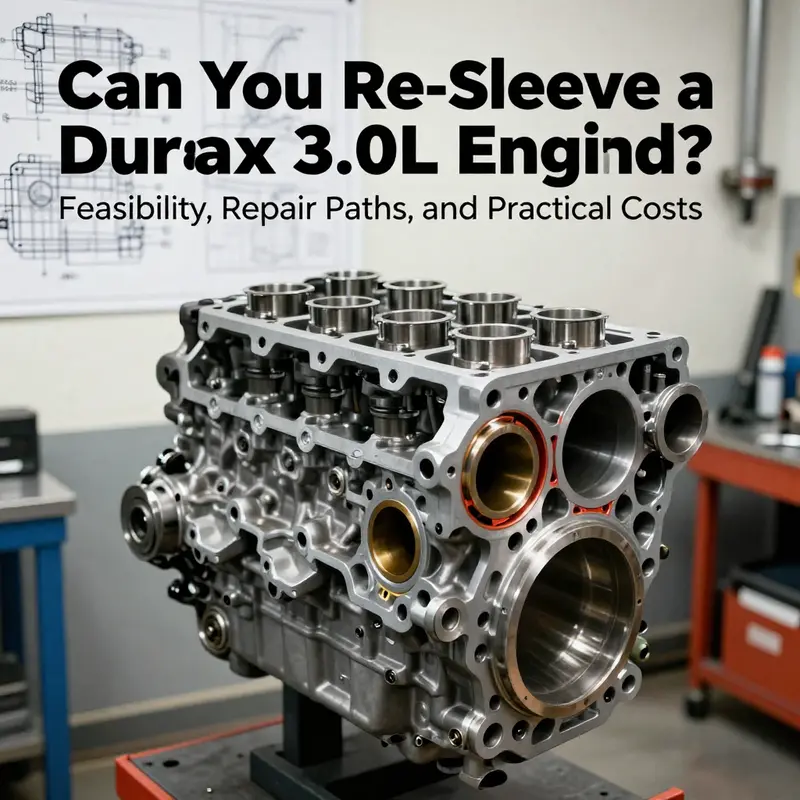
The Duramax 3.0L has defined durability and efficiency in modern turbo-diesel applications, but its aluminum block with integral cast-iron sleeves presents unique repair challenges. When a bore is damaged, traditional sleeving procedures that date back to older iron-block engines aren’t always applicable, and the decision to re-sleeve requires careful analysis of materials, tolerances, and long-term reliability. This article targets motorcycle and auto owners, parts distributors and wholesalers, and repair shops by outlining what makes the Duramax 3.0L sleeve design distinct, what feasible repair approaches exist beyond a simple recoating or honing, and how the economics of sleeving affect maintenance planning, warranty considerations, and service capability. The discussion unfolds in three focused chapters: first, the engineering feasibility, material choices, and design implications of re-sleeving the 3.0L block; second, the spectrum of repair alternatives, their limitations, and the potential failure modes; and third, the economic and workshop implications that influence decision-making in real-world service environments. Together, these sections aim to equip stakeholders with a grounded understanding of when re-sleeving is technically viable, how to evaluate alternatives, and what workflows and costs to anticipate in a modern diesel repair operation.
null
null
Re-sleeving a Duramax 3.0L Block: Weighing Viability, Limits, and Realistic Repair Paths
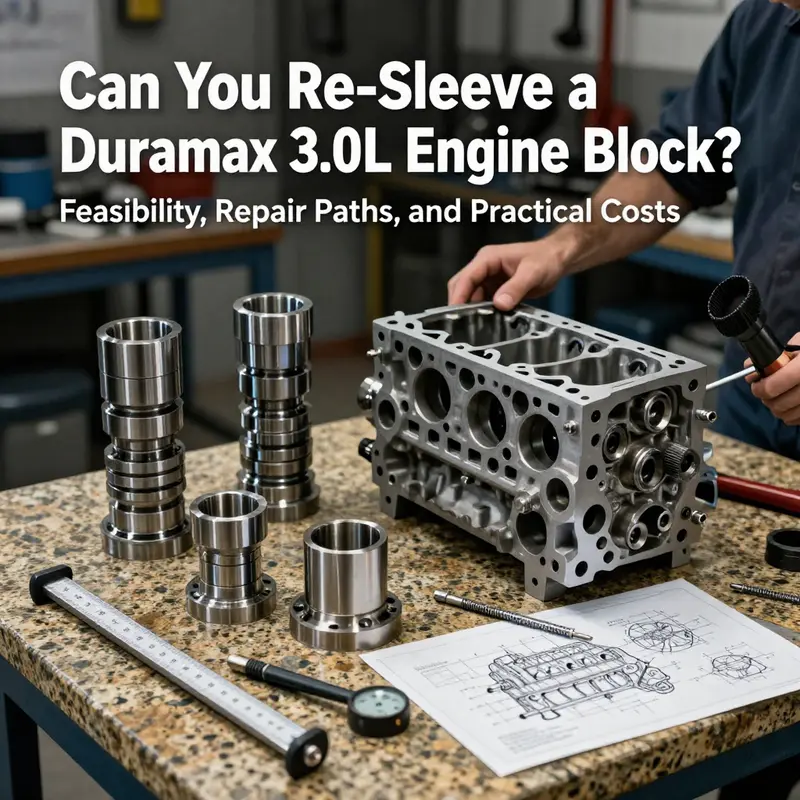
The cylinder bore is the heart of a diesel engine’s sealing and longevity, and in the modern Duramax 3.0L that heart faces a set of design decisions that complicate any traditional sleeve repair. When the walls of a cylinder wear, score, or crack, a technician must weigh not only the immediate fix but also the long-term reliability, the geometry of the bore, and how coolant and oil passages intersect the bore region. In the 3.0L Duramax family, the discussion around re-sleeving is highly technical and practical at the same time. It is not simply a matter of pulling out a damaged wall and slipping in a new sleeve, because the block’s architecture—whether described as aluminum with iron liners or a cast-iron block with precision-machined bores—set limits that are different from those in older engines. These limits shape every repair decision and, more importantly, determine what counts as a mechanical success versus a costly failure soon after the rebuild. To understand why sleeves are rarely used as a repair in this engine, it helps to look beyond the sleeve itself and examine the surrounding features that either support or undermine a sleeving approach. The bore must hold a sleeve under thermal cycling and mechanical loads while remaining perfectly round and coaxial with the crank and valve train. The cooling passages must deliver uniform cooling without causing differential expansion at the bore edge. The oil galleries must align with the piston rings to maintain lubrication and sealing. Any misalignment, distortion, or change to the bore diameter can propagate a cascade of failures, from rings sticking and loss of compression to oil consumption and coolant leaks. In short, the 3.0L Duramax is a compact, high-stress platform where the bore is not a stand-alone wear item but an integrated feature of a high-performance system. Because of that integration, sleeves, if attempted, demand a level of precision machining and verification that is expensive and time-consuming, and that precision must be maintained across the entire engine assembly, not just the bore wall.
For readers who want the broad strokes about engine sleeves in general, a helpful starting point is to understand what engine sleeves are and how they function within a block. What engine sleeves are gives an overview of wet and dry sleeve concepts, the materials typically used, and the kind of machining required to install a sleeve in a conventional scenario. That foundational knowledge is essential when one weighs the Duramax 3.0L’s particular layout against sleeve repair possibilities. The Duramax’s design imposes an unusual set of constraints: the bore planes, the alignment of the coolant channels, and the way the block structurally supports the cylinder walls. Even when sleeves are technically possible, the engineering risk remains high if the bore’s seating, wall thickness, and the sleeve’s fit are not exact. In practice, the most conservative repair choices are favored when the block’s remaining life is uncertain and the cost of a sleeving job climbs above the price of a replacement block or a remanufactured engine that offers verified performance.
When a cylinder wall has sustained damage, the first line of defense is a careful inspection and bore evaluation. Minor surface wear or slight scoring may respond well to professional honing, which reestablishes a true cylindrical surface with the correct surface finish and roundness. A seasoned machinist will measure roundness, taper, and the cylindricity of the bore, then determine whether a standard honing pass is enough to restore proper sealing with the piston rings. The advantage of honing is that it preserves the original bore diameter and the structural characteristics of the block while improving the surface finish to support optimal ring seating. However, honing cannot correct deep scoring, heat damage, or structural flaws in the bore edge. If the bore is compromised in a way that honing cannot cure, the repair path must shift to more robust options, even if those options are less convenient or more costly. In the context of the Duramax 3.0L, honing is a common, prudent step for many wear scenarios, and it is the first checkpoint in the decision tree for a failed cylinder.
Another repair technique that is widely discussed in advanced repair circles is bore plating, sometimes called Nikasil or electroless nickel plating. This process coats the inner surface of the bore with a hard, wear-resistant layer that can restore sealing capability without removing material lineage from the wall. For engines where the bore itself has not failed structurally, bore plating can effectively restore the seal and reduce oil consumption by refining the surface hardness and improving wear characteristics. The advantage is that it keeps the original bore size and avoids the complexity of sleeve installation. The downside is that plating requires meticulous surface preparation, a controlled coating thickness, and an even coat that cannot be compromised by any misalignment or defect in the bore geometry. As with any repair that changes the surface properties inside a bore, plating demands rigorous quality control and testing to ensure the coating adheres under the engine’s thermal and pressure cycles.
If damage is more substantial, the industry commonly considers engine replacement as a preferred option. In the Duramax 3.0L ecosystem, a rebuilt or remanufactured engine can deliver predictability, known performance benchmarks, and a warranty path that might be less risky than a bespoke sleeve repair. Replacing the block or engine removes the uncertainty associated with the bore’s ability to maintain integrity over a long service life after a sleeve intervention. It also provides opportunities for updated components and validated tolerances that a patch repair cannot guarantee. In this scenario, the decision to replace rather than sleeve is often driven by cost comparisons, availability of a suitable core, and the owner’s tolerance for downtime and uncertainty. The practical reality is that a sleeving operation, even when technically feasible, becomes a high-stakes engineering project where every component—coolant passages, oil galleries, head gasket sealing, valve train alignment, manifold fitment, and turbocharger interfaces—must be revalidated in concert with the sleeve installation. Any one of these interfaces can become a point of failure if the sleeving is not executed to an exact specification, and the consequences can propagate quickly across the engine’s operating envelope.
The specialized nature of the Duramax 3.0L’s cylinder bore complicates sleeve attempts to a degree that pushes most repair shops toward alternative strategies. A sleeve must be precisely located relative to the bore axis and must harmonize with the block’s surrounding materials. The sleeve’s position is not simply a matter of seating it into a hole; a failure to preserve concentricity can result in piston slap, uneven compression, or accelerated wear on the rings and bearing surfaces. Moreover, the 3.0L’s bore geometry, cooling channel routing, and oil gallery layouts place a strong emphasis on heat transfer and lubrication stability. If a sleeve is installed but the bore becomes a heat-induced distortion point, the entire engine’s reliability is jeopardized. The risk is not limited to a single cylinder; if one sleeve fails to hold its tolerances, it can cast a shadow over the rest of the engine’s life cycle, undermining the project’s overall goals.
In the most cautious assessments, sleeve repair is described as technically possible but conventionally impractical for the Duramax 3.0L. The consensus in expert repair literature points toward honing and bore plating as the practical accommodations for minor to moderate cylinder wear, with full engine replacement as the standard response to more severe damage. The sleeve option tends to be the tail end of the decision tree, engaged only when a shop with very specific capabilities agrees to undertake a true bespoke repair and the customer understands the elevated risk profile and the potential long-term implications. Even when a shop includes bore restoration methods in its repertoire, it will often stage the workflow with rigorous measurements, multiple confirmation passes, and a risk acknowledgment that the final outcome may not meet the same durability expectations as a factory remanufactured unit. For readers navigating this terrain, the crucial question is not simply whether sleeves can be installed but whether the project will meet the engine’s endurance demands under real-world use, with turbocharged diesel operating temperatures and the high-stress duty cycles typical of modern pickups and heavy-use applications.
Maintenance and failure mode awareness also shape the decision. When the Duramax 3.0L cylinder walls suffer, several failure modes tend to appear in sequence if the root causes—such as overheating, detonation, or lubricant contamination—are not properly managed. Piston ring breakage or excessive wear is a frequent symptom, often leading to oil consumption and degraded compression. Cylinder wall scoring can occur from abrasive debris, coolant intrusion, or improper lubrication, and it undermines the seal between the piston rings and the bore. Head gasket failures can introduce coolant into the combustion chamber or allow cross-contamination between cooling and lubrication circuits, which is particularly dangerous in a turbocharged diesel where pressures and temperatures swing quickly. Injector leaks are another important concern, as leakage can dilute fuel, induce premature wear on the chamber surface, and accelerate deposits that worsen sealing. Each failure mode informs the repair strategy: if ring wear dominates, honing or plating may suffice; if bore damage is extensive, the prognosis for a sleeve repair becomes more guarded; if head gasket integrity is compromised, addressing cooling and sealing becomes a prerequisite before any bore work is considered viable.
The decision framework thus hinges on several practical factors. First, the availability of a suitably prepared block or a rebuilt engine is central. A replacement unit offers a known baseline for tolerances, a controlled assembly process, and the possibility of warranty coverage. The second factor is the level of precision machining the shop can deliver. A sleeve installation would demand line boring, true bore alignment, precise sleeve interference fit, careful heat-treatment considerations for the sleeve material, and meticulous surface finishing. Finally, the customer’s risk tolerance, budget, and intended use—daily driver versus high-performance application—drive the calculus. If the aim is a long-term, low-uncertainty solution, many technicians counsel against sleeving the 3.0L and favor a proven remanufactured block or engine that has undergone stringent testing and validation.
From a design and engineering perspective, the Duramax 3.0L’s cylinder organization—whether described as aluminum blocks with iron liners or as a block with precision-machined bores—was chosen to optimize weight, thermal management, and structural rigidity within modern turbo-diesel constraints. Sleeving in this context would need to reconcile the sleeve material properties with the block’s thermal conductivity, the geometry of the bore with the sleeve’s wall thickness, and the cyclic loading from forced induction without introducing heat traps or lubrication gaps. The engineering risk is not merely about achieving a sealed bore; it is about maintaining that seal across tens of thousands of miles, under variable ambient temperatures, fuel quality conditions, and the unpredictable stresses of real-world use. For many high-mileage Duramax 3.0L engines, a decisive path that balances reliability, cost, and time remains replacement rather than re-sleeving. Yet the topic retains interest for a subset of engines that operate in specialized conditions or in a shop that has developed a refined, cautious approach to engineered bore repair.
What does this mean for a vehicle owner facing cylinder wear? It means starting with a precise condition assessment and a clear price-to-risk assessment. A professional shop will begin with a tear-down plan, imaging the cylinder walls and evaluating the bore for scoring depth, taper, and ovality. They will also check the block for any latent distortions around the cylinder region, which could compromise a sleeve’s seating even if the bore itself looks superficially acceptable. If the wear or damage is minor, honing can restore the bore’s cylindricality, surface finish, and sealing capability with the original geometry intact. If more substantial wear is found and the shop has the capability, bore plating might be offered as a repair that preserves bore dimensions while restoring wear resistance. If neither option yields a sustainable result, engine replacement becomes the rational decision, especially when the owner’s goals include credible reliability and predictable performance. In all scenarios, communication between the technician and the owner—discussing the limits of the repair, the expected service life, the warranty implications, and the downtime involved—is essential to arrive at a decision that aligns with one’s use-case and budget.
The overarching takeaway is that re-sleeving a Duramax 3.0L engine block, while technically possible in controlled settings, remains a high-stakes, specialized operation with significant risk factors associated with bore geometry, cooling and lubrication integration, and the engine’s overall reliability. For most repair scenarios, conservative strategies that emphasize honing or bore plating, or the certainty of engine replacement, provide a more straightforward route to a dependable engine return. The nuanced reality is that the sleeve path, though discussed in some advanced repair circles and mentioned in specialty technical resources, rarely delivers a durable, cost-effective solution in the Duramax 3.0L’s design space. As with many modern high-performance diesels, the balance between repair feasibility and long-term reliability tips toward replacement or established bore restoration methods that preserve the original bore integrity and avoid introducing new failure vectors into a high-thermal-load, high-pressure engine ecosystem.
For readers seeking deeper technical detail on repair procedures and the broader repair landscape, consult the official service manuals and specialized technical guides, which offer the most authoritative guidance on tolerances, line boring, sleeve installation feasibility, and post-repair testing. These resources emphasize meticulous measurement, alignment, and validation procedures as prerequisites to any bore work. In the end, the question of whether you can re-sleeve a Duramax 3.0L block does have an answer—yes in theory, but practically it is rarely the right choice. The recommended path for most owners is to pursue honing or bore plating for limited wear, or to pursue engine replacement for more extensive damage, under the supervision of a shop that has demonstrated experience with modern turbo-diesel engines and a rigorous quality assurance regime. The goal is a repair that preserves the engine’s reliability, performance, and longevity without introducing avoidable risk.
In closing, the Duramax 3.0L’s unique bore architecture is what makes sleeves such a controversial topic. The decision to sleeve should be undertaken only after a thorough evaluation of all variables—design compatibility, machining capability, and long-term performance expectations. When executed by a skilled team in a suitable context, a bore restoration approach can be a viable alternative to full block replacement. But sleeve installation, given the engine’s specific geometry and thermal dynamics, remains a rare, high-risk option that commands a clear justification and an explicit agreement on durability expectations. For most owners, the simplest, most reliable path remains a well-executed honing, potential bore plating, or a remanufactured engine solution, each chosen with a careful eye toward the engine’s intended use, the owner’s budget, and the acceptable downtime. External reference: Diesel Power magazine technical guides.
Resleeving a Duramax 3.0L Block: Economic, Operational, and Workshop Realities
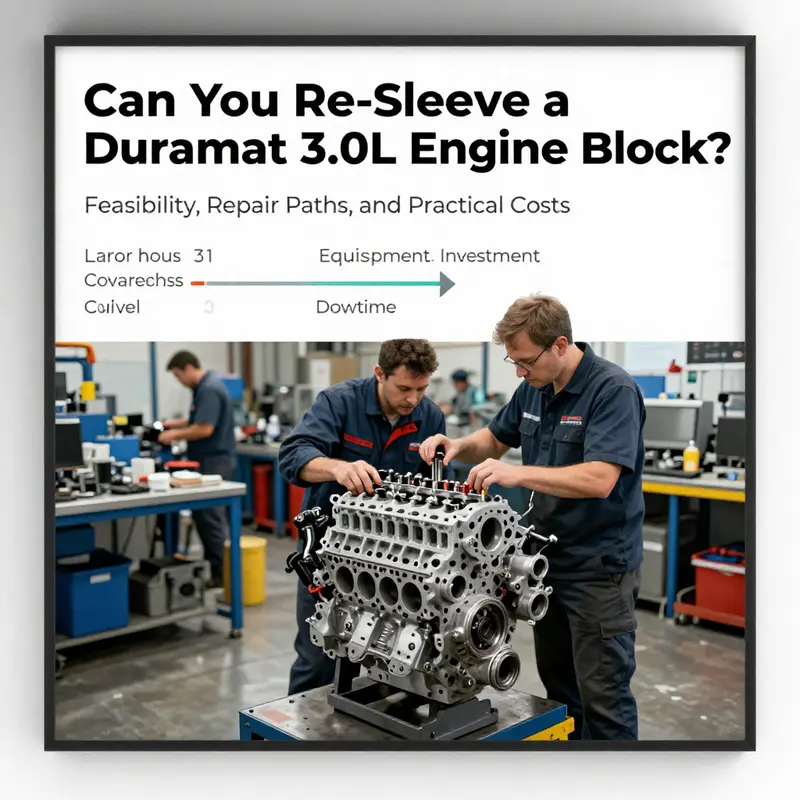
The Duramax 3.0L block sits at the intersection of modern engineering and practical repair work. It uses an aluminum block cast to house a set of cylinder walls that are, in practice, integrated with the block itself through a liner system. This design is different from older diesel layouts where a cast-iron block could be rewritten more easily with removable sleeves. In the 3.0L Duramax, the sleeves are part of the block’s architecture, which means the repair landscape after cylinder-wall damage takes on a different shape. When a bore shows signs of overheating, detonation, or severe wear, two broad paths present themselves: refine the existing bore through honing and close inspection, or pursue a full engine block replacement. Sleeving—removing the damaged bore material and installing precision sleeves to restore the cylinder diameter—has historically been a more common solution with some engine families. For the Duramax 3.0L, this path is possible, but it sits within a specialized niche of machine work and tight tolerances, not a standard, routine fix found in every shop or in every repair scenario. The literature on this topic emphasizes that while re-sleeving can be accomplished, it demands a high level of precision, sophisticated equipment, and a clear plan for uncertainty, especially given the block’s aluminum substrate and the thermal behavior characteristic of modern turbo-diesel operation.
A core piece of the story is the physical reality of the block itself. The 3.0L Duramax relies on an aluminum crankcase with cylinder walls that are bonded or otherwise integrated with the liner structure. When the bore is compromised, simply swapping in a new sleeve is not as straightforward as it might be on a traditional iron-block design. The bore must be coaxial with the rest of the engine’s rotating assembly and must maintain exact wall thickness, surface finish, and sealing integrity to handle the pressures and heat of modern diesel operation. As a result, even though the concept of re-sleeving exists in the broader diesel repair world, the Duramax 3.0L block makes the process more demanding. This is why many discussions in the field frame sleeving as a specialized option rather than a first-line repair. Yet, with the right conditions—good block integrity, high-quality sleeves, and precise machining—the option can restore a block to a near-new state without the cost and downtime of a full engine block replacement.
To understand the practicalities, it helps to map out what distinguishes a re-sleeve repair from the simplest path of honing. Honing a bore is a relatively common step when damage is minor—pitting, light scoring, or slight taper can sometimes be corrected with careful honing and a recheck of ring seal integrity. In those cases, the engine can be brought back to spec without introducing sleeves at all. When damage is deeper—unseen scoring, groove wear, or a hollowed wall that compromises compression and oil control—re-sleeving enters the conversation. For a modern aluminum block with integrated sleeves, the decision to sleeve becomes an engineering judgment: how much material can be safely removed or replaced, how the sleeve will seal against the block, and how the bore will be finished so that the piston rings seat correctly and oil control remains predictable across operating temperatures.
Within this framework, it is possible to perform a re-sleeve using sleeves produced from robust materials like cast iron or ductile iron, chosen for their wear resistance and thermal properties. The sleeves must be machined to exact inner diameters, then pressed or otherwise secured into the prepared bore, and finally machined to the precise outer dimensions to ensure a perfect fit with the aluminum block. Sealing is a critical step; the interface between the sleeve and the block must be sealed to prevent coolant ingress and oil leakage, which would undermine compression and lubrication schemes. The industry recognizes several best practices in this space: precise alignment of the sleeves with the bore axis, careful surface finishing to minimize friction, and bore restoration techniques that bring the finished bore back to the required tolerance. A key takeaway is that the overall success of a re-sleeve hinges on the sum of many small decisions taken during machining, assembly, and initial engine run-up.
Economically, re-sleeving can be a compelling option when the block’s core remains sound and only the bore surfaces require attention. The economic calculus typically weighs the cost of a new factory block against the repair work required to install sleeves, plus the cost of labor, machine time, and the materials involved. Reports from shops that perform this work regularly describe a price range for a professional re-sleeve that is significantly lower than the price of a brand-new block. In practical terms, this means the economics can favor sleeving, especially for engines with substantial remaining life, where downtime and block replacement would extend repair time and disrupt vehicle use. The numbers commonly cited in the field suggest that a new Duramax 3.0L block can exceed a few thousand dollars, whereas a well-executed sleeving job, including precision bore work and final assembly checks, can fall into a lower tier of cost. The total bill often breaks down into parts and labor, with sleeves themselves representing a material cost that is modest compared to the overall repair. Importantly, re-sleeving can preserve components that wear well when the rest of the assembly is in good shape—pistons, rings, and the crankshaft may all be reusable if their surfaces and clearances meet the required standards. This reuse aspect supports the argument that sleeving can be a budget-conscious yet high-value repair strategy when executed correctly.
Operationally, the quality of the outcome in a re-sleeve depends on what happens after the machining work finishes. The sleeves chosen must align with the engine’s tolerances and the hardware that surrounds the cylinder walls. The finishing steps—bore finishing, honing, and final round of measurements—must verify that the bore is perfectly square and smooth, and that the vertical and horizontal alignments are in spec. The surface finish of the bore is more than a cosmetic concern; it directly influences how quickly rings seat and how well oil becomes distributed in the ring lands. If the bore finish is too rough, ring sealing suffers; if too smooth, the oil film may be compromised. The seal between the sleeve and the block—validated by appropriate gaskets or epoxy along with O-ring seals in certain designs—is equally critical. Any micro-leak or misalignment can yield a cascade of issues: reduced compression, lower boost efficiency, increased coolant leakage, and in the worst case, a failure that can cascade into overheating or a loss of lubrication. In other words, a sleeving decision is not about choosing a patch; it is about restoring a tightly engineered balance between heat, pressure, and wear resistance that the 3.0L Duramax relies on during intense driving conditions.
From a workshop perspective, sleeving the Duramax 3.0L is both an opportunity and a risk. The opportunity lies in offering a durable, cost-conscious repair path to customers who want to keep their high-mileage or heavily used trucks on the road. It also distinguishes a shop with advanced machine capabilities from a standard rebuild operation. The risk, however, is equally real. The equipment required for sleeves is non-trivial: a precision lathe or boring mill to machine the block, a press or specialized tooling to insert the sleeves, and a bore aligner to ensure coaxial accuracy. Overlaying these are the skills demanded of technicians who understand diesel engine thermodynamics, torque and sealing protocols, and the delicate interplay between aluminum blocks and iron sleeves under changing thermal loads. The upfront investment in equipment, the calibration of measurement instruments, and the need for rigorous process control all contribute to making sleeving a willingness-to-invest decision rather than a low-cost, risk-free option. Shops that master the technique often develop a reputation for handling high-mileage engines or specialized builds where reliability under heavy use is the priority. For vehicle owners, this translates into a repair path that preserves the core hardware of the engine while achieving outcomes comparable to a fresh build, provided the process is executed with discipline and precision.
In the practical flow of decision making, the Duramax 3.0L sleeving option should be considered alongside a thorough assessment of the block’s overall condition. This means evaluating the structural integrity of the aluminum matrix, the condition of the crankcase, and the alignment of decks and main bearing surfaces. If the block is compromised beyond the bore, sleeving may still be feasible, but the risk of long-term issues grows. In such cases, some shops will recommend block replacement as the more predictable long-term solution, especially when warranty considerations or expected duty cycles—such as heavy towing or extreme ambient temperatures—demand maximum reliability. The decision is never purely technical or purely economic; it sits at the intersection of durability goals, downtime, and customer expectations for performance. The guiding principle is to preserve what is working well in the existing block, minimize intrusive changes to the rest of the rotating assembly, and ensure the bore geometry supports robust piston sealing and oil control under the engine’s anticipated operating envelope.
In weaving together these threads—the engineering realities, the cost dynamics, and the workshop implications—there emerges a practical synthesis. Re-sleeving a Duramax 3.0L engine block is not a blanket recommendation nor a one-size-fits-all alternative. It is a controlled, precision-oriented repair path that can deliver a durable result when the block remains otherwise viable, when sleeve materials and tolerances are matched to the engine’s operating demands, and when the shop has the skill set and the equipment to execute the job to factory-like standards. It is, at its best, a bridge between the financial practicality of repair and the mechanical reliability that modern diesel engines demand. For technicians and shop owners, the allure lies in offering a high-value service that preserves core components and delivers a return on investment that aligns with the vehicle’s usage profile, while for owners, it offers the chance to extend service life without the higher cost and longer downtime of a block replacement.
For a deeper dive into the conceptual and practical aspects of sleeving an engine, including the terminology, material considerations, and the decision framework, see a concise guide that covers what sleeving an engine means. This resource helps illuminate how the sleeve selection and installation process is shaped by the specific engine design and the demands of diesel operation, and it provides a useful reference point when weighing the sleeving path for a Duramax 3.0L block. What sleeving an engine means.
Additionally, practitioners planning a sleeving project should stay current with factory guidance on cylinder block repairs and sleeve installations. Official service literature for GM diesel engines outlines recommended practices and tolerances that help ensure a sleeve job will hold up under the thermal and mechanical stresses that torque the assembly during operation. This reference framework is essential because it anchors the repair in a tested, manufacturer-supported approach, reducing the risk that a sleeving job might drift into an unproven method and later manifest reliability concerns. External guidance, such as factory service bulletins, provides the standards by which a sleeve installation should be judged and offers procedural guardrails that align with engineering intent for long-term engine durability.
In sum, sleeving the Duramax 3.0L block is not merely a repair technique; it is a careful engineering choice that must be evaluated against the engine’s overall health, the projected use case, and the shop’s capability to deliver a measured, repeatable, and durable result. When carried out with disciplined machining, strict adherence to tolerances, and a clear plan for seal integrity and bore finish, sleeving can restore cylinder bore integrity, revive compression, and sustain reliable performance across a meaningful portion of the engine’s service life. The practice, while specialized, is not exotic. It sits alongside a spectrum of modern repair options where the objective is to preserve the core architecture of a sophisticated diesel engine while aligning the repair strategy with practical constraints and real-world usage.
External resource: GM Service Bulletin guidance for cylinder block repairs and sleeve installations in General Motors diesel engines. https://www.gm.com/technical-service-bulletins/22-07-30-006A
Final thoughts
Re-sleeving a Duramax 3.0L engine block is a technically nuanced option that hinges on block design, material behavior, and precise machining. While not a standard repair in most shops, advanced sleeve solutions and bore restoration approaches exist in specialty facilities. Owners, distributors, and service providers should weigh feasibility against the reliability demands of turbo-diesel operation, compare sleeve-based remedies to full block replacement, and plan for a clear decision workflow that includes warranty and long-term service implications. In many cases, a rebuild or a block replacement may remain the most predictable path, but for certain high-value installations or specialist fleets, carefully engineered sleeves—executed by experienced machinists—can extend engine life when performed with rigorous quality control.