
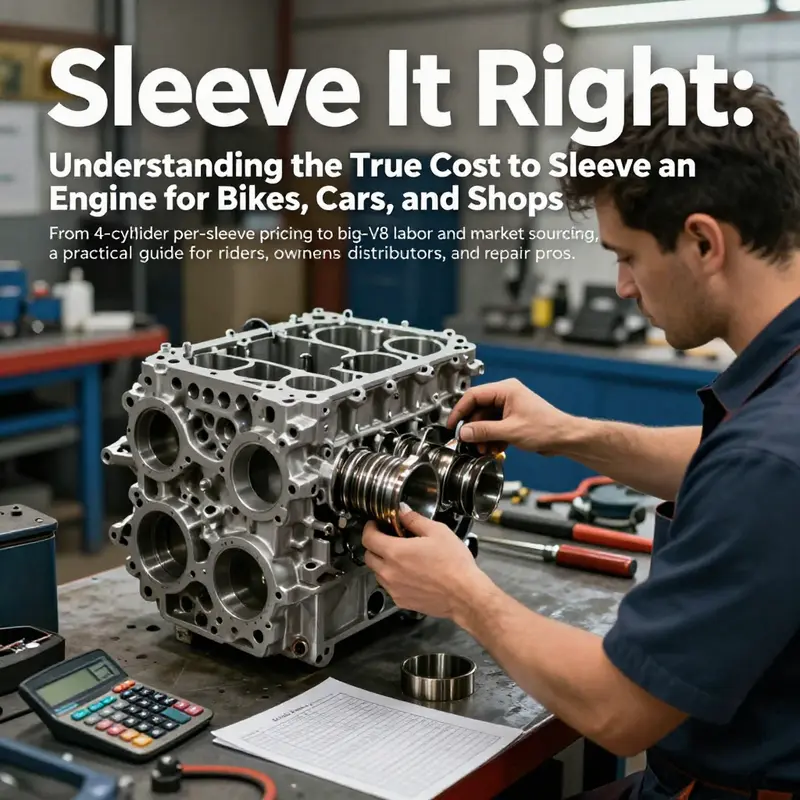
Engine sleeving is a precision repair that restores worn bores by inserting durable sleeves. For motorcycles and passenger/industrial engines alike, the decision to sleeve hinges on bore wear, cost, and expected service life. Pricing is never fixed; it blends sleeve material, machining work, installation labor, and overhead, then adjusts for engine size, make, and regional labor rates. Understanding the math helps motorcycle and auto owners budget repairs, while giving distributors and shops a clearer framework for quoting and procurement. This article breaks the topic into three focused chapters: Chapter 1 analyzes 4-cylinder sleeve pricing and the per-sleeve breakdown; Chapter 2 covers larger engines (V8 and beyond) where labor complexity drives cost higher; Chapter 3 dives into market variability, sourcing options, and reliable price sources. Each section builds on the previous one to provide a cohesive view of sleeve costs across common engine families and purchasing scenarios.
Economics Under the Sleeve: Decoding 4-Cylinder Re-Sleeving Costs, Per-Sleeve Realities, and the Practical Tradeoffs
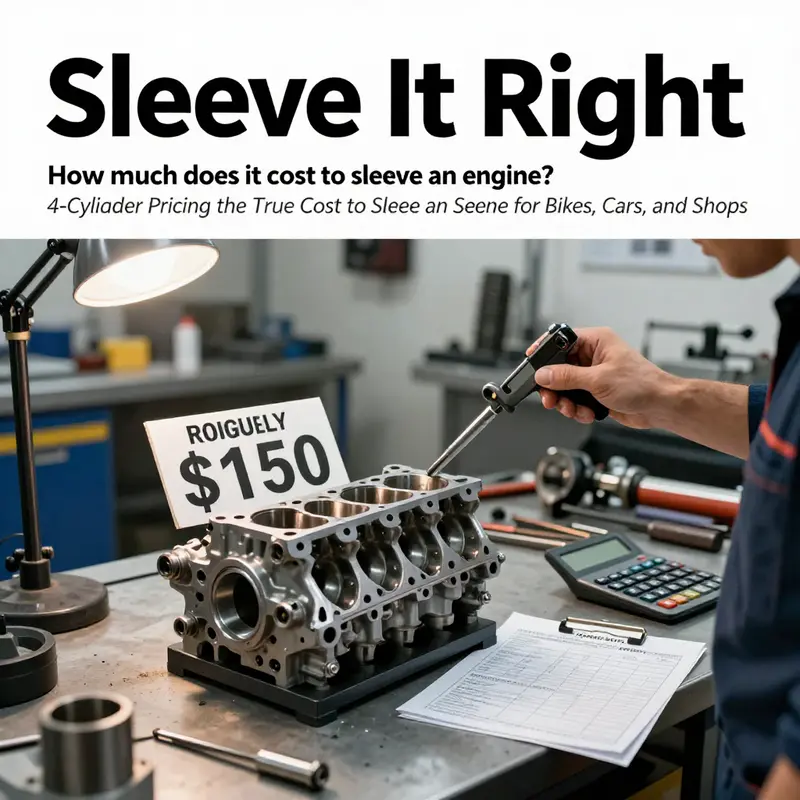
On the shop floor, the moment of decision often arrives after a stubborn set of warnings from the engine itself: loss of compression, rough idle, and the telltale glow of scoring in the cylinder walls. Re-sleeving a cylinder is more than a replacement task; it is a precision operation that restores bore integrity, controls heat transfer, and sets the stage for reliable combustion again. The costs that accrue along the way are as much about the mechanics of the process as they are about the realities of the market, the particular engine in question, and the shop’s location and rate structure. For a standard four-cylinder engine, the price tag can feel almost like a bell curve, veering from a conservative range to higher, more specialized figures depending on the factors at play. In many typical repair scenarios, customers see a total price in the neighborhood of $900 to $1,500, but that is a broad brush. When a shop is chasing tighter tolerances, when premium sleeve materials are specified, or when the job drags in additional machining steps, the bill can creep up toward or beyond the $2,000 mark. The numbers you actually pay will still hinge on the same underlying bones of the repair: sleeves, labor, and the ancillary work that breathes life into a block that would otherwise head toward the scrap pile or a costly full engine rebuild.
To understand the structure of those costs, it helps to break the total into two practical components: the sleeves themselves and the labor surrounding their installation. In practice, a single cylinder sleeve, including the installation work, often lands in the $200 to $350 range. Multiply that by four for a complete four-cylinder rebuild, and you’re looking at roughly $800 to $1,400 just for the sleeves. This per-sleeve figure is not a guaranteed price; it reflects a range that captures the reality of different sleeve materials, the precision required for fit, and the level of machining the block must endure to reach optimum tolerances. The sleeve material choice itself can tilt the figures. Cast iron sleeves, commonly used for durability and cost-effectiveness, sit on the lower end of the spectrum, while stainless steel or nickel-plated variants, which offer specific friction, wear, or longevity advantages, push costs up a notch. Dry-fit sleeves, which require additional handling and final sealing, can also nudge the price higher because they demand tighter machining and verification steps.
When the entire cost is tallied, the total for a 4-cylinder re-sleeve typically appears in a band that captures both the machining ecosystem and the labor intensity. The base repair, which includes sleeve removal, installation, block preparation, honing, and a basic inspection, can land in the $900 to $1,500 band. But the exact number depends on several levers: the engine’s make and model, the block’s condition, whether the sleeves require pre- or post-install machining, and whether additional work such as piston replacement or crank inspection is warranted. In some cases, especially with modern or performance-focused engines, a shop may adopt a more conservative approach to tolerances and require extra steps, nudging costs toward $2,000 or beyond. This is not merely a reflection of desire to charge more; it is an acknowledgment of the increase in precision, the complexity of the fixture, and the risk management that accompanies any repair that touches the heart of the engine’s operating cycle.
The process begins with an accurate diagnosis. A technician will assess bore wear, the evenness of the cylinder walls, and whether there is any scoring, ovalization, or water intrusion that would render a simple overbore inappropriate. If the bore is still workable with a sleeve, the next steps are outlined with a careful plan: remove the assembly to access the block, select the appropriate sleeve size and material, machine the block to receive the new liner, fit the sleeve to the bore, and then hone to the exact finished diameter and surface finish required for the piston ring pack and the intended compression ratio. It is here that the heart of the cost lies beyond the sleeve price itself. The installer must ensure alignment with the crankshaft and piston geometry, confirm proper cooling channels, and verify that the deck height remains within spec after the sleeve install. All of these steps are labor-intensive and require precision measuring tools and a steady hand honed by experience.
There is a broader economic truth behind these numbers: re-sleeving is often more economical than replacing an engine block, especially in older or classic vehicles where original parts may be scarce or prohibitively expensive. Re-sleeving restores the bore and makes it possible to operate the engine safely at the intended compression and with a renewed tolerance to heat and pressure. For enthusiasts and restorers, this is a practical bridge between preservation and performance. The cost is not merely a financial decision but a decision about how much of the original block one is willing to preserve and how much reliability one needs for daily driving or spirited use. In practical terms, a four-cylinder re-sleeve, when pursued with reasoned expectations, can deliver a return on investment that makes the repair worth it when the alternative is a more expensive block replacement or a complete engine rebuild.
To ground this discussion in a bit of context, consider the broader pricing landscape. Several sources in the field place 4-cylinder re-sleeving within a range similar to what’s described above, acknowledging that the particular engine model, the city or region, and the specific shop’s rates can move the numbers. In certain more specialized shops, especially where performance builds or classic restorations meet exacting standards, the price can climb as the shop accounts for rare sleeves, specialized tooling, and meticulous measurement protocols. Conversely, many standard repair shops will price toward the lower end of the spectrum, particularly when the engine model uses a common sleeve design and routine machining. The reality is that the sleeve itself is only part of the equation; the labor, the precision, and the quality of the finishing work are what ultimately shape the final invoice. For people trying to estimate a budget, it is prudent to think in terms of up-front quotes that itemize the sleeve price, the labor, and the ancillary work. A straight per-sleeve model can be helpful for planning, but it should always be coupled with a clear understanding of what each sleeve install entails and whether additional line-bore checks, deck resurfacing, or crankwork might be required.
A particularly informative lens on the subject can be gained by understanding the sleeve’s role within the engine’s architecture. If you want to ground yourself in the basics of what sleeves are and how they function within a block, you can read a concise primer that explains their purpose and the typical use cases for re-sleeving. What are engine sleeves? This resource helps frame why the sleeves are needed, what the different sleeve options mean for wear and heat transfer, and how a shop determines when a sleeve replacement is the most sensible approach. The answer to whether a given engine actually requires a sleeve is often not a simple yes or no; it depends on the structural integrity of the bore, the depth of wear, and the intended service life after the repair. A strong part of the decision-making rests on whether the block can be machined to receive a sleeve that will hold the compression, the coolant, and the oil pressures the engine will encounter without degrading the alignment or the surface finish that the piston rings rely on for a proper seal.
When the discussion shifts to per-sleeve costs in a four-cylinder setup, it is also helpful to contrast these prices with the realities of larger engines, where the economics move in a different scale. In a V8 or similarly sized six- or eight-cylinder layout, the number of sleeves increases, and so does the time spent on each sleeve’s preparation and verification. The labor hours tend to rise with the number of cylinders, and the complexity of the required line bore checks and the need for precise head-to-deck alignment can add up quickly. As a practical rule of thumb, the sleeve count and the corresponding labor can push the total repair cost into a higher band, sometimes meaning that the difference between a well-executed 4-cylinder sleeve job and a basic V8 re-sleeve becomes substantial. This isn’t merely a matter of scale; it reflects the incremental hours and the higher likelihood of encountering unusual machining variances across more cylinders. For a technician, the challenge is not simply dropping sleeves into a block but orchestrating a synchronized set of measurements and adjustments that ensure uniform bore sizing, consistent lubricating film, and reliable heat transfer across all cylinders.
The materials story is an important part of the equation as well. Cast iron sleeves are robust and predictable, which helps with cost control but may not deliver the same heat resistance or wear properties as stainless steel or nickel-plated variants. In high-performance or high-mileage scenarios, the shop might recommend more advanced sleeves because of the anticipated demands on torque, compression, and longevity. Each material category carries with it a different fabrication and finishing cost, and that cost is passed along in the final bill. Other options, such as dry-fit sleeves that require precise preparation and fitment, can increase both the machining time and the required quality assurance checks. The result is a broader distribution of price rather than a single fixed number. A customer who is choosing sleeves with enhanced corrosion resistance, lower friction, or a design that tolerates tighter clearances may expect to pay a premium that is justified by the projected service life and reliability gains.
The story would be incomplete without addressing the ancillary work that often accompanies a sleeve job. Even when the block is mechanically prepared and the sleeves are installed to spec, there are other pieces of the repair that frequently appear on the invoice. The block may require honing to achieve the correct surface finish for the piston rings. The cooling passages might need inspection for blockage or damage, and the head or deck surfaces may need resurfacing to ensure proper sealing with new gaskets. If the engine has high mileage or signs of prior maintenance neglect, the technician may recommend a more thorough inspection of the crankshaft, connecting rods, and bearings, and perhaps even the pistons and rings if wear or debris is suspected in the bottom end. These steps, while not exclusive to re-sleeving, are often bundled into a comprehensive repair package when a shop believes the engine’s longevity depends on more than simply installing new sleeves. Each of these steps increases the total cost, but they can also increase the repair’s value by reducing the risk of a premature failure after the engine is back in service.
All of these factors coalesce into a set of expectations customers can carry into the repair quote. A typical four-cylinder re-sleeve will come with a price floor anchored by the sleeves themselves and the core labor. The price ceiling will be shaped by the engine’s particularities, the materials chosen, and any incidental work required to bring the bore to spec and ensure a reliable seal for thousands of miles to come. The practical takeaway for readers is to approach a sleeve job with a clear understanding that while the sleeve price per unit can be estimated, the final invoice reflects the sum of machining, measurement, material choice, and the degree of disassembly and reassembly the shop deems necessary for a proper fix. It is this blend of material science, mechanical precision, and shop overhead that makes re-sleeving both a technically nuanced repair and a cost-conscious decision for owners who value engine longevity and reliability.
If you’re comparing quotes, a wise approach is to ask the shop to break out the costs: per-sleeve price, block machining, honing, any line bore or deck work, piston or ring kit costs, gaskets, and the estimated labor hours. A transparent line-item quote not only clarifies where the money goes but also illuminates where a shop may be offering a value-add—such as premium sleeves or more exhaustive quality checks—that might justify a higher overall price. And because pricing can swing with local market conditions, it’s reasonable to obtain a few quotes to gauge the range, while also considering a shop’s reputation for quality and the credibility of its diagnostic process. In some cases, the most economical choice is not a race to the bottom on price but a measured assessment of the shop’s track record, the warranty offered, and the confidence with which the technician describes the steps needed to bring the engine back to life and keep it there.
A final frame for thinking about costs is to consider the long view. A sleeve job is an investment in restoring integrity to the engine’s bore, and it often enables higher compression or improved longevity compared to the miseries of an overhauled block or a neglected bore that is beyond economical repair. The decision to sleeve should be guided by a balance of the car’s intended use, the availability of replacement engines, the value of original components, and the owner’s budget. It is not a one-size-fits-all answer; it is a tailored calculation that blends engineering possibility with economic practicality. For readers who want to pursue deeper technical context as they read, the broader literature on engine sleeves and re-sleeving costs provides a useful cross-check against shop estimates, especially when the engine model introduces unique challenges or when a particular sleeve material is strongly recommended by the shop. A credible external overview on the mechanics of re-sleeving and its cost implications can be found here: https://www.mechanicsfiles.com/how-to-choose-a-sleeve-valve-engine-and-re-sleeving-cost/ .
In sum, the economics of sleeve work for a four-cylinder engine revolve around three axes: the sleeves themselves, the labor to install and machine the block, and the surrounding tasks required to return the engine to reliable service. The per-sleeve price of roughly $200 to $350 offers a practical starting point, with a full set pulling the sleeves’ cost into the $800 to $1,400 range for many typical scenarios. Total job costs commonly land in a broader band, frequently between $900 and $1,500 for standard cases, but with the potential to reach or exceed $2,000 when premium materials, precision work, or extensive ancillary machining are necessary. The reader should enter the process with a clear set of questions for the shop: what materials are being proposed for the sleeves, what exact machining steps are included, and what condition does the block truly need before the sleeves can be installed with confidence? The answer to that last question—the engine’s true condition after inspection—will often be the deciding factor in the final price and, more importantly, in the repair’s long-term reliability.
For readers seeking a broader technical perspective beyond the cost, the linked primer on engine sleeves offers a concise framework for understanding the sleeves’ role in engine architecture. It helps connect the cost discussion to the practical engineering choices that drive the repair, the materials science behind sleeve performance, and the reasons a shop might advocate particular sleeve designs for different use cases. The path from diagnosis to a reliable, living engine is a careful sequence of decisions, and the price gate at the end is simply the measure of how tightly those decisions have been tuned to deliver ongoing value rather than a single, momentary fix.
As you plan your next step, remember that the sleeve decision sits at the intersection of function, durability, and budget. The right sleeve choice should not only restore the engine’s bore but also align with your expectations for reliability and the kind of driving you intend to do. When everything lines up—the engine’s health is confirmed, the sleeve material matches the anticipated service life, and the shop’s plan is transparent—the investment in re-sleeving becomes much less about an isolated repair and more about a thoughtful restoration that preserves the vehicle’s value and keeps it on the road with confidence.
External resource for further technical context and cost considerations: https://www.mechanicsfiles.com/how-to-choose-a-sleeve-valve-engine-and-re-sleeving-cost/
From Four-Cylinder Baselines to V8 Complexity: The True Cost of Engine Sleeving
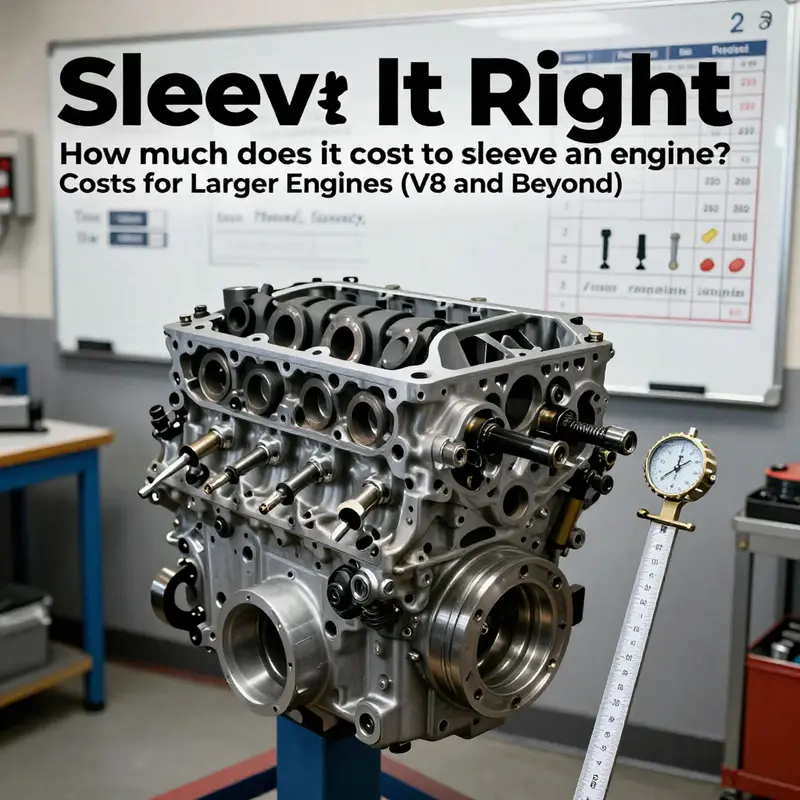
When a cylinder bore wears beyond what a standard hone can repair, or when an engine block has developed misalignment or core damage that threatens compression and sealing, sleeve work becomes a practical route back to reliable power. The price tag attached to that repair, however, is rarely a simple line item. It is a composite, braided from the number of sleeves required, the precision demanded by machining, the scalability of tooling, and the condition of the block before the first cut is ever made. In practice, the cost to sleeve an engine grows with the size of the engine and with the complexity of the work, turning a straightforward, per-sleeve material charge into a labor-intensive project that tests shop efficiency and the customer’s budget alike. Understanding what drives that cost—and what constitutes a fair quote—requires walking through how an engine block becomes the canvas for sleeves, and how a shop translates that canvas into a finished, rebuild-ready piece of machinery.
A useful starting point is the baseline scenario many shops use to frame pricing. For a compact four-cylinder engine, sleeves are often priced at roughly $150 per sleeve, with labor adding the rest. This translates to a typical total in the neighborhood of $900 to $1,300. The per-sleeve figure helps shops standardize their estimates across a broad spectrum of four-cylinders, where the bore diameters are smaller, the block length is short, and the number of sleeves is modest. This baseline, though, is a snapshot, not a universal law. It serves as a rough map that points toward the central truth: sleeve work is about more than the raw cost of a piece of metal. It is about the time, the precision, and the specialized setup that sit behind every cut, every bore, and every finish.
For a reader new to the topic, it helps to pause at this baseline and then step up to a more demanding corner of the industry—the cost reality for larger engines, especially V8s and beyond. The premise is straightforward in theory: more cylinders require more sleeves, and more sleeves require more machine work, fixtures, and meticulous alignment. In the real world, that means the price can quickly climb past the $2,000 mark in many shops, particularly when the engine block presents any additional complications. The arithmetic is not just multiply-by-two; it is multiply-by-complexity. Doubling the number of sleeves from four to eight does not simply double the material bill. It doubles the number of critical processes that must be performed in perfect sequence and perfect tolerance, and it multiplies the risk if any one cylinder slips out of spec. A V8, therefore, often becomes a project with higher material costs, longer labor hours, and a more substantial overhead allocation to cover the specialized tooling and extended fixture time required for precise alignment across all eight sleeves.
What follows is not a mere accounting of line items. It is a narrative about how sleeve work evolves as engine size grows and as drivers of cost—like bore sizes and sleeve finishes—become more influential. When you extend a four-cylinder baseline to a V8, you are not just adding two more sleeves per bank. You are entering a regime where the engine block’s geometry, the oil passages, the deck surface, and the valve train interact in nuanced ways with the sleeves. The block becomes a larger, more intricate canvas, demanding a higher degree of craftsmanship and a broader set of tools. The result is a pricing landscape where labor time expands and the margin for error narrows. The same principles that govern the four-cylinder project—precision, cleanliness, and correct preparation—grow in importance and cost as you scale up.
One of the clearest drivers of cost is sleeve quantity. An eight-cylinder block doubles the sleeve count relative to a typical four-cylinder block, all else being equal. More sleeves mean more raw material, more setup time, and more hands-on time with the block. Each sleeve requires its own bore prep steps: boring the sleeve seats, aligning the bore with the crank axis, and honing the bore to the correct finish and size. When you multiply these steps across eight cylinders, you don’t simply see a doubling of cost; you experience an exponential feel of the process, because each bore must be machined with the same care as the others, and any misalignment in one corridor can ripple across the entire engine’s timing, sealing, and lubrication systems. The impact is most visible in the longevous, patient work of honing and final finish steps, which must be performed to uniform tolerances across all eight cylinders. The engine block sits on fixtures and jigs that are proportionally larger, requiring more space, more secure clamping, and often more costly consumables that are dedicated to high-volume sleeves.
The narrative of cost does not end with quantity, though. Precision and alignment rise to the same plane of importance, and thus cost, in direct proportion to the block’s scale. In a four-cylinder re-sleeve, the technician’s objective is to produce a set of sleeves that line up with tight concentricity and flawless oil passages, while not disturbing the head gasket surface or the water jackets. In a V8, the challenge multiplies. The sleeves must be positioned across a longer deck, with oil and coolant passages that can span more extensive paths and connect in more complex networks. The likelihood of minute misalignments grows, and with it the need for meticulous checks before, during, and after assembly. Achieving the required precision often demands more time on the machine shop floor, the use of more advanced fixtures, and sometimes the adoption of specialty sleeves that require additional finishing steps, coatings, or hone passes to reach the target bore quality. All of these factors push up the labor component, and with longer block work comes heavier shop overhead, because the fixed costs of tooling, calibration, and jig wear are amortized over a greater number of sleeves and longer cycle times.
Another pivotal driver is the block condition and the availability of compatible sleeves for a given model. Some engines use odd bore sizes or require sleeves with non-standard wall thicknesses to achieve exact compression and sealing characteristics. In those cases, material costs rise, and lead times can extend as the shop sources the correct sleeve geometry. The more unusual the bore size or the more specialized the finish required—say, a precise honed finish or a stainless sleeve for a higher-corrosion environment—the more the bill can rise. It is not unusual for high-end sleeve configurations to include extra features such as coatings or finishes designed to improve wear resistance or heat transfer characteristics. Each option carries a price premium, and in larger engines the incremental steps can accumulate quickly.
Material selection itself cannot be ignored. In many shops, the baseline sleeve is a standard steel sleeve with a surface treatment. Some projects, however, call for stainless or other specialty sleeves to meet particular service conditions or to resist corrosion in coolant-heavy or aggressive fuel environments. The decision to use a premium sleeve is rarely about a single cylinder or a single bore; it is a systemic choice meant to ensure long-term reliability in the face of the engine’s operational demands. The price delta from standard to premium sleeves adds to the total, especially when several cylinders or multiple decks require these enhancements. Finishes and coatings, too, can add cost. A honed finish, a dry film coat, or a specialized surface treatment can all improve alignment stability and reduce wear. Each finish has an associated labor time and a materials cost that the shop must recoup in the final quote.
Beyond the sleeves themselves, other services in the re-sleeving workflow contribute to the cost tapestry. Deck resurfacing, tube or oil passage rework, valve seat work, and the reconditioning of ancillary components can all become necessary. If the block’s deck surface has warped or corroded or if the oil passages require re-boring or cleaning to prevent cross-contamination between the sleeve and the lubrication system, these steps add to the labor hours and the risk of downtime. A larger engine often implies longer, more meticulous deck work. The resurfacing depth may be modest in some cases, but in others, it becomes a feature that requires careful planning, additional machine time, and when necessary, precision materials to restore sealing surfaces without compromising the strength of the block. The need for these steps might emerge during initial inspection or become evident only after a teardown, adding a ripple effect to the schedule and the pricing.
Shop strategies for pricing large-engine sleeve work are built around the same core disciplines as smaller projects: clarity, traceability, and a thorough, itemized estimate. For customers, the most valuable quotes are those that present a clear parts-and-labor breakdown, not just a lump-sum figure. A robust estimate should enumerate sleeves, bore preparation, honing, deck work, oil passage rework, valve work if required, coatings if chosen, and any other necessary services. If an estimate lumps several tasks together, it becomes harder to assess what is truly essential and what might be optional or adjustable. In practice, customers benefit from obtaining multiple estimates to compare the scope of work and the inclusions. A shop that offers a transparent breakdown is typically the shop that can justify its pricing in terms of precision, reliability, and long-term durability.
In the larger-engine scenario, the choice of engine model and bore size has outsized influence on the final numbers. Some models present simply larger versions of a familiar bore, while others demand unusual cores that must be sourced with care. The driver here is not only material cost but the lifecycle of the project: how much time the shop must invest to bring every cylinder to spec, how much fixture wear will accumulate, and how often the sleeves must be indexed and re-checked to ensure alignment remains within tolerances. A project of this scale benefits from a collaborative approach between the customer and the shop, with clear milestones, anticipated downtime, and a realistic timeline. It is not unusual for large-engine sleeving to require a staged plan, where baseline measurements are taken early, sleeves are installed and honed in a controlled sequence, and final checks are performed after assembly to confirm that oil flow and compression are consistent across all cylinders.
For readers who want to see a concise primer that anchors these ideas in the broader context of engine sleeves, there is a resource that outlines the fundamental concepts of sleeves and their role in engine design. It can be helpful to begin with a clear understanding of what sleeves are and why they matter before approaching a shop. What are engine sleeves? This link is a useful starting point for grasping the basics—the material choices, the fit within the bore, and the general principles that underpin any re-sleeving project. Yet the specifics of cost still demand a dialogue with a qualified technician who can inspect the actual block, assess its condition, and translate those findings into a precise, itemized estimate. The discussion should extend beyond the sleeves themselves to the ancillary tasks that either support or accompany the sleeving process. A fair quote will be explicit about what is included and what is not, and will clearly state the assumptions about block condition, required resurfacing depth, and any discretionary options such as premium sleeves or coatings.
The moral of this cost landscape is deceptively simple: sleeves are not just pieces of metal. They are part of a tightly orchestrated mechanical system that requires exacting alignment, measured material choices, and a clean, controlled environment for installation and finishing. The larger the engine, the greater the consequences of even minor deviations. A slight misalignment in one cylinder can cascade into head gasket leakage, coolant migration, oil contamination, or uneven piston ring wear. Each of these outcomes has the potential to undermine the project’s value, leading to additional diagnostic time, potential resealing, or even a second sleeving pass. When a shop sets expectations with a customer, those risks should be translated into the pricing narrative: the higher up-front investment reflects not just the sleeves but the sturdy scaffolding of precision, time, and expertise that keeps the engine reliable over thousands of miles of service.
From there, a practical path emerges for buyers and builders alike. Begin with a careful assessment of the engine’s history and current condition. Are the sleeves a preventative measure, a repair after a failure, or a mid-life refresh tied to a broader engine rebuild? Has the block shown signs of warping, corrosion, or prior repairs that complicate the sleeving process? Collect as much information as possible about bore sizes, deck surface condition, and the presence of any steel sleeves or protective coatings that may already exist in the block. With this information in hand, request quotes that itemize each major work item: sleeves, bore prep, honing, deck resurfacing if required, oil passage rework, valve work, coatings, and the labor hours attributed to each step. Seek at least two or three quotes to compare scope and price, and ask for the shop’s rationale for each line item. A reputable shop will walk a customer through the sequence of operations and explain how each step contributes to the engine’s reliability and longevity.
In terms of timing, the sleeving process for a large engine can become a multi-day or even multi-week engagement depending on the shop’s backlog, the block’s condition, and whether any unexpected issues surface. Scheduling should account for the availability of critical fixtures, the time needed for precise alignments, and the potential need for iterative checks. For a customer, this means planning ahead for downtime and ensuring that the vehicle’s other maintenance needs—such as timing components or cooling system refreshment—are aligned with the sleeving project to minimize rework later. The best outcomes arise when the customer and the shop agree on a well-structured plan, with milestones that reflect the realities of a high-precision rebuild rather than a single, lump-sum expectation.
In closing, the cost of sleeving a large-engine block is a measure of more than the sleeve itself. It embodies the scale of the project, the depth of precision required, and the commitment to restoring the engine to reliable operation. For most shops, the move from a four-cylinder baseline to an eight-cylinder project is less about doubling material and more about recognizing the cascade of operational demands that comes with higher cylinder counts and longer, more complex blocks. If you walk away with a quote that clearly separates material costs from labor, and if the shop provides transparent notes about bore prep, honing, deck work, and any optional finishes, you’ll have a solid basis for comparison. And if you’re unsure about any line item, don’t hesitate to ask—good sleeves deserve careful scrutiny, because their success is measured not merely in how they are installed, but in how well they perform under real-world conditions, miles down the road.
External reference for further context on sleeve-valve projects and cost considerations: https://www.mechanicsfiles.com/2026/01/how-to-choose-a-sleeve-valve-engine-and-re-sleeving-cost/
Pricing the Sleeved Cylinder: Navigating Market Variability, Sourcing, and the Real Cost of Engine Re-Sleeving

When you plan to sleeve an engine, you are not simply purchasing a single component. You are entering a layered, specialized process where the numbers you see on the quote sheet reflect more than the sleeve itself. A successful re-sleeve depends on precision machining, correct material choice, exact bore and clearance targets, proper alignment, and a logistics chain that begins with the engine block and ends with the test run after reassembly. The cost to sleeve an engine, therefore, reads like a map of constraints: the size of the engine, the condition of the block, the availability of sleeves, the skill of the shop, and the region where the work is performed. In the most common four-cylinder applications, the market has settled into a rough band, but even that band hides a wide spread of realities. The numbers you’ll see in quotes—roughly nine hundred to thirteen hundred dollars in many cases—are products of many small, interacting factors, not a single fixed price. For larger, more complex platforms such as V8s or engines built for performance or heavy duty, the sticker shock tends to be higher, often surpassing two thousand dollars and, in some circumstances, creeping past the three-thousand-dollar mark. These figures are snapshots of current market conditions in the United States as economies, supply chains, and labor costs shift. They are not universal guarantees; they are guidelines shaped by the engine configuration, the shop, and the particular project you bring to the bench.
To understand why those numbers vary, it helps to walk through the lifecycle of a sleeving job, from the moment a block is sent to a machine shop to the moment the engine is started on the first test run after break-in. The first major decision is the type and quality of sleeves you’ll use. Sleeves are not a single commodity; they come in materials, finishes, and tolerances that affect durability, heat transfer, and wear characteristics. Cast iron sleeves, which have a long track record, offer predictable wear and familiar machining steps. Hypereutectic alloys and other modern formulations can offer improved wear resistance and reduced thermal expansion in some conditions, but they also require careful matching to the block’s aluminum or cast iron structure and to the lubrication regime of the engine. The choice of sleeve material is often the hinge around which the rest of the project orbits. It impacts the cost of the sleeves themselves, the tools required to install them, and the precision required when honing to final bore diameter.
Once the sleeve material is chosen, the shop must ensure the block is prepared for sleeving. Preparation includes addressing any prior damage in the cylinder walls, ensuring that the deck surfaces are true, and confirming that the bottom end of the bore is clean and square. Any deviation from perfect geometry will demand corrective work—truing, align boring, or even deck resurfacing—which adds time and expense. The bore size must be re-established with tight tolerances; this in turn dictates how many sleeves must be installed, how many reworks may be necessary, and how long the machine tools must stay on the job. It is here that labor rates begin to pull the levers. A shop in a high-cost urban market with experienced technicians will inevitably charge more per hour than a shop in a rural setting, even if the same hairstyle of machine work is performed. The rates reflect not only the wage bill but the overhead that keeps the shop ready to handle precision tasks, the calibration of the measuring equipment, and the availability of the specialized tooling that modern sleeving requires.
To paint a practical picture, consider a four-cylinder block. If a shop quotes a price around nine hundred dollars, that figure generally includes the sleeves at roughly one hundred fifty dollars per bore plus labor for installation and a finish honing to restore proper crosshead and piston ring seals. The math is simple in concept: four sleeves at around one hundred fifty each equals six hundred dollars in sleeve material, leaving the remainder to cover the skilled labor of boring, fitting, pressing the sleeves in, and finishing the bore to the exact diameter required for the rings and pistons to operate with the desired clearance. When you push the project toward the middle of the price range, say around a thousand to thirteen hundred dollars, you are often looking at additional charges such as derusting, deck resurfacing, or a more aggressive finish honing to meet a stricter target tolerance. In some cases, the project also includes reconditioning other components that interact with the cylinders, such as valve seats or head gaskets, if the engine’s overall condition warrants it. All of these add-ons, although sometimes small in isolation, accumulate quickly when spread across four or more cylinders or across a larger engine family.
For larger engines, the arithmetic changes but the logic does not. A V8 or other multi-bank configuration multiplies the number of sleeves you need to a corresponding expansion in both sleeve material and labor. Even if the per-sleeve price remains consistent, eight sleeves require twice the material and typically twice the labor, plus any extra time the shop needs to rework other features of the block to maintain alignment with the new sleeves. In practical terms, a V8 project can easily exceed two thousand dollars, and in some cases surpass three thousand, when the shop is working to meet tight tolerances, or when the engine is old, rare, or requires special fixtures. The cost spread widens because the complexity of the labor grows not just with the number of cylinders but with the reliability needs of the finished machine. A shop that is comfortable with mass-produced, modern engines may not have the same degree of efficiency in handling an older or performance-oriented V8 where the sleeves and the block must match unusual block tolerances and where the risk of misalignment has more severe consequences.
The market variability section would be incomplete without acknowledging the role of sourcing and tooling. A confident sleeve job relies on access to factory-qualified sleeves and precision services. This access comes at a price, but it also delivers with it a degree of predictability: sleeves that are matched to the block, with a known compatibility profile, and a track record of durability under the engine’s anticipated operating conditions. On the other side of the spectrum lie aftermarket sleeves, which can be cheaper but vary widely in quality and compatibility. Some of these sleeves are well-suited for conventional daily driving, while others might be better suited for restored or modified blocks where a direct factory match is not possible. Then there is the option of used sleeves, which can attract a steep discount but carry significant risk: wear patterns that do not align with the block, micro-cracks, or unknown histories that undermine reliability. The decision among factory-qualified, aftermarket, or used sleeves is not merely a price choice; it is a choice about reliability, longevity, and return on investment. If the project involves a vintage engine with a specific historical specification, the shop may lean toward factory-qualified sleeves to preserve authenticity and ensure that the engine continues to meet its intended performance envelope. In high-stakes builds, quality and fit are worth paying for, while in budget-conscious restorations, the risk calculus may tilt toward more economical options with strict re-checking and rework in the plan.
Another layer of cost comes from the real-world logistics of getting the engine block to the shop and back into service. Turnaround time is not a fixed variable; it ebbs and flows with the shop’s workload, the availability of specialized tools, and the difficulty of any ancillary work the project might require. For engines with unusual bore dimensions, for example, the shop may need to source a limited supply of sleeves or even custom-fabricate a solution, which can stretch the calendar and the budget. The customer, understandably, can be tempted to save money by choosing the fastest path or by assuming that the most economical sleeve will suffice for the intended use. Yet the sleeve and bore system is a precision interface. When tolerances start to drift, performance and longevity suffer, which can translate into higher costs later through oil consumption, reduced compression, or accelerated ring wear. It is, in truth, not a single price point but a spectrum of outcomes governed by how well the project is scoped and managed from the outset.
To navigate this spectrum, most experienced technicians begin with a careful intake that captures engine configuration, block condition, desired performance goals, and the operating environment the vehicle will encounter after restoration. The intake might be complemented by a rough assessment of the cylinder wall condition, the heads, and any crank components that interact with the sleeved region. It is a practical error to assume that a single “one-size-fits-all” sleeve will meet every need. The sleeves, like any precision part, must be matched to the block’s bore, the piston diameter, and the desired clearance. Even small variations in the bore will translate into different honing requirements, different lubrication demands, and, ultimately, different costs. In this sense, the price is not merely the number you see on the quote; it is a reflection of the degree to which the project is customized for your specific engine and its planned service life.
A telling reminder comes from the question many enthusiasts ask: how do I plan around the unpredictability of sleeves and their costs? The practical approach emphasizes getting multiple quotes from local rebuilders or machine shops to establish a realistic regional benchmark. It also invites a broader look at how the project fits within the overall rebuild plan. If sleeves are being installed as part of a broader restoration or upgrade, the cost distribution changes. Some shops will bundle sleeve work with other precision tasks—deck resurfacing, valve work, and head refurbishment—because those operations benefit from the same tooling alignment and the same measurement discipline. The bundling can offer a composite cost advantage, or it can simply reflect the reality that the machine shop’s resources are allocated to the entire project rather than a single subprocess. Either way, the budgeting exercise becomes less about a single price and more about a coherent program with defined milestones, test procedures, and acceptance criteria.
The sourcing question also extends to how sleeves are procured. Factory-qualified sleeves tend to be the safest path when reliability and predictability are the priorities. They are more likely to fit cleanly and to provide the final alignment and wear performance that engines rely on. However, the cost savings of aftermarket sleeves can be meaningful, particularly for engines that are common and well understood by the shop. In many cases, a skilled rebuilder will propose a middle ground: a sleeve that is not strictly factory, but that has proven compatibility with the block, paired with meticulous inspection and rework to align it with the engine’s tolerances. This balanced approach often yields a cost that sits comfortably between the high-end, factory-orientated route and the low-end, high-risk option. The exact choice depends on the engine’s intended use, the customer’s budget, and the shop’s assessment of long-term reliability in the target operating regime.
From a planning perspective, the takeaways are pragmatic. First, expect broad price bands rather than a single fixed price. Second, understand that the per-sleeve cost is only part of the story; the labor, the tooling, and the required precision work are just as critical to the final price. Third, recognize that engine size and complexity materially reshape the cost landscape. A four-cylinder program will look very different from a multi-cylinder, high-compression, or performance-oriented build. Fourth, remember that sourcing choices influence both price and risk. Factory sleeves minimize risk but cost more upfront; aftermarket sleeves offer savings but demand careful vetting and precise measurement. Finally, anticipate that lead times can stretch if the job requires rare sleeves, specialized fixtures, or careful, vintage-rebuilding expertise. When you plan for these contingencies, you build a budget that can accommodate the realities of engine re-sleeving rather than a price that only reflects ideal conditions.
If you’d like a primer on what sleeves are and how they function, you can read a concise explainer here: What are engine sleeves?. This resource helps frame the foundational questions that lead to the numbers in the quotes: what material the sleeve is made from, how thick it is, how it interfaces with the existing block, and how the final bore and pressure-lubrication regime are managed to deliver long-term reliability. The explanations in that explainer set the stage for a more informed budgeting conversation with the shop, so you can push back on estimates that seem excessive or validate a quote that aligns with your engine’s needs and your performance goals.
Throughout this discussion, the implicit message is that sleeve pricing is a function of both objective engineering requirements and subjective market realities. The engine’s configuration, the block’s condition, the sleeve material selected, and the shop’s labor rates all contribute to the final figure. Add to that the regional variations, the availability of tooling, and the time a job must wait in a queue, and you begin to see why a single number rarely captures the truth of the situation. The practical consequence for a rebuild project is clear: enter the process with a plan that respects the range of possible outcomes, benchmark your quotes against a solid understanding of what is being offered, and maintain flexibility to adjust scope in the interest of reliability and value. This is how a sleeving project evolves from a speculative line item into a measured investment in the engine’s future performance.
In sum, the cost to sleeve an engine is a composite of sleeves, labor, and the craft of precision machining. It is influenced by the engine’s architecture, the chosen sleeve material, and the shop’s capabilities. Market variability reflects the broader economics of the area, the availability of specialized tooling, and the risk tolerance of the customer. Sourcing choices—factory-qualified sleeves, aftermarket options, or used sleeves—shape both the upfront price and the long-term reliability. The best path forward is a well-scoped plan that blends realistic budgeting with a disciplined evaluation of options and a clear mechanical target for the final build. For those who must operate within a finite budget, the reality remains straightforward: prioritize quality and fit, seek transparent quotes that itemize sleeve material and labor, and prepare for the possibility that the final price will reflect a carefully engineered balance between durability and cost. This approach preserves both performance and peace of mind, which is precisely what sleeving a cylinder aims to achieve.
External resource for further reading: How to Choose a Sleeve Valve Engine and Re-Sleeving Cost (MechanicsFiles) – https://www.mechanicsfiles.com/sleeve-engine-rebuild-costs
Final thoughts
Engine sleeving is a cost center that rewards precise quoting and informed decision-making. For a typical 4-cylinder engine, plan on approximately $900 to $1,300 per the sleeve plus labor, while larger engines such as V8s frequently push costs beyond $2,000 due to more sleeves and tighter tolerances. Market variability, sourcing options, and supplier pricing all play a major role in final numbers. Distributors and auto repair shops should standardize itemized quotes that separate sleeves, machining, honing, and assembly, then monitor supplier price signals to maintain margins. Vehicle owners and motorcycle riders benefit from knowing the breakdown so they can compare bids, validate scope, and choose the right combination of sleeve material and labor strategy for longevity.